
Knowledge Center
How To Select A Peltier Module
Most disappointing thermoelectric results come from choosing the module before the heat sink. This is the order that works.
Do It In This Order
The sequence matters more than any single calculation. Working in the wrong order produces a module that looks right on paper and disappoints on the bench.
Step 1: Fix The Hot Side First
Every catalogue figure we publish is measured at a hot side temperature of 30 °C. If your heat sink lets the hot side sit at 55 °C, the module will not deliver its catalogue performance, no matter which code you choose.
Work out what the sink can hold with the total heat it has to reject, which is the cold side load plus the module's own electrical input. On a module drawing 60 W electrically to move 30 W of load, the sink has to handle 90 W.
If that number is impossible, stop here. Improving the sink is almost always cheaper and more effective than moving up the catalogue.
Step 2: Calculate The Real Heat Load
Add up every path into the cold volume, not just the obvious one:
- The active load, for example the electronics or the sample you are cooling
- Conduction through the mechanical mounting, which is often larger than expected
- Conduction along the lead wires and any sensor cabling
- Convection from air inside the enclosure, and infiltration if the enclosure is not sealed
- Radiation into the cold surface from warmer surroundings
- Any heat generated by condensation on the cold side
On small assemblies the parasitic paths frequently exceed the active load. Reducing them is cheaper than buying a bigger module.
Step 3: Work Out The Required Delta-T
ΔT is the hot side temperature you can actually hold minus the cold side temperature you need. Use the temperature the sink will really sit at, not the ambient.
Compare that with the ΔTmax column. Never design at ΔTmax, because at that point the module pumps zero heat. A practical design sits well below it.
Step 4 And 5: Footprint, Qmax And Delta-Tmax
Filter the catalogue by the footprint that fits your cold plate, then look for Qmax around twice your working heat load. That gives an operating point with usable efficiency and margin for a warm day.
If nothing fits, the choices are: improve the hot side, reduce the load, use an aluminium substrate module for more efficiency in the same footprint, or move to a cascade if the differential rather than the load is the limit.
Step 6: Match The Supply
Vmax and Imax define the module's electrical window. Pick a code whose Vmax sits comfortably under your supply voltage and whose Imax your supply can deliver continuously.
Running at around 0.6 to 0.7 of Imax is usually the best compromise between cooling and efficiency. Running at Imax maximises ΔT but wastes a great deal of power as Joule heating in the module itself.
If nothing matches your supply, that is a normal reason for a custom module: we change the couple count so Vmax lands where you need it.
The Five Most Common Selection Mistakes
- Choosing the module before designing the heat sink
- Using ΔTmax as a design point instead of a limit
- Ignoring parasitic loads, especially lead conduction and radiation on small assemblies
- Sizing the supply at exactly Imax with no headroom for a hot day
- Forgetting condensation, then losing the module or the electronics to water
Related Products
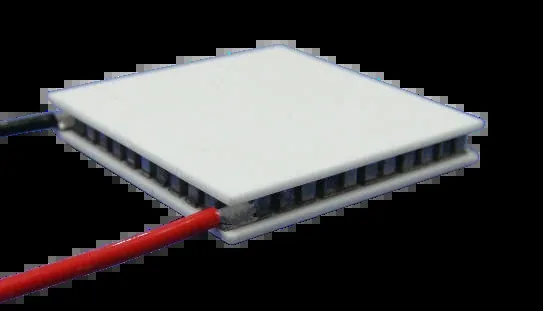
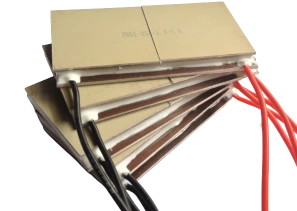
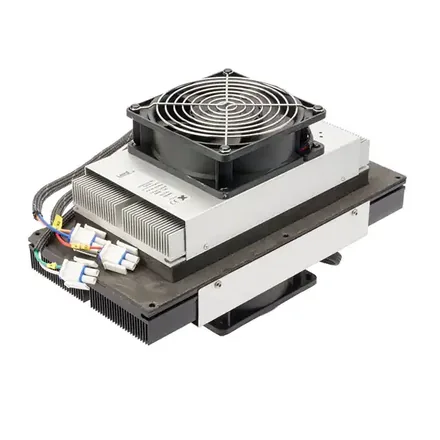
Parts Mentioned In This Guide
Keep Reading
Other Guides And Applications

FAQ
Frequently Asked Questions
How much margin should I leave on Qmax?
A common working rule is to choose a module whose Qmax is around twice the heat load at your working ΔT. That leaves room for a hot day and for a load you underestimated.
Should I run at Imax?
Rarely. At Imax the module reaches its largest ΔT but dissipates a great deal of power as heat itself. Around 0.6 to 0.7 of Imax is usually the better operating point.
What if no catalogue code fits my supply?
That is one of the most common reasons for a custom module. Changing the number of couples moves Vmax and Imax without changing the footprint.
Can I parallel two modules instead of using a bigger one?
You can, and it is sometimes the right mechanical answer. Make sure both modules see the same clamping and the same hot side temperature, otherwise the hotter one will do less work and run harder.
Do I need a controller, or is a fixed supply enough?
If you only need to reach a temperature, a fixed supply can work. If you need to hold one, you need a thermistor and proportional control.
Send Us Your Numbers And We Will Do The Shortlist
Heat load, hot side, target cold side, footprint and supply. We will come back with part numbers.
No forms. Messages reach our engineering desk directly. Reply within 24 hours, Monday to Friday, 9:00 to 17:00 Beijing time.