
Knowledge Center
Thermoelectric Generator Design Guide
Most thermoelectric generator projects fail on the cold side or on the electrical match, not on the module. This guide covers both.
Start With The Real Hot Side Temperature
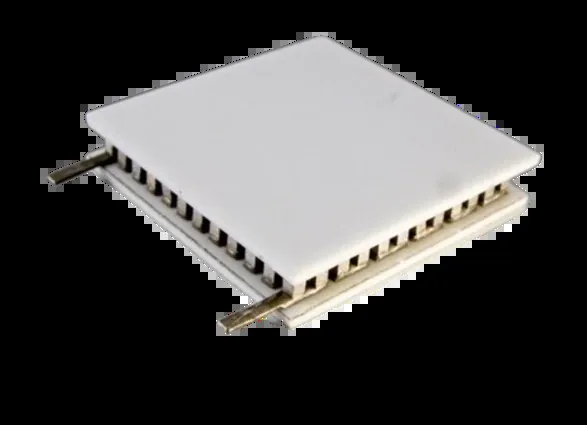
Catalogue output is quoted at a stated hot and cold side temperature. The 210 °C class is specified with the hot side at 160 °C and the cold side at 50 °C. The 320 °C class is specified with the hot side at 300 °C and the cold side at 50 °C.
The number that matters is the temperature of the module surface under load, not the gas temperature or the peak temperature. Every interface between the heat source and the module costs you temperature, and output falls with the square of the temperature difference lost.
The Cold Side Is Where Projects Fail
Look at the heat flow through module column in the catalogue. TEG126-60B produces 18 W of matched output while 357.4 W of heat flows through it. All of that has to leave through the cold side.
Designers routinely size the cold side for the electrical output rather than for the heat flow, which is a factor of twenty error. If the cold side cannot take the heat flow, the cold side temperature rises, the differential collapses and the output disappears.
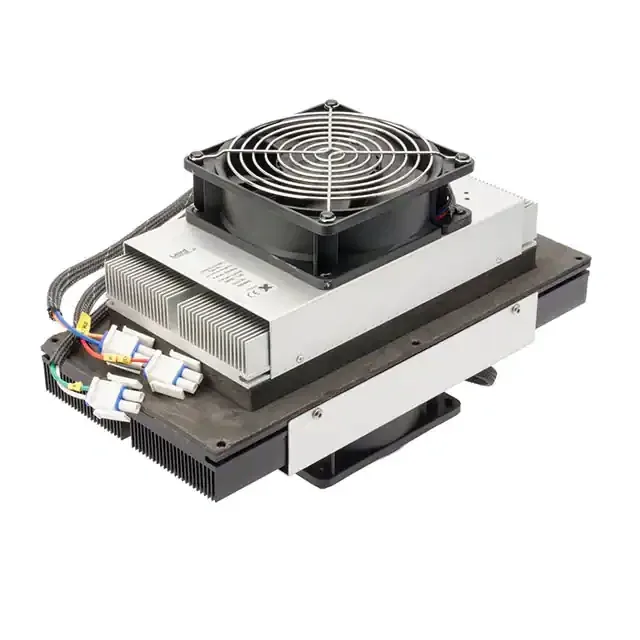
Air cooling is possible at low module counts. Above that, a liquid cold plate is usually the only practical answer.
Electrical Matching
Every catalogue code lists open circuit voltage, matched output resistance in ohms, matched output voltage and matched output power. Maximum power transfer happens when the external load resistance equals the module's internal resistance.
In practice that means the converter's input impedance, not a fixed resistor, has to sit near the matched value across the operating range. A converter with maximum power point tracking does this automatically; a fixed voltage converter does not.
A mismatched load can easily throw away half the available power, which is a larger loss than any realistic improvement in the thermal design.
Clamping And Expansion
A generator module sits between a hot surface and a cold surface, so the two faces expand differently. Clamping has to keep even pressure on the module without over constraining that differential movement.
Springs or belleville washers are the normal answer, sized to hold the module in contact without exceeding the 1 MPa maximum compressive load. Rigid bolting to a hot plate is the most common mechanical failure mode in generator arrays.
Use a thermal interface material rated for the hot side temperature. Standard silicone grease will not survive a 300 °C hot side.
Wiring An Array
Modules are wired in series for voltage and in parallel for current. A pure series string is simple but one open circuit module takes down the whole array, so most designs use series groups connected in parallel.
Keep every module in a group at a similar temperature. A module running cooler than its neighbours becomes a resistance in the string rather than a contributor.
Setting Realistic Expectations
Compare the matched output power and the heat flow through module columns for any code and you have the honest module level conversion figure for the stated conditions. Use it, and design the system around it, rather than around a headline number.
Thermoelectric generation wins where reliability, silence and the absence of moving parts matter more than conversion efficiency, and where the heat is being thrown away anyway.
Related Products
Parts Mentioned In This Guide

FAQ
Frequently Asked Questions
How do I estimate system output?
Take the matched output power for the chosen code at your real hot and cold side temperatures, multiply by the number of modules, then subtract converter losses and the effect of any temperature spread across the array. Then check the cold side can reject the total heat flow.
Why is the cold side so important?
Because the heat flowing through the module is typically ten to twenty times the electrical output. The cold side has to reject all of it, and any rise in cold side temperature directly reduces the differential that is producing your power.
Can I use a standard DC to DC converter?
Only if its input impedance sits near the matched load resistance over the operating range. A converter with maximum power point tracking is far more effective on a thermoelectric source.
What thermal interface survives the hot side?
Standard silicone greases do not survive a 300 °C hot side. Use a high temperature interface, and tell us the hot side temperature so we can confirm the module class as well.
Do you supply complete generator systems?
We supply the generator modules and can advise on the interface. Describe the heat source and we will tell you what we can support directly.
Describe Your Heat Source
Hot side temperature, available area, cold side option and target power. We will suggest a class, a code and an array.
No forms. Messages reach our engineering desk directly. Reply within 24 hours, Monday to Friday, 9:00 to 17:00 Beijing time.