
Knowledge Center
Peltier Module Installation Guide
A correctly chosen module installed badly will underperform a badly chosen module installed well. This is the assembly practice that protects your design.
Surfaces And Flatness
Our modules are supplied flat to ±0.05 mm, with a height tolerance of ±0.2 mm. Your mating surfaces should be at least as good. A gap between the module and the plate is a thermal resistance in the worst possible place.
Clean both surfaces before assembly. Machining oil, fingerprints and swarf all add resistance and none of them are visible once the assembly is closed.
Thermal Interface Material
Apply a thin, even layer to both faces of the module. Thermal grease is a conductor compared with air but an insulator compared with metal, so more is not better. A thick line of grease is a thermal resistance you paid for.
Graphite sheet is the better choice for volume production because thickness is set by the sheet rather than by the operator, it does not pump out under thermal cycling, and it keeps the line clean.
Clamping Force
The maximum compressive load is 1 MPa. That limit applies over the module area, so on a small module it is very easy to exceed with a normal screwdriver.
Distribute the force across the whole module, not through two corner screws. A clamping plate that bows will load the module edges and leave the centre unsupported.
If your assembly cannot guarantee even clamping, an aluminium substrate module is much more forgiving than a ceramic one, because it is metallic and breakage free.
Leads And Polarity
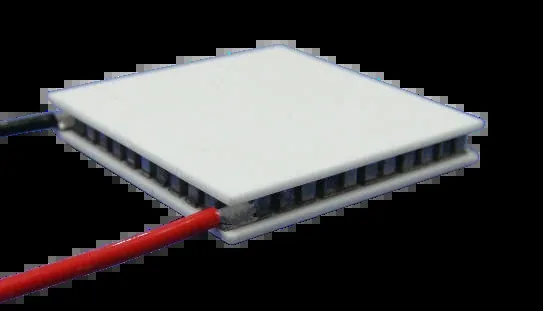
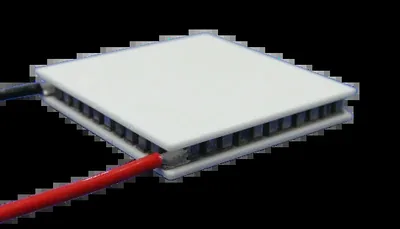
Lead wire is 150 mm as standard, red positive and black negative. Other lengths, gauges and terminations are available on request.
Confirm polarity before powering. Reversed polarity does not damage the module, but it makes the intended cold face hot, which will surprise a test rig and can damage whatever you are trying to cool.
Strain relieve the leads. Repeated flexing at the solder joint is a common assembly induced failure.
Sealing And Condensation
Silicone gel sealing is applied by default. Specify if you do not want the module sealed.
Sealing protects the module, but the surrounding assembly still needs a plan. Any surface below the local dew point will condense water. The three practical options are to hold the set point above dew point, to seal the cold volume, or to purge it with dry gas.
Condensation is the most common cause of a thermoelectric assembly failing weeks after it was commissioned successfully.
Commissioning Sequence
Power up at low current first and confirm the cold side falls while the hot side rises. Then check the hot side temperature under full load. If it keeps climbing, the sink is undersized and no adjustment to the module will fix it.
Fit the thermistor on the surface you actually want to control, close the loop, and tune for a stable set point rather than the fastest possible pull down. Hard cycling shortens module life.
Related Products
Parts Mentioned In This Guide
Keep Reading
Other Guides And Applications
FAQ
Frequently Asked Questions
How much clamping force should I use?
Enough for even contact, and never more than the 1 MPa maximum compressive load over the module area. Even distribution matters more than magnitude.
Grease or graphite sheet?
Grease for prototypes and service work, graphite sheet for production where repeatability between units matters more than the last fraction of a degree.
What if my surfaces are not flat?
Machine or lap them if you can. If you cannot, an aluminium substrate module tolerates imperfect surfaces far better than a brittle ceramic one.
Do I need to seal the module?
Silicone gel sealing is standard unless you ask for it to be omitted. Sealing the module is not the same as managing condensation in the assembly, which is a separate design task.
Can I solder to the module leads?
Yes, but keep heat away from the module body and strain relieve the joint. Excess heat at the lead can damage the internal solder joints the module depends on.
Getting A Result Below Expectation
Describe the assembly, the measured hot side temperature and the current draw and we will help you find where the performance went.
No forms. Messages reach our engineering desk directly. Reply within 24 hours, Monday to Friday, 9:00 to 17:00 Beijing time.