
Knowledge Center
Aluminium Versus Ceramic Substrate
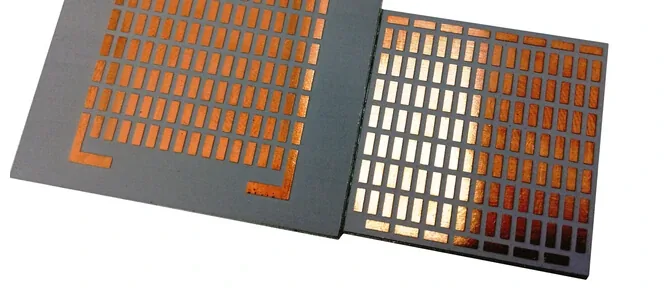
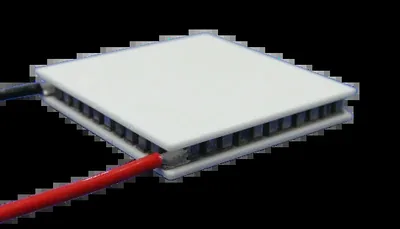
The plates on a thermoelectric module are not just packaging. They sit directly in the heat path, and their conductivity decides how much of the module's capacity reaches your load.
The Numbers
Aluminium conducts 122 W/(m·K). Alumina ceramic conducts 12 W/(m·K). That is an order of magnitude difference in a layer that sits directly between your load and the thermoelectric pellets.
In our modules that translates into a cooling and heating efficiency improvement of 30 % to 50 % for the same footprint and the same pellet array.
| Aluminium substrate | 122 W/(m·K), metallic, breakage free |
| Alumina ceramic substrate | 12 W/(m·K), electrically insulating, brittle |
| Efficiency difference | 30 % to 50 % in favour of aluminium |
| Tooling for a new size | 1 to 2 weeks aluminium, about 4 weeks ceramic |
| Catalogue footprints | Aluminium 40×40 to 80×120 mm, ceramic 10×10 to 80×120 mm |
The Mechanical Argument Is Bigger Than The Thermal One
Ceramic plates are brittle. They crack under uneven clamping, under shock, under vibration and under repeated thermal cycling. In field returns, cracked ceramic is a far more common failure than degraded thermoelectric material.
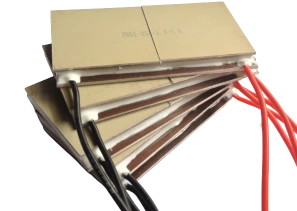
An aluminium plate is metallic and breakage free. It tolerates the imperfect flatness of a real machined surface, the clamping force of an assembly worker, and the vibration profile of a vehicle.
EVERREDtronics is the first company in China to develop aluminium substrated thermoelectric modules and is among the few enterprises in the world able to supply them at scale and at high quality.
When To Choose Which
| Choose aluminium | Vibration, shock, severe conditions, tight thermal budget, a metal chassis mounting, or a fast custom tooling requirement |
| Choose ceramic | Small footprints below 40 mm, the widest possible size choice, or where the substrate must be electrically insulating |
The one real caution with aluminium is electrical. The plate is metal, so isolation and creepage in your assembly have to be planned rather than assumed. On a ceramic module the plate itself provides that isolation.
Swapping An Existing Design
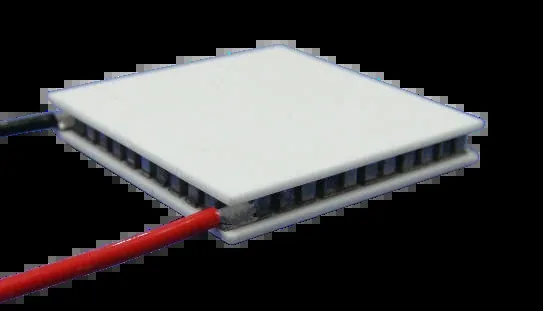
Several aluminium codes mirror ceramic codes in footprint and electrical rating. TEA1-12705 has the same 5.0 A, 15.00 V and 42.50 W rating as TEC1-12705 in a 40×40 mm footprint.
Two things change. The assembled height differs, so check your mechanical stack. And the module is electrically conductive on both faces, so revisit isolation.
Because more of the pumping capacity reaches the load, you may also find you reach the target ΔT at a lower current, which reduces both the power draw and the load on the heat sink.
Tooling Lead Time Is A Project Argument
Aluminium substrate tooling takes one to two weeks. Ceramic takes about four. On a development programme that difference frequently decides whether a custom footprint fits inside a prototype cycle at all.
We welcome customers to send specifications for development when the existing modules do not match the requirement, and we can design modules of customised shape and size so the module matches the thermal interface perfectly.
Related Products
Parts Mentioned In This Guide
FAQ
Frequently Asked Questions
Is the efficiency claim measured or calculated?
The 30 % to 50 % improvement is the figure our engineering team publishes for aluminium against ceramic substrate modules, and it follows directly from the 122 against 12 W/(m·K) substrate conductivity.
Does an aluminium plate short my circuit?
It is a conductor, so plan isolation between the module plate and any live or grounded surface. Tell us how the module will be mounted and we will confirm the surface finish that suits.
Can I get an aluminium module below 40 mm?
The catalogue starts at 40×40 mm. Smaller aluminium builds are a development discussion, and tooling is fast, so send the drawing.
Which is better for vibration?
Aluminium, clearly. It is metallic and breakage free, which is why it is our recommendation for automotive and high vibration industrial applications.
Ask For The Aluminium Equivalent Of Your Module
Send the ceramic part number you use today and we will tell you what the aluminium version changes.
No forms. Messages reach our engineering desk directly. Reply within 24 hours, Monday to Friday, 9:00 to 17:00 Beijing time.