
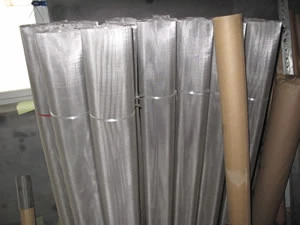
Stainless Steel Wire Mesh
Forty-eight woven specifications with open area and weight published for every one of them.
A knitted structure that compresses, conducts and separates - specified by wire material rather than by aperture.
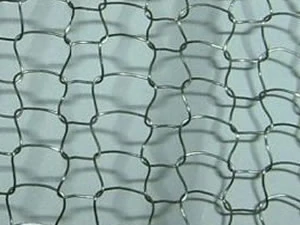
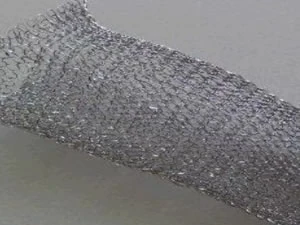
Knitted wire mesh is looped rather than woven, which lets it compress and spring back. It is made from copper, monel, Teflon, plastic and stainless steel wire.
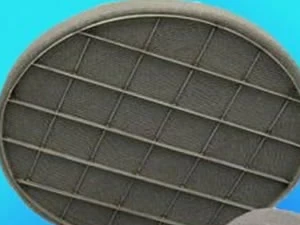
It is used for mist elimination in process vessels, for EMI shielding gaskets and as a wear-resistant outer layer over softer gasket materials.
The wire material, not the mesh count, is what decides performance in this product - so that is how Anwang specifies it.
A shielding gasket that corrodes loses contact and stops shielding. Material choice is the whole answer.
Tinned copper clad steel gives the best shielding of the knitted wires but wears through in abrasive service - so the wrong choice fails quickly and quietly.
Soft gasket materials abrade at the contact face; a knitted stainless outer layer stops that.
Extreme environments defeat standard wires; monel is the answer where corrosion resistance has to hold across all of them.
Every photograph below is from our own product record.
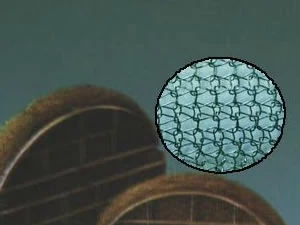
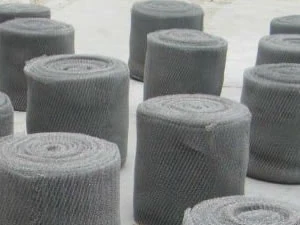
Figures published here are the ones printed in our own product record. Anything we have never published is marked TBC and confirmed in writing before you order.
Monel for extreme corrosion environments where conductivity and toughness are both needed. Tinned copper clad steel for shielding, where its low contact resistance and small permeability beat the alternatives - but not in abrasive service, because worn tin exposes the copper. Stainless steel as a wear-resistant contact surface over a softer knitted core. Copper, Teflon and plastic wire are also knitted for specific gasket and filter duties.
Because this product is specified by material and density rather than aperture, the order should state the wire material, the finished dimensions and the required density. Confirm all three in writing before production - they are not interchangeable between applications.
Material chosen for conductivity, corrosion resistance or wear.
Wire is knitted into a continuous looped tube or flat strip.
Strip is crimped where a defined density is needed.
Layers are rolled or folded into pads, rings or gasket profiles.
Density and dimensions checked against the order.
| Product | Where It Fits |
|---|---|
| Knitted wire mesh | Looped; compressible; for mist elimination, gaskets and shielding |
| Stainless steel wire mesh | Woven; fixed aperture; for filtration and screening |
| Welded wire mesh | Welded; rigid; for guarding and enclosures |
Forty-eight woven specifications with open area and weight published for every one of them.
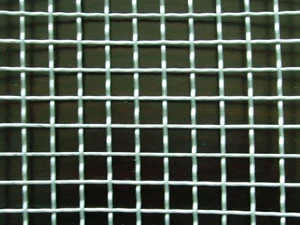
Fifteen mesh counts with wire diameter and aperture stated for each, in widths up to 1.5 m.
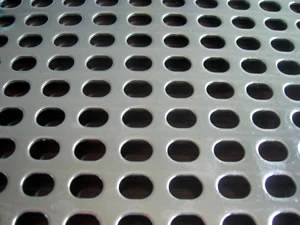
Hole size, pitch, open area and the thicknesses each pattern can be punched in - all published.
Answers taken from our own product record. Where a figure has never been published, we say so instead of guessing.
Copper, monel, Teflon, plastic and stainless steel wire.
Knitted wire mesh made of tinned copper clad steel has the best shielding performance of all wires used in knitted meshes, combining low contact resistance with a small degree of permeability.
In highly abrasive applications. The tin plating may wear away and expose the copper underneath.
Monel knitted wire mesh has good corrosion resistance in all extreme environments, is reasonably conductive, and is tough with high tensile strength, which gives good wear characteristics.
Often as a protective final layer over other knitted mesh gasket materials, to provide a wear-resistant contact surface.
Yes. Send the vessel dimensions, the duty and the preferred wire material by WhatsApp or email.
Give us the specification, the quantity and the destination port. We reply with price, packing and the full specification written out.