
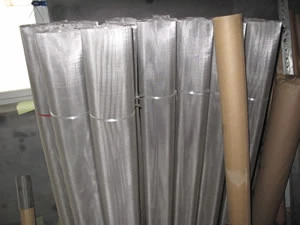
Stainless Steel Wire Mesh
Forty-eight woven specifications with open area and weight published for every one of them.
Four alloys, three questions: what chemistry, what temperature, and will it be welded afterwards.
Type 304 is often referred to as 18-8, meaning 18% chromium and 8% nickel. It is the basic stainless alloy most commonly used for wire cloth weaving. It withstands outdoor exposure without rusting and resists oxidation at an elevated temperature up to 1400 degrees Fahrenheit.
Type 316 is an 18-8 alloy stabilised by the addition of 2% molybdenum. It has better resistance to pitting corrosion than the other chromium-nickel stainless steels where brines, sulphur-bearing water or halogen salts such as chlorides are present. A valuable property of 316 is its high creep strength at elevated temperatures. Wire cloth woven of 316 is used extensively in chemical processing where better corrosion resistance is required.
Type 304L is very similar to 304, the difference being the reduced carbon content for better weaving and secondary welding characteristics. Type 316L stands in the same relationship to 316. If the cloth will be welded into a frame or an element after weaving, specify the L grade.
Mechanical properties and fabricating characteristics of 316 are otherwise similar to 304, so the choice really is about chemistry, temperature and welding rather than about strength.
Start with the chemistry. Chlorides, brines or sulphur-bearing water means 316. Then check whether anyone will weld the cloth after it leaves the loom; if so, move to the L grade. Only then choose mesh count and wire diameter from the specification table.
Alloy designation is the one property you cannot verify by eye on delivered cloth. Ask for the mill certificate at order stage when the application is pressure, food or pharmaceutical.
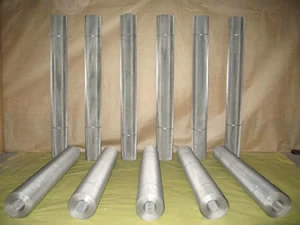
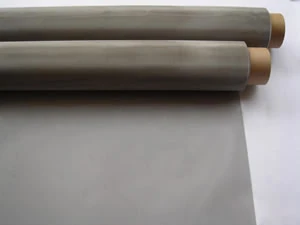
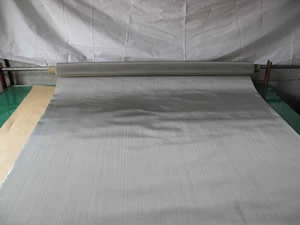
Forty-eight woven specifications with open area and weight published for every one of them.
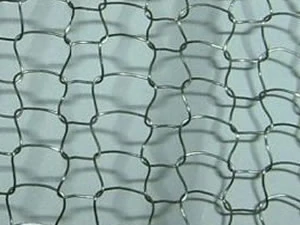
A knitted structure that compresses, conducts and separates - specified by wire material rather than by aperture.
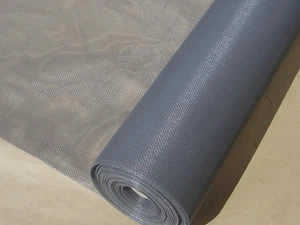
Seven screen materials with their mesh counts, gauges, roll sizes and colours set out side by side.
18% chromium and 8% nickel - the composition of type 304, and the base of type 316 as well.
It resists oxidation at elevated temperature up to 1400 degrees Fahrenheit.
316 is enough unless the cloth will be welded after weaving, in which case the reduced carbon of 316L gives better secondary welding characteristics.
Tell us the application rather than the part number. We will work back to the specification with you.