
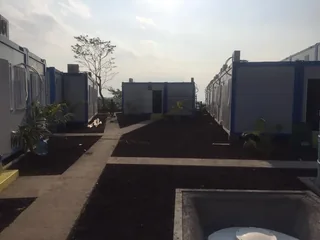
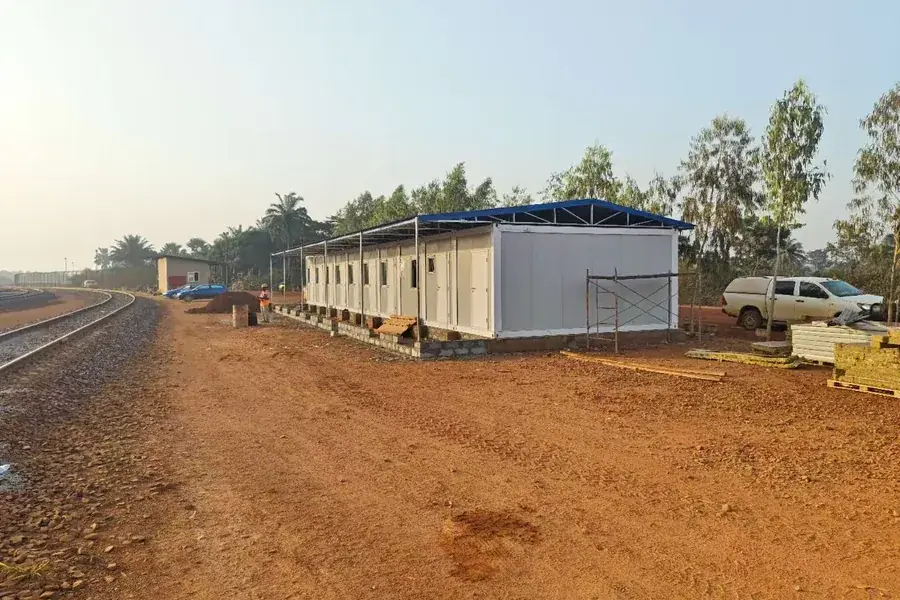
RUSAL Bauxite Mine Accommodation Camp Guinea
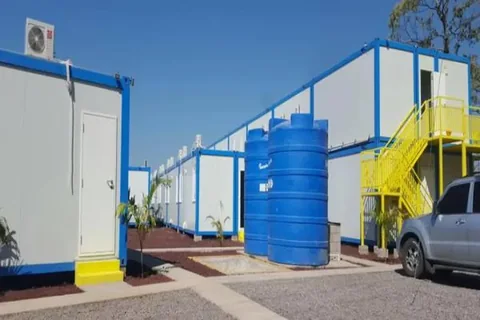
A mining accommodation camp delivered as detachable container modules — dormitories, sanitary and facility blocks assembled quickly on a prepared pad, with finished interiors and corridors ready on arrival.
Who the Project Was For
COBAD, part of the RUSAL group, operates bauxite mining in Guinea. The camp supports mine operations on a site where the working day starts a long way from any town.
Client — COBAD – RUSAL
What Had to Be Solved
Deliver a complete accommodation camp — sleeping, sanitary and facility buildings — that could be assembled quickly on a prepared pad and be habitable almost immediately after erection.
The Pressures on This Project
Time between arrival and occupation
Every day between the containers landing and the camp opening is a day of accommodation paid for somewhere else.
Sanitary provision on a remote site
Fitting out wet rooms locally is slow and hard to inspect.
Mixed building types on one order
Dormitories, sanitary blocks and facility buildings usually come from different suppliers with different grids.
Red-earth site conditions
Haul roads and site conditions are hard on anything shipped fully assembled.
What We Supplied and Why
180 detachable container modules covered every building in the camp — dormitory, sanitary and facility blocks — on a single grid and a single erection sequence.
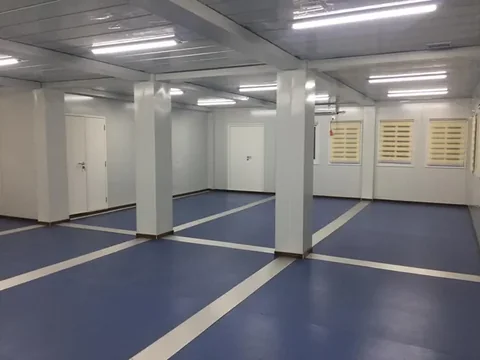
Interiors and corridors were finished in Weifang, so the buildings arrived complete rather than as shells requiring local fit-out.
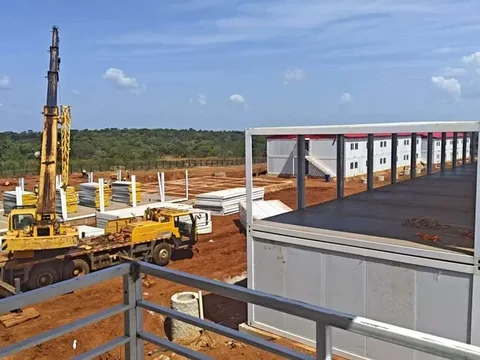
Blocks were arranged as single and two-storey rows to suit the prepared pad, with external circulation keeping internal areas fully usable.
How It Was Built and Shipped
Camp layout
Building positions, circulation and service routes were drawn and approved before fabrication.
Fabrication and fit-out
Frames cut, welded and galvanised; interiors, corridors and sanitary fittings installed and tested.
Packing
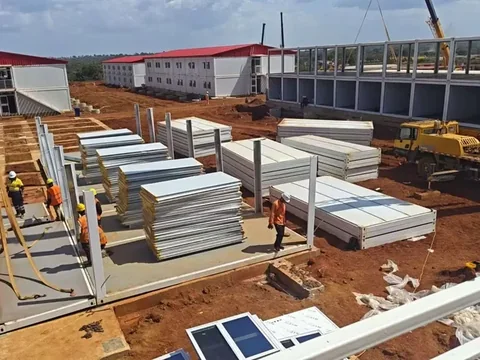
Modules knocked down flat and loaded to a container plan with photo reports.
Assembly
Modules opened, combined and bolted up on the prepared pad.
Getting It There in the Right Order
The camp shipped as a planned sequence of containers so the site could erect continuously rather than sorting a yard full of unrelated parts.
What Was Checked
- Material and fittings checked against the approved camp specification
- Frame geometry inspected before galvanising
- Sanitary services water tested before knock-down
- Photo report issued before each container was sealed
What Was Delivered
A 180-module accommodation camp with dormitories, sanitary and facility blocks assembled on a prepared pad, with finished interiors and corridors ready on arrival.
What It Changed
- Short time between the containers landing and the camp being occupied.
- Sanitary blocks built and water tested in the factory rather than fitted out on a remote site.
- One supplier and one grid across every building type in the camp.
Products For This Requirement
Detachable Container House
The unit we build most camps from. It knocks down to a flat stack for the sea leg, then opens back out into a finished room that can…
View productAblution and Sanitary Block
The module with the least tolerance for improvisation. Floors, falls, waterproofing and fittings are built and tested in the factory…
View product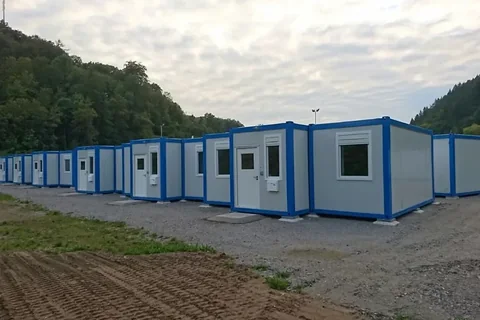
Worker Dormitory Block
The sleeping accommodation that most of a camp is made of. Rooms are combined from standard units, stacked two storeys with external…
View productRelated Pages
Have a Project Like This
Tell us the country, the use and the rough size — we will scope it and quote.