
Choosing the Right Chain Link Type
Short, medium, and long link chains are not interchangeable. Each has a distinct shape, strength profile, and application. This guide explains how to choose the right one based on the duty, the equipment, and the standard.
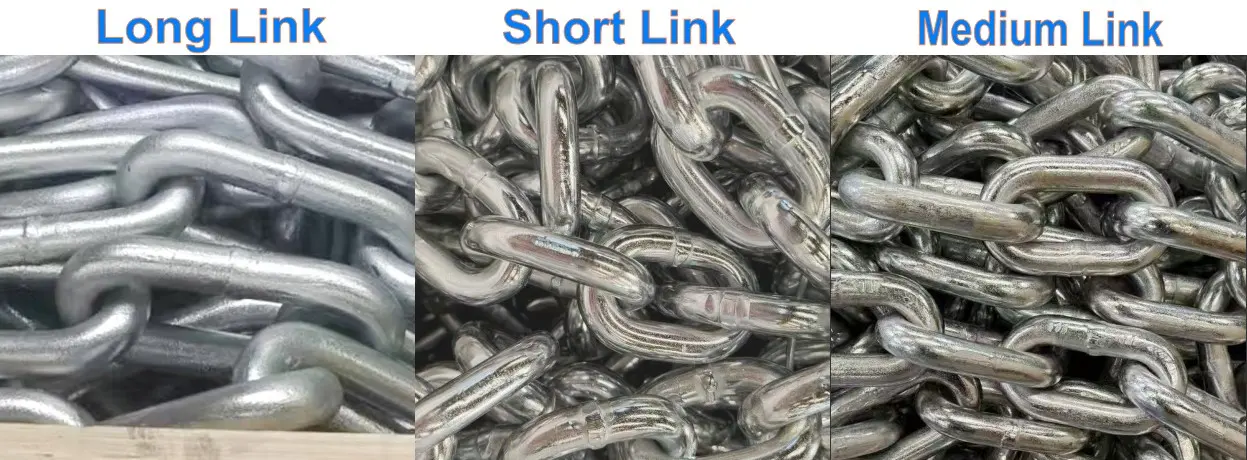
What Short Medium and Long Link Chains Actually Are
All three are forged or welded steel chains used in industrial and marine applications, but their link geometry defines their function. Long link chains have links longer than they are wide, often oval or rectangular. Short link chains have links nearly square, with length close to width. Medium link chains fall between them, with links longer than wide but not as elongated as long link chains. The shape affects how the chain handles, how it fits into machinery, and how it performs under load. A mismatched chain can fail in service, so the link type must be chosen based on the equipment and the standard.
Where Long Link Chains Belong
Long link chains are designed for flexibility and ease of handling. They are used in general lashing and securing, where the chain needs to wrap around irregular shapes or be connected to multiple fittings without kinking. Common applications include mooring lines, anchor systems, and decorative chains. Their elongated links allow for smooth bending and reduce stress at connection points. They are specified under DIN 763 and are often used in marine environments where flexibility and low weight per length are priorities. For a distributor, this means long link chains suit marine suppliers, rigging contractors, and equipment rental businesses that need chains for temporary or variable setups.
Tow Chain V Bridle with Large Shank J Hooks and Grab Hooks WLL 4700 lbs
Where Short Link Chains Belong
Short link chains are built for strength and precision. Their compact, nearly square links make them ideal for use with sprockets, pulleys, and windlasses, where tight engagement and minimal slack are critical. They are commonly used in lifting and hoisting operations, especially with chain hoists and overhead cranes. In marine applications, they are used in anchor systems where the chain must be wound and unwound through a windlass without jamming. The DIN 766 standard governs their dimensions and strength. For a buyer, this means short link chains are the right choice when the chain must interface with mechanical drive systems or when the duty involves repeated, high-cycle loading.
Tow Chain V Bridle with Large Shank J Hooks and Grab Hooks WLL 4700 lbs
Where Medium Link Chains Belong
Medium link chains are a compromise between long and short link chains. They offer more flexibility than short link chains but more strength and stability than long link chains. They are used in applications that require moderate load-bearing capacity and some degree of handling ease. Typical uses include industrial machinery, conveyor systems, and certain types of rigging where the chain must move through guides or pulleys but not be subjected to extreme tension. They are not as common as the other two types but are specified in some DIN standards and are often used where a standard short link chain is too rigid and a long link chain is too weak.
Towing Chain Bridle With Forged 4 Inch Mini J Hooks
The Direct Comparison
On shape, long link chains are elongated, short link chains are nearly square, and medium link chains are intermediate. On strength, short link chains are the strongest, medium link chains are moderate, and long link chains are the weakest. On flexibility, long link chains are the most flexible, medium link chains are moderate, and short link chains are the least. On typical use, long link chains suit mooring and lashing, short link chains suit lifting and windlass use, and medium link chains suit industrial machinery and intermediate rigging. On standard, long link chains follow DIN 763, short link chains follow DIN 766, and medium link chains are often defined by custom or in-house specifications. On buyer, long link chains suit marine and rental suppliers, short link chains suit lifting and crane operators, and medium link chains suit industrial equipment integrators.
Towing Chain Bridle With Forged 4 Inch Mini J Hooks
How to Read the Link Shape on Arrival
The link shape is the first field check. A chain with long, oval links is a long link chain. A chain with short, square links is a short link chain. A chain with links longer than wide but not as elongated as long link chains is medium link. This visual check is useful on a dock or in a warehouse, but it is not proof of rating. Always verify the standard and grade marking on the chain. A chain can be shaped to look like one type but be made to a different standard. Ask for the grade stamp and the certificate for the batch.
Towing Chain Bridle With Forged 4 Inch Mini J Hooks
Matching the Chain to the Equipment
Using the wrong link type with a machine can cause failure. A short link chain will not fit properly in a windlass designed for long link chains, and a long link chain will not engage with a sprocket meant for short links. The chain must match the equipment's design. When sourcing, confirm the chain type required by the machine manual or the standard. If you are integrating chain into a system, ensure the link type matches the pulley, sprocket, or windlass. Mixing types in a single system is not recommended and can lead to premature wear or failure.
How to Split the Range as a Distributor
Most rigging and marine distributors carry all three types, but weighted by market. Stock long link chains in the smaller sizes for general lashing and mooring applications. Stock short link chains in the mid to large sizes for lifting and windlass use. Keep medium link chains in stock only if your customer base includes industrial machinery integrators or custom rigging projects. Focus on the most common sizes and grades in each category, and keep the grades physically separated in bins to avoid mix-ups. The most common patterns are the standard sizes under DIN 763 and DIN 766.
What to Ask a Supplier Before You Order
Ask which link type the chain is, and confirm it matches the equipment or standard. Ask for the standard that governs the chain, such as DIN 763 or DIN 766. Ask whether the grade is stamped on the chain and what it says. Ask for a Material Test Certificate for the batch if your customers are audited. And ask whether the supplier can quote chains with the correct link type, grade, and size together, because a single quotation is the only way to ensure the chain is right for the job.
Ordering note. Long link chains are flexible and used for mooring, lashing, and decorative applications; governed by DIN 763 Short link chains are compact and strong, used for lifting, hoisting, and windlass systems; governed by DIN 766 Medium link chains are intermediate in shape and use, suited for industrial machinery and moderate rigging duties The link shape must match the equipment—short link chains will n