
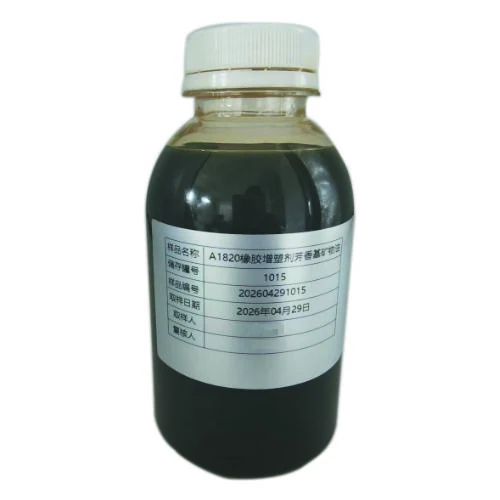
A1820 TDAE Rubber Plasticizer Aromatic Base Mineral Oil
A1820 is the heavier, more aromatic of our two TDAE grades, refined as the eco-friendly replacement for traditional high-PAH aromatic oils. Its higher aromatic content softens rubber compounds, lowers mixing viscosity and boosts filler dispersion for carbon black and silica, which shows up as smoother mixing and easier extrusion on the line.
What You Get With This Grade
- 22.4% CA, the more aromatic carbon profile, for compounds that need stronger softening
- 8PAHs measured at 2.76 mg/kg against a 10 mg/kg maximum
- Flash point measured at 250 °C against a 220 °C minimum specification
- Batch-to-batch control on viscosity, flash point, aromatic content and PAH level to remove production fluctuation
Technical features
- High aromatic content softens compounds and lowers mixing viscosity
- Improves flexibility, elasticity, low-temperature crack resistance and ageing resistance in the finished product
- Retains aromatic compatibility while cutting PAH content well below regulatory limits
- Suitable for all common rubber polymer systems
Where A1820 TDAE Rubber Plasticizer Aromatic Base Mineral Oil Is Used
Tire manufacture
Enhances wear resistance, grip and rolling resistance in compounds aiming at current global emission and performance standards.
Hoses seals and belts
Used across rubber hoses, seals and belts where processability and ageing resistance both matter.
Footwear rubber
Softens compounds for rubber footwear without the PAH exposure of traditional aromatic oil.
Moulded industrial rubber goods
General moulded goods requiring REACH-compliant process oil.
Buyers This Grade Is Built For
- Tire manufacturers meeting EU REACH and other global environmental rules
- Compounders running harder recipes that need stronger aromatic softening than A1426 gives
- Small rubber goods factories as well as large tire plants — the grade is not volume restricted
- Buyers who need consistent viscosity and PAH levels lot to lot to keep output stable
What It Stops Going Wrong
- Aromatic oil that varies between lots creates mixing viscosity swings that propagate down the line
- High-PAH oils are blocked by EU REACH and by the environmental rules of many export markets
- Poor filler dispersion shows as inconsistent physical properties in the cured part
- Buying oil from a trader leaves the compliance statement resting on someone else's certificate
Quality Index for A1820 TDAE Rubber Plasticizer Aromatic Base Mineral Oil
| Density at 20 °C | 946.0 kg/m³ (GB/T 1884-2000, GB/T 1885-1998) |
|---|---|
| Kinematic viscosity at 100 °C | 21.47 mm²/s, specification 16-26 (GB/T 265-1988) |
| Flash point | 250 °C, specification 220 °C minimum (GB/T 3536-2008) |
| Pour point | 23 °C, specification 20 °C maximum (GB/T 3535-2006) |
| Aniline point | 73.2 °C, specification 85 °C maximum (GB/T 262-2010) |
| Colour number | 5.0 (GB/T 6540-1986) |
| Acid value as KOH | 0.07 mg/g (GB/T 4945-2002) |
| Refractive index | 1.5262 (SH/T 0724-2002) |
| Viscosity gravity constant | 0.87 (NB/SH/T 0835-2010) |
| Sulphur content | 1.0311% (GB/T 17040-2019) |
| Mechanical impurities | None (GB/T 511-2010) |
| Water content | Trace (GB/T 260-2016) |
| Carbon type analysis CA / CN / CP | 22.4% / 29.4% / 48.2%, CA specification 18 minimum |
| Sum of eight PAHs | 2.76 mg/kg, specification 10 mg/kg maximum (SN/T 1877.3-2007 Method One) |
How It Ships and How to Store It
Packing
- Ocean freight by tank container
- Ocean freight by flexitank
Storage and transport
- Store as a mineral oil product away from ignition sources
- Note the 23 °C pour point when planning winter discharge
How the Lot Is Released
Every batch is controlled for viscosity, flash point, aromatic content and PAH level against the standard methods listed, so production fluctuation from the oil side is removed.
What We Can Change
The grade can be tailored to your processing and performance needs. Send the compound requirement and your current oil data and we will respond with the comparison.
Against the Alternatives
A1820 carries more aromatic character than A1426 — 22.4% CA against 18.4%, aniline point 73.2 °C against 86.4 °C and density 946.0 against 935.4 kg/m³. It is less viscous at 100 °C at 21.47 against 32.25 mm²/s. Its 8PAHs result is higher at 2.76 mg/kg but still well inside the 10 mg/kg limit. Use A1820 where softening demand is greater.
Handling A1820 TDAE Rubber Plasticizer Aromatic Base Mineral Oil on Your Site
Written for the person who receives the drum, not for a brochure.
- Plan winter discharge around the 23 °C pour point, which is higher than A1426's 11 °C
- Review mixing time after the first batch, since filler dispersion improves
- Keep the lot report with the compound record for the REACH compliance file
- Confirm tank container or flexitank discharge capability before booking
A1820 TDAE Rubber Plasticizer Aromatic Base Mineral Oil FAQ
How aromatic is A1820?
Carbon type analysis gives CA 22.4%, CN 29.4% and CP 48.2%, against a CA specification of 18 minimum.
What is the pour point?
23 °C on the reported lot, against a specification of 20 °C maximum. Plan cold weather discharge accordingly.
What is the 8PAHs figure?
2.76 mg/kg against a maximum of 10 mg/kg, tested to SN/T 1877.3-2007 Method One.
Is it suitable for a small rubber goods factory?
Yes. Whether you run a large tire plant or a small rubber goods factory, the grade can be tailored to your processing and performance needs.
What does it do to rolling resistance?
It enhances tire wear resistance, grip and rolling resistance, which supports safer and more fuel-efficient tires.
How is batch consistency controlled?
Strict quality control is maintained on viscosity, flash point, aromatic content and PAH levels for every batch.
Related Products
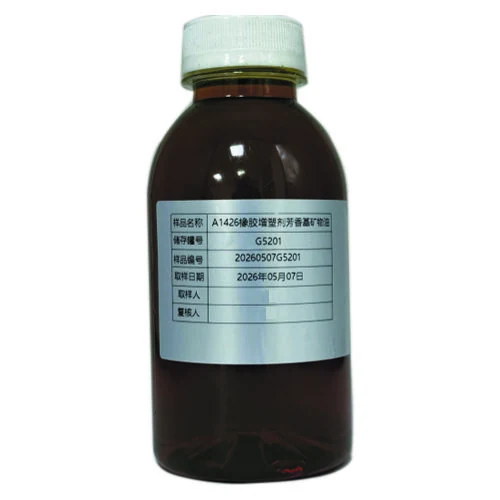
A1426 TDAE Rubber Plasticizer Aromatic Base Mineral Oil
CAS TBC · Treated Distillate Aromatic Extract
A1426 is the lighter of our two TDAE grades, a treated distillate aromatic extract engineered as the environmentally friendly replacement for...
View specification →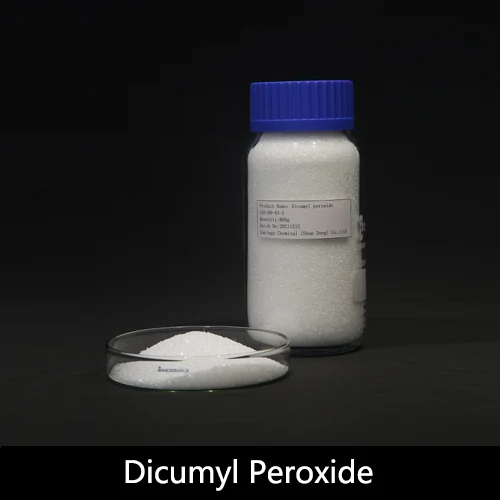
Dicumyl Peroxide
CAS 80-43-3 · C18H22O2
Dicumyl peroxide is the rubber vulcanising agent and polyolefin crosslinker of the range, a white crystalline solid above 99% purity with a melting...
View specification →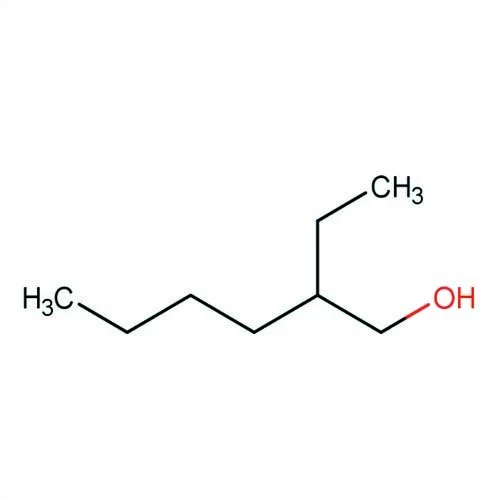
2-Ethylhexyl Alcohol
CAS 104-76-7 · C8H18O
2-Ethylhexyl alcohol, also called octanol or 2-EH, is the C8 alcohol that esterifies with phthalic anhydride and with aliphatic diacids into the...
View specification →Where This Product Fits
Request a Quotation for A1820 TDAE Rubber Plasticizer Aromatic Base Mineral Oil
Tell us the grade, the tonnage and the packing your site can unload. We reply within 24 hours with the current quality index.