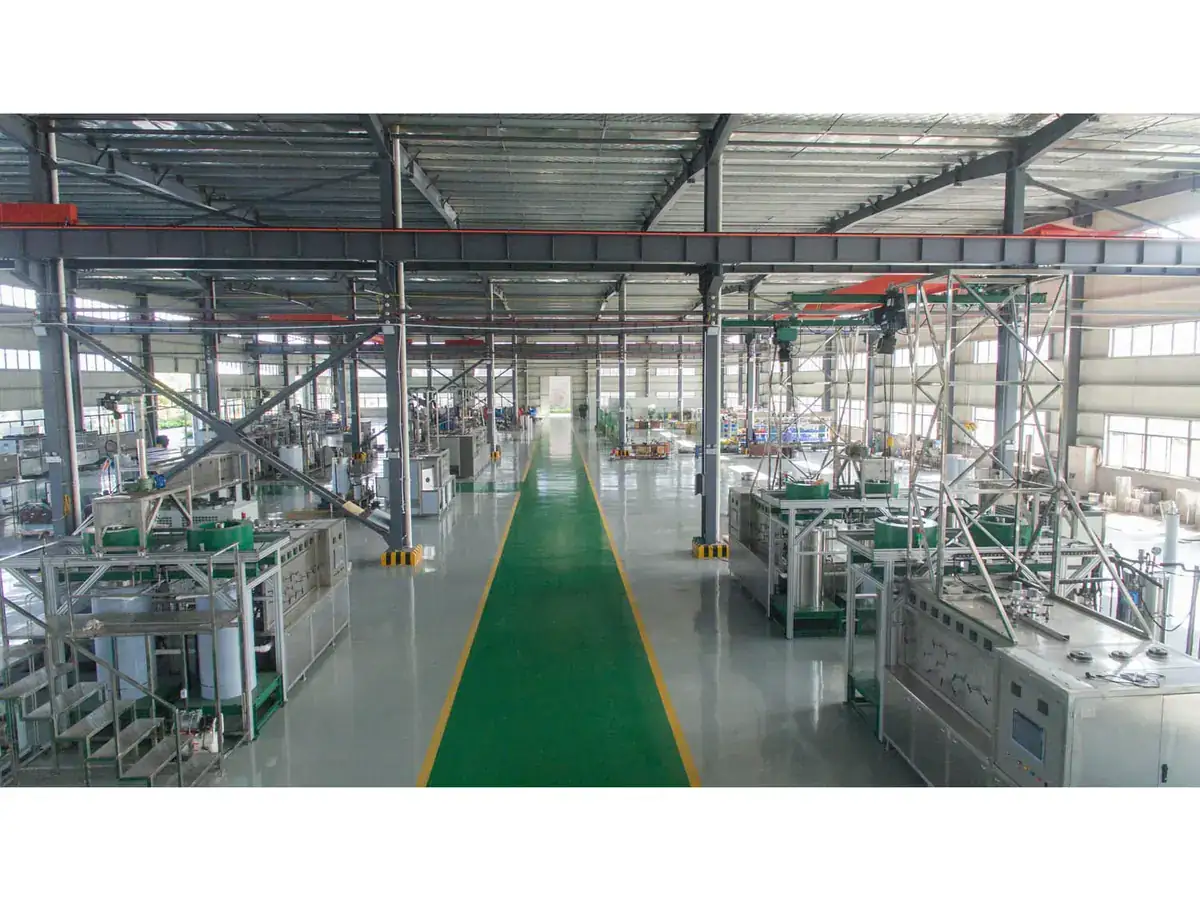
What happens inside the pot
Steam distillation works because a mixture of water and an immiscible oil boils below the boiling point of either one alone. Steam passes through the plant bed, ruptures the oil-bearing structures and carries the volatile oil with it as vapour. The mixed vapour is condensed, and because oil and water do not mix, the two separate in the collecting vessel. What you decant off is essential oil; what remains is hydrosol.
Why indirect heating matters
Direct fire or a directly heated pot base creates hot spots that scorch the plant material sitting against them. Scorched material contributes burnt notes that no amount of downstream handling removes. Heating indirectly through heat-transfer oil spreads the heat evenly and brings the pot to 100°C quickly under clean, safe, atmospheric conditions.
Reading the specification
Two numbers tell you most of what you need when comparing distillation plants of the same pot volume.
- Heating area of the distillation pot. This decides how quickly the charge reaches distillation temperature and how steadily it holds there.
- Condensation area of the condenser. This decides how much vapour can be condensed per hour, which in practice caps the distillation rate. An undersized condenser is the most common bottleneck on a cheap still.
Across the standard range those figures scale with the pot: 0.3m2 heating and 0.7m2 condensing on the 10L plant, 0.4m2 and 0.75m2 on the 20L, 0.33m2 and 0.72m2 on the 30L, and 0.50m2 heating with 0.85m2 condensing plus a separate 0.80m2 cooling area on the 50L.
When to add a vacuum pump
Adding a vacuum pump lowers the boiling point, which raises the extraction speed of the essential oil and reduces thermal exposure. It is worth adding for delicate floral material where the top notes are the commercial value.
Charging the pot
Bulk density matters more than weight. Grassy material such as citronella and lemongrass fills a pot quickly at low weight; flower material is bulkier still. Packing a pot too tightly channels the steam around the bed instead of through it, and the run yields poorly even though the pot is full.