The supercritical state in one paragraph
Carbon dioxide has a critical point at roughly 31°C and 7.4MPa. Above that point it stops behaving as either a liquid or a gas and becomes a supercritical fluid: dense enough to dissolve resins, waxes and volatile oils the way a liquid does, but able to diffuse through a packed plant bed the way a gas does. That combination is what makes it useful. A liquid solvent wets the outside of the material; a supercritical fluid travels into it.
Why CO2 rather than a liquid solvent
The practical argument is what happens at the end of the run. When pressure drops in the separator, the CO2 returns to gas and simply leaves. There is nothing to purge, nothing to evaporate off and no residual solvent test to pass. The CO2 itself is then recirculated rather than consumed, so consumption per batch is small.
The second argument is temperature. Extraction runs from ambient temperature up to 85°C on these systems, which is gentle enough to keep volatile aroma fractions intact. Steam distillation, by comparison, holds the material at 100°C for the whole run.
What the equipment actually does
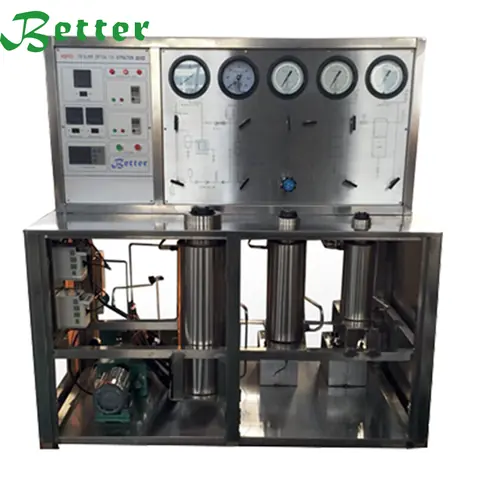
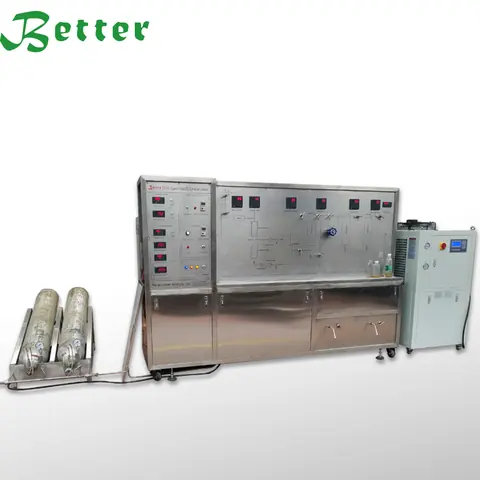
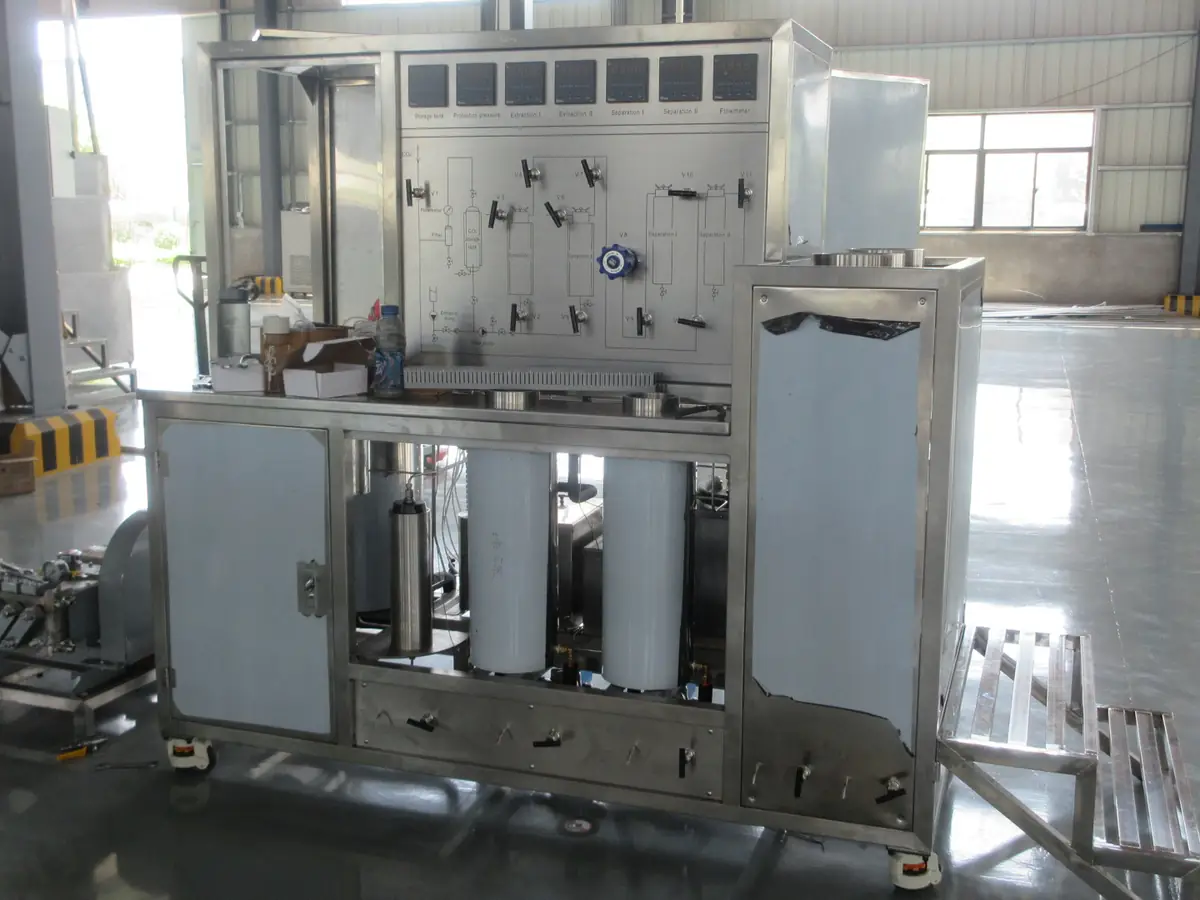
A supercritical extraction machine is a pressure circuit with four jobs: raise CO2 above its critical point, push it through the plant bed, drop the pressure so the extract falls out, and return the CO2 to the start of the loop.
- The extractor holds the milled botanical. On the HSFE machines the highest working pressure of the solid extractor is 50MPa and the highest working temperature is 85°C.
- Two separators sit downstream. Dropping pressure in stages lets heavier and lighter fractions be taken off separately rather than collected together.
- An additive can be dosed into the supercritical fluid where the target compound needs a co-solvent to move.
- Pressure, temperature and flow are read from pressure gauges and digital instruments so the operator can verify the process at any point.
- Pipe parts, valves and pipelines are all stainless steel.
Pressure and temperature are the recipe
There is no single set of conditions that suits every botanical. Higher pressure raises density and pulls a broader spectrum, including waxes and heavier resins. Lower pressure is more selective and gives a lighter, more aromatic extract. Temperature works against density but raises the volatility of the target compound. The working recipe for a given material comes out of trial work, which is why an extraction test on your own raw material is worth running before the machine is sized.
Where CO2 extraction sits in a production line
CO2 extraction produces a crude. Depending on the material and the finished product, that crude may still carry waxes and lipids, in which case it is winterized before short path distillation. A hemp line typically runs extraction, winterization and distillation in sequence; a spice oleoresin line often stops at the separator.
Sizing and lead time
Machines are supplied from 0.5L to 200L, and larger capacity is customised on request. Because the process flow of a supercritical CO2 machine is complex and every procedure is inspected, production generally takes about 60 workdays.