
What winterization removes
Crude extract is not only the target actives. It also carries plant waxes, fats and lipids that were dissolved along with everything else. Those compounds cloud the oil, blind filters, and carry into a distillation column where they contaminate the fractions. Winterization is the step that takes them out.
Why cold ethanol works
Solubility falls with temperature, but it does not fall at the same rate for every compound. Waxes and lipids come out of ethanol solution long before the target actives do. Dissolve the crude in ethanol, chill the mixture hard and hold it, and the waxes precipitate as a visible solid while the actives stay in solution. Filter cold and the wax stays on the filter.
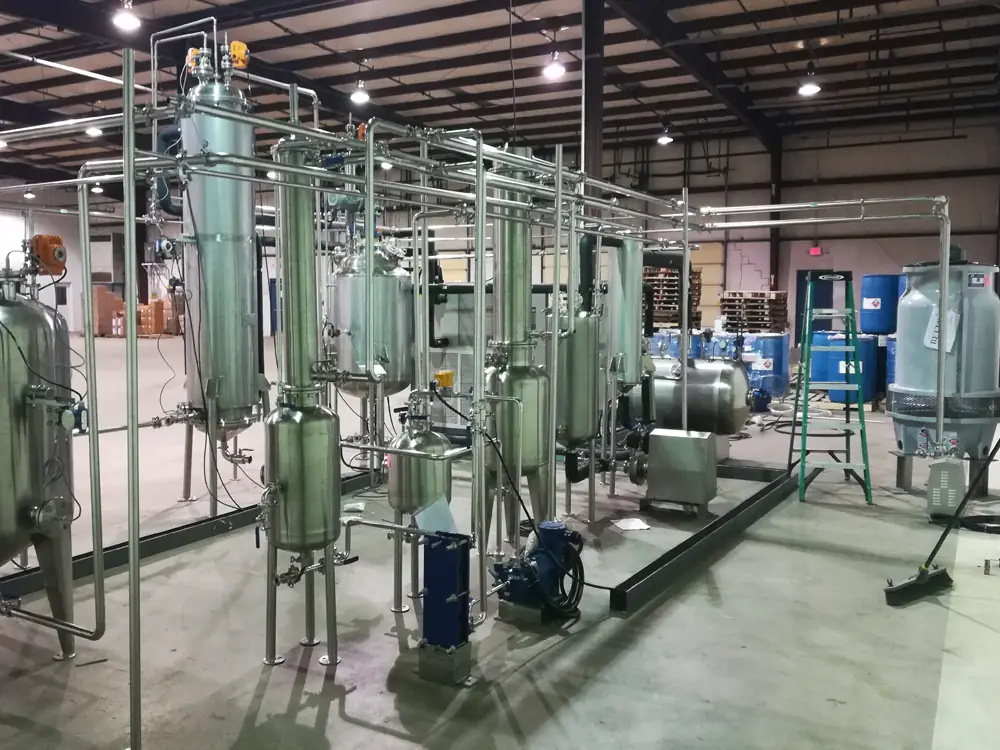
The four stages of a winterization system
- Dissolution. The crude is mixed into ethanol at a defined ratio so that everything goes into solution before chilling starts.
- Chilling and hold. The solution is taken down to temperature and held there long enough for the wax to nucleate and drop out. Rushing the hold is the most common reason a winterization run underperforms.
- Cold filtration. The chilled mixture is filtered while still cold. Let it warm up on the way to the filter and some of the wax redissolves.
- Solvent recovery. The ethanol is evaporated off and condensed for reuse, leaving the dewaxed extract behind.
Why it should be bought as a system
The four stages have to be matched to each other. A chiller that cannot hold temperature through the filtration step, a filter sized for a smaller batch, or a recovery stage that cannot keep up with the extraction line will each cap the throughput of the whole plant. A whole winterization system is engineered as one line for that reason, rather than assembled from loose components bought separately.
Winterization and the extraction route
Cold ethanol extraction at -75°C already leaves much of the wax behind in the biomass, which reduces the winterization load downstream but rarely removes it entirely. Supercritical CO2 extraction at higher pressures pulls waxes along with the resin, so CO2 crude usually needs dewaxing too. Either way, feed that still carries wax should not go into a short path distiller.