Start from output, not from the catalogue
Buyers usually open with a machine size. It is the wrong end of the calculation. The size falls out of four numbers: how much finished product you need per month, what yield your material gives, how long one cycle takes, and how many shifts you will run. Fix those and the kettle volume is arithmetic.
The four numbers
- Target output per month, in kilograms of finished product.
- Yield, as a percentage of input material. This is what an extraction trial on your own material establishes, and it is the number people most often guess wrong.
- Cycle time, including loading, extraction, separation, discharge and cleaning. The extraction time alone is not the cycle.
- Operating hours: shifts per day and working days per month.
Input material per month equals target output divided by yield. Batches per month equals operating hours divided by cycle time. Batch size equals input material divided by batches. The kettle volume follows from batch size and the bulk density of your material.
Bulk density is the trap
Kettle volume is measured in litres but material is bought in kilograms, and the conversion is not one to one. Milled hemp, whole flower, grassy citronella and dense woody material all fill a given volume at very different weights. Sizing on weight alone routinely leads to a machine that is either half empty or cannot take the batch.
Leave headroom
Very few plants stay at their original throughput. If a size falls between two options, the larger one usually costs less than buying a second machine two years later, and it can always be run under-loaded. It is also worth checking early whether the building, power supply and chilled water capacity can support the larger option.
What to send with the enquiry
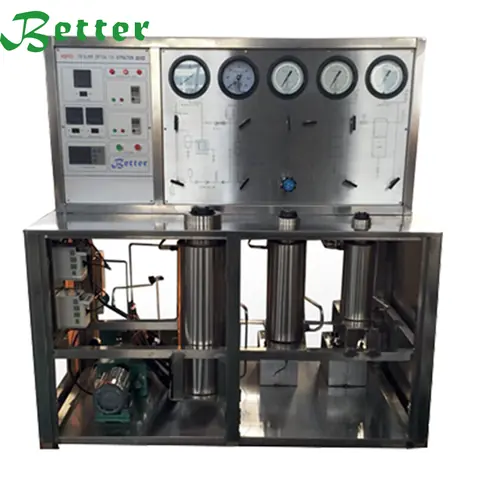
Two things start a real quotation: the raw material you will process, and the production capacity you need per batch. Machines are supplied from 0.5L to 200L, and larger capacity is customised on request. Because every procedure and detail is inspected during production, a supercritical CO2 machine generally takes around 60 workdays to build, so lead time belongs in your planning from the beginning.