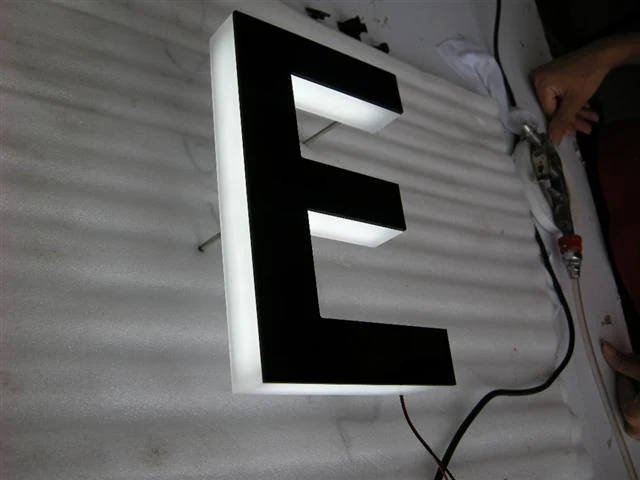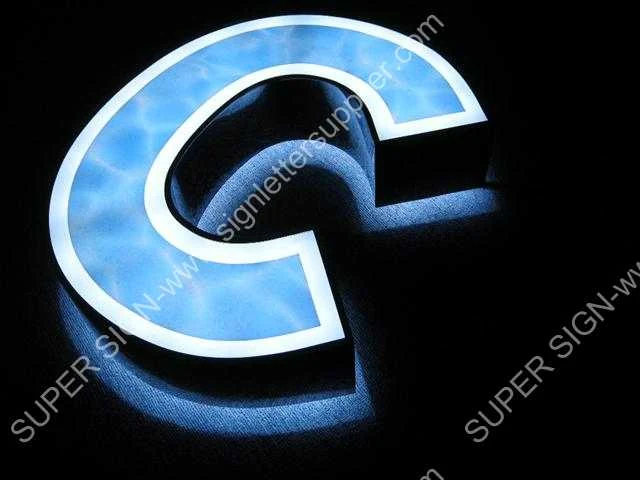
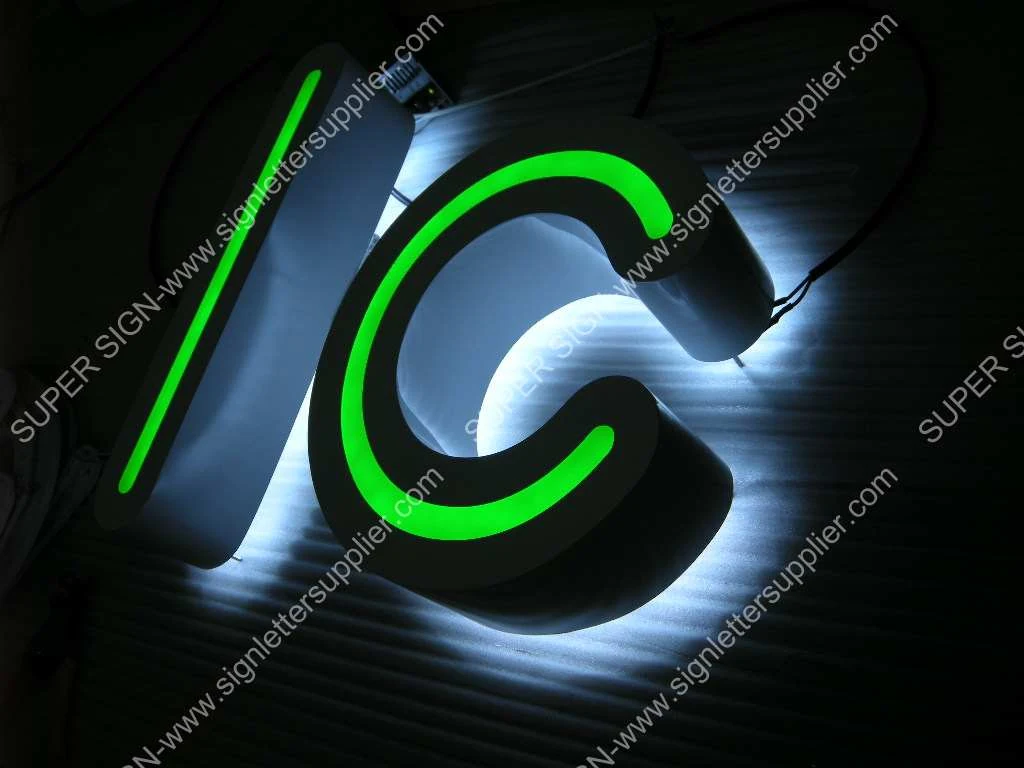
Most illuminated sign enquiries arrive as "we want it lit". That is not yet a specification. Light can leave a fabricated letter through the front face, out of the back onto the wall, or along the cut edge of solid acrylic, and those three routes produce signs that look nothing alike at night and almost identical during the day.
Frontlit letters: light through an acrylic face
A frontlit or facelit channel letter is a metal return with a translucent acrylic front and waterproof LED mounted on a PVC, stainless or aluminium back plate. The letter itself glows. This is the only one of the three that stays legible in full daylight, which makes it the default for street-facing retail.
- Acrylic faces come in standard stock colours; a specific brand colour is achieved by applying film to the acrylic
- Saturated acrylic colours cut light output, so deep colours need denser LED behind them
- Rim construction is recommended above 400mm letter height to keep the face flat
- A shallow return needs tighter LED spacing or the face shows hotspots
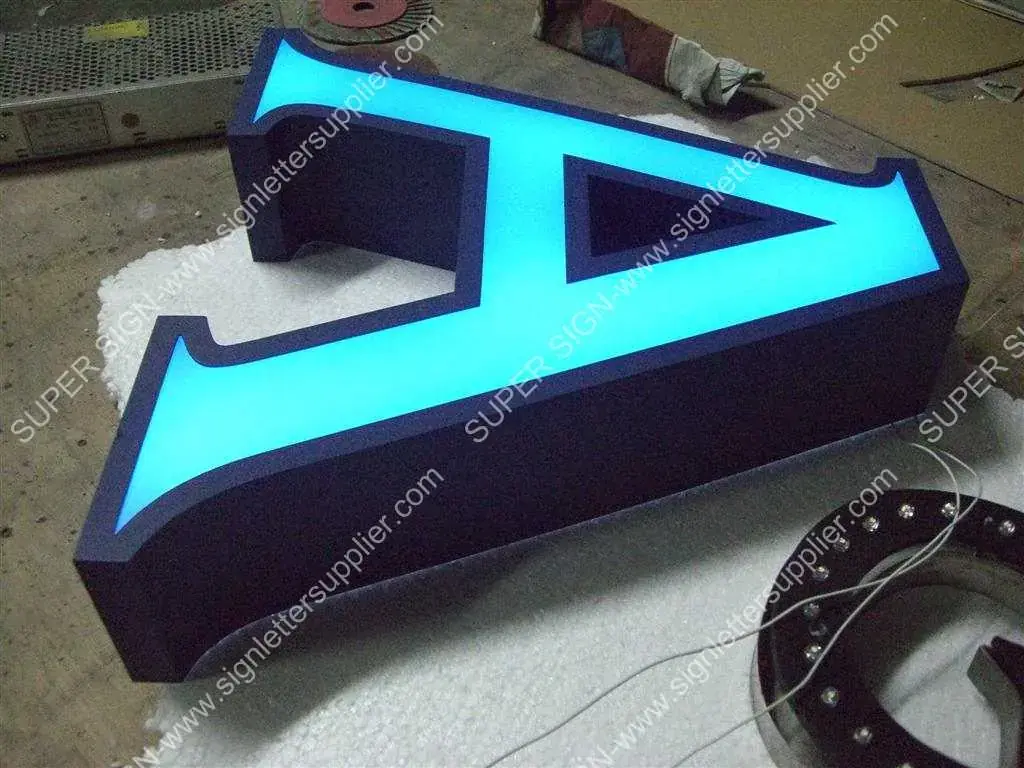
Backlit and halo letters: light onto the wall
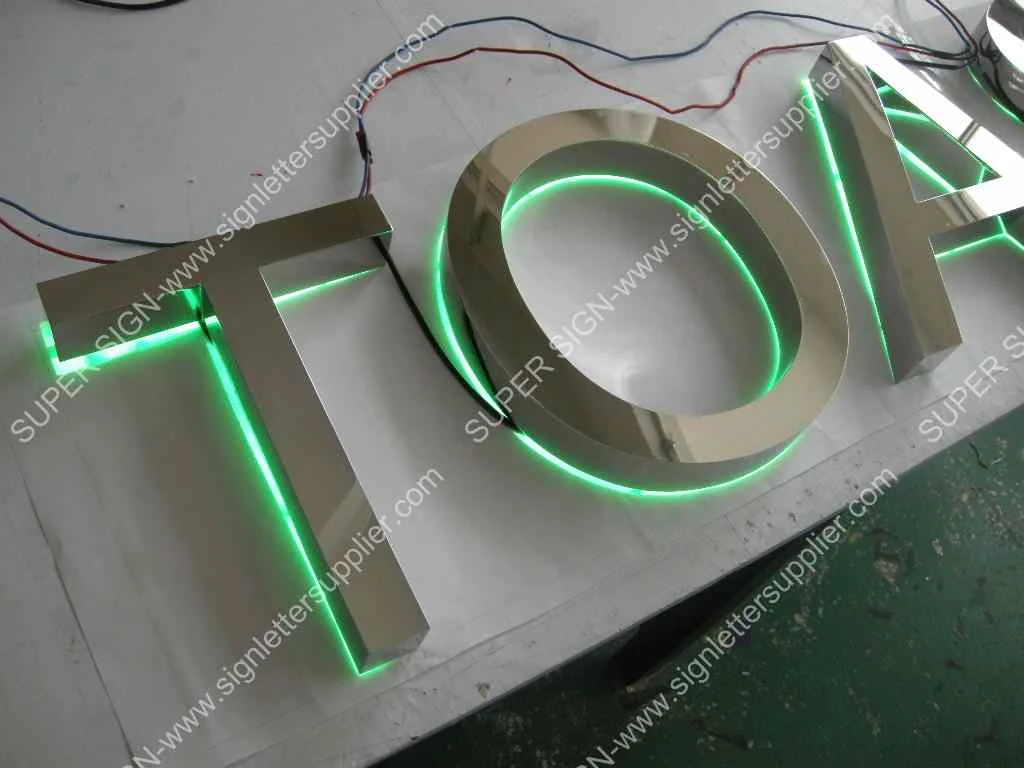
A backlit letter keeps the face solid metal and aims the LED at the mounting surface, producing the halo or corona outline. Nothing glows forwards. In daylight you are looking at a plain metal letter, so the letterform and the finish have to carry the sign on their own.
The halo is made by the wall as much as by the letter. Pale, smooth and flat gives a clean outline; dark paint absorbs the light and textured render scatters it. The stand-off distance, set by the stud length, decides whether the corona is tight or soft. Neither of those is a letter specification in the usual sense, which is why they get forgotten.
Edge lit letters: light out of the acrylic edge
Edge-lit builds have an opaque metal front that blocks light entirely and a 20, 25 or 30mm solid translucent acrylic back that is cut away inside to hold the LED. The light travels through the acrylic and escapes along the cut edge only, so the letter reads as solid metal with a line of light around it.
The effect needs a relatively dark surround. In bright daylight it barely registers, which makes it an interior technique rather than a facade one. It also runs 7 to 10 days in production rather than 5 to 7, because the thick acrylic has to be machined before the LED goes in.
Side by side
| Frontlit | Backlit / halo | Edge lit | |
|---|---|---|---|
| Where the light exits | Through the acrylic face | Onto the wall behind | Along the acrylic edge |
| Face material | Translucent acrylic | Solid metal | Opaque metal |
| Reads in daylight | Yes | As unlit metal only | Barely |
| Depends on the wall | No | Yes, heavily | Yes, needs a dark surround |
| Typical production | 5–7 days | 5–7 days | 7–10 days |
| Colour set by | Acrylic or applied film | LED colour | LED colour |
Two builds that do not fit the three categories
Some catalogue products combine effects. One build has a stainless return, a translucent acrylic front and separate frontlit and backlit LED inside, so the face lights for daytime readability and the halo appears at night. It draws power on two circuits, so the transformer capacity has to be confirmed on site.
Another uses perforated LED punched directly through a solid metal face, so the letter is metal by day and a pattern of light points by night. There is no acrylic at all in that build.
If the sign has to be read from a moving car at noon, choose frontlit. If it sits on a pale wall in a controlled interior, halo will look better. If you are not sure what the wall will be, frontlit is the lower-risk choice.