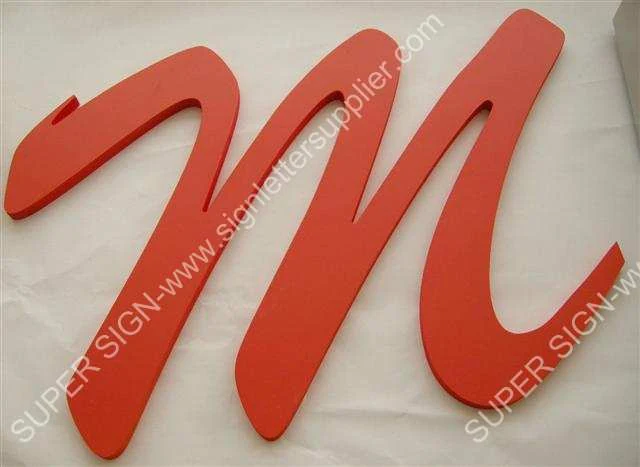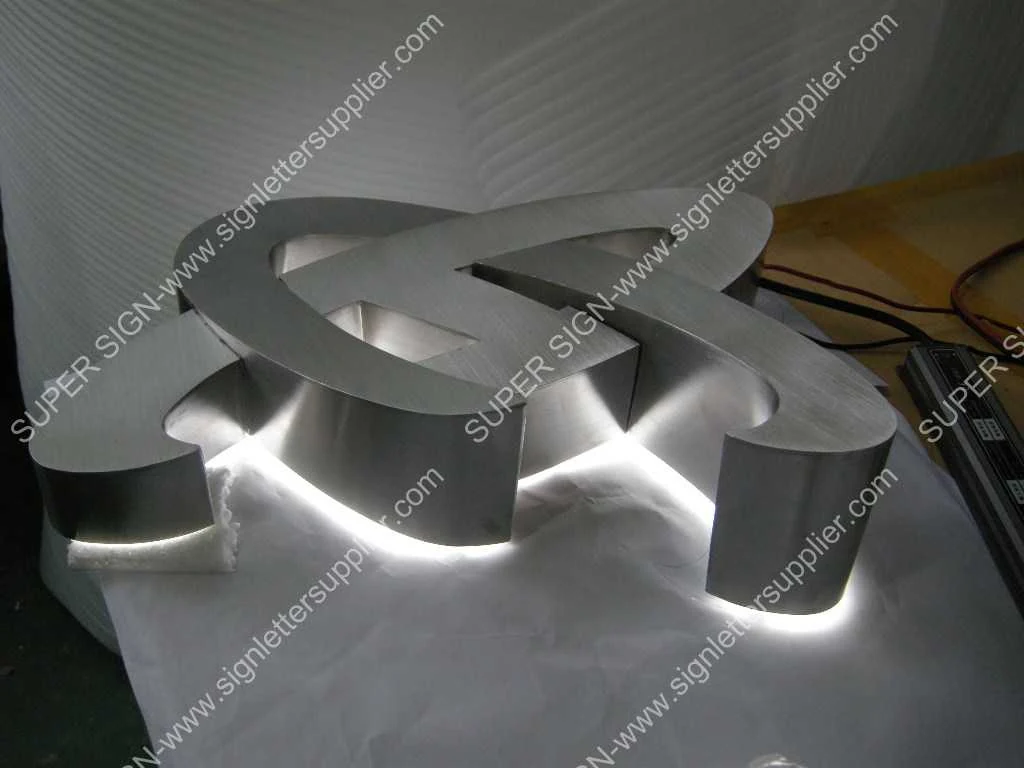
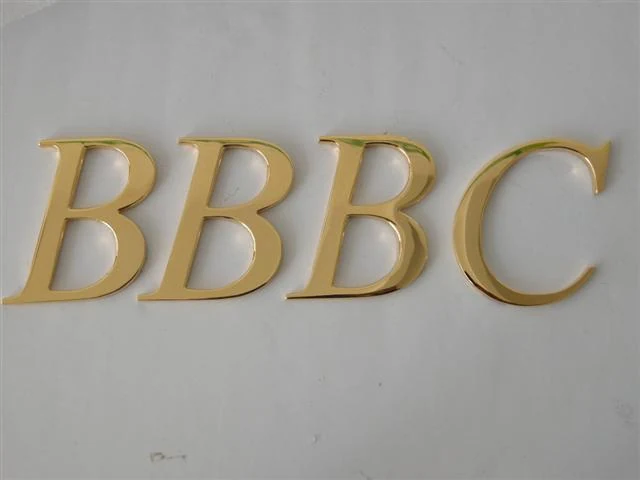
There are two ways to make a metal sign letter. Fold sheet metal into a face and a return and solder it into a closed box, or cut the whole letter from one piece of solid material. Both appear in this catalogue and they suit opposite ends of the size range.
Fabricated letters
Sheet metal is folded to form the face and the return, then soldered or welded and dressed back so the joint disappears. The letter is hollow, which is what keeps a large character light enough to hang on a wall. It is also what makes illumination possible, because there is a cavity for the LED.
- The practical construction for anything over roughly 300mm high
- Return depth becomes a design decision rather than a material limit
- Can be built as a closed box for outdoor use, or with a cavity for LED
- The seam is invisible on a finished letter but it is there, which matters at small sizes
Flat cut solid letters
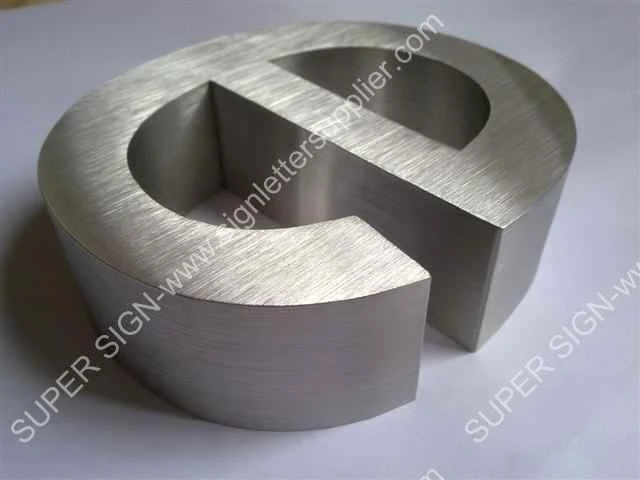
One piece of material, cut to shape, with no return and no cavity. Our catalogue covers water jet cut solid brass, flat cut 304 and 316 stainless with the cut edge finished to match the face, and CNC route cut acrylic and PVC.
- Described in our specifications as able to produce super slim shapes and very small letters, which fabrication cannot
- No seam, because there is no joint
- Heavy per square centimetre, which is why size is limited by weight and cost rather than by technique
- Cannot be illuminated, because there is no cavity
The size crossover
| Letter height | Sensible construction | Why |
|---|---|---|
| Under about 100mm | Flat cut solid | A return looks disproportionate and the seam sits where the eye lands |
| 100–300mm | Either | Decide on weight, wall fixing and whether it needs to light up |
| Over 300mm | Fabricated | Solid material becomes too heavy and too expensive |
| Any size, illuminated | Fabricated | Flat cut has no cavity for LED |
What changes at close range
On a door plate read from thirty centimetres, three things give away a cheap letter: a visible seam on the return, a plated edge where the base metal shows through, and an inside corner radius that does not match the typeface. Flat cut construction removes the first two entirely, and the third is managed by drawing the artwork with the cutter radius in mind.
If the wording will be read from less than two metres, start from flat cut and only move to fabricated if the size forces it.