
The Most Common Types of Load Binder
Ratchet binders and lever binders both tighten chains to secure cargo, but they differ in force multiplication, ease of use, and load capacity. This guide explains where each type belongs, how to choose based on chain size and WLL, and what to check before ordering.
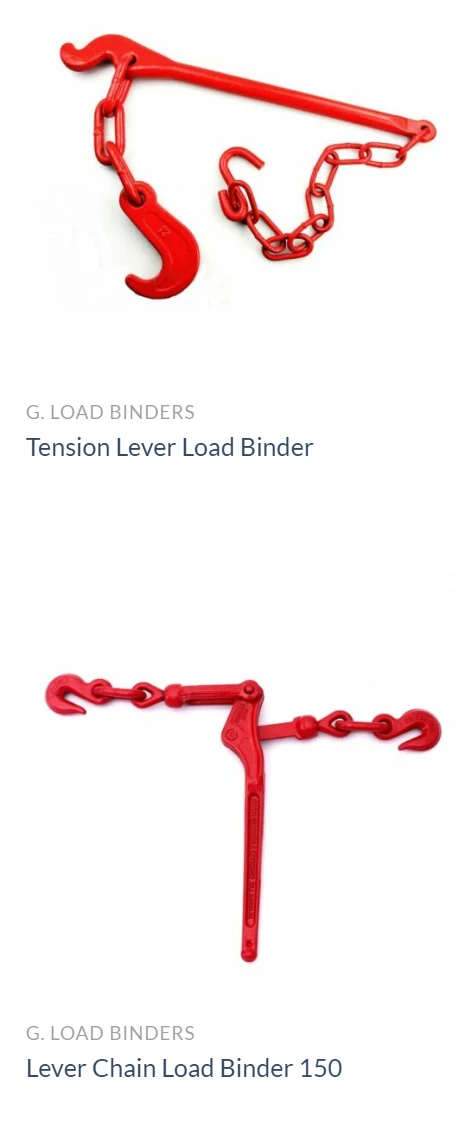
What Ratchet Binders and Lever Binders Actually Are
Both are mechanical tensioning tools used to secure cargo with chain, but they use different force multiplication methods. Ratchet binders use a lever and a screw thread together to build tension incrementally, allowing for high force application over time. Lever binders use a single lever arm to pivot a cam or cam plate, which tightens the chain in one motion. The ratchet system is more powerful but slower; the lever system is faster but limited in maximum tension. Each is designed for a specific duty and must be matched to the chain size and working load limit of the assembly.
Where Ratchet Binders Belong
Ratchet binders are the standard for heavy-duty transport and industrial tie-downs where maximum tension is required. They are used on flatbed trailers, container securing, heavy machinery transport, and in construction logistics. Their ability to apply continuous force makes them ideal for loads that shift under vibration or sudden movement. They are commonly specified in oil and gas, mining, and marine transport where safety margins are critical. For a distributor, ratchet binders are the go-to for fleet operators, logistics providers, and industrial suppliers who need reliable, high-tension performance.
50mm 5000kgs Ratchet Tie Down with Alu. handle and Doube J Hook
Where Lever Binders Belong
Lever binders are best suited for lighter to medium-duty applications where speed and ease of use are priorities. They are commonly used in utility trailer operations, equipment rental, agricultural transport, and short-haul logistics. Their single-motion operation allows one person to secure a load quickly without repeated handle cranks. They are often preferred in environments where frequent loading and unloading occur, such as delivery fleets or warehouse operations. For a buyer, lever binders reduce operator fatigue and improve turnaround time, though they are not suitable for loads requiring sustained high tension.
50mm 5000kgs Ratchet Tie Down with Alu. handle and Doube J Hook
The Direct Comparison
On force application, ratchet binders offer greater tensioning capacity and are rated for higher working load limits, typically from 2,600 lbs to 13,000 lbs or more. Lever binders range from 2,200 lbs to 13,000 lbs, but their maximum is usually reached faster and with less mechanical advantage. On operation, ratchet binders require repeated cranking; lever binders use a single lever push. On chain size, both types are available in 1/4 inch to 1/2 inch sizes, but ratchet binders are more common in larger sizes. On user effort, lever binders are easier to operate; ratchet binders require more physical input. On application, ratchet binders suit heavy transport; lever binders suit fast, repeated use.
50mm 5000kg Ratchet Tie Down with Rubber Handle and Flat Hook
How to Read the Working Load Limit and Chain Size
The Working Load Limit (WLL) is stamped on the binder body and must match the chain and hook system. A ratchet binder with a WLL of 10,000 lbs must be used with chain rated at or above that limit. Chain size compatibility is critical: a 5/16 inch chain requires a binder with a 5/16 inch chain hole. Mismatched sizes reduce the system's strength and create a safety risk. Always verify the WLL and chain size on the product marking and confirm with the supplier before ordering. Do not assume the binder fits the chain just because the hole looks similar.
50mm 5000kg Ratchet Tie Down with Rubber Handle and Flat Hook
Matching the Binder to the Chain and Hooks
A tie-down system is only as strong as its weakest component. If a ratchet binder has a WLL of 10,000 lbs but the chain is Grade 43 with a WLL of 8,000 lbs, the entire assembly is rated at 8,000 lbs. The same applies to hooks and chain links. Always confirm that the binder, chain, and hooks are from the same grade system. Kailipu can quote binders, chain, and hooks together to ensure compatibility and avoid mismatched assemblies. Keep the components from the same grade system in separate bins to prevent accidental mixing.
50mm 5000kg Ratchet Tie Down with Rubber Handle and Flat Hook
How to Split the Range as a Distributor
Most transport hardware distributors carry both ratchet and lever binders, weighted by customer type. Stock ratchet binders in the 1/4 inch to 1/2 inch sizes for fleet and heavy transport customers who need high tension. Stock lever binders in the same sizes for rental shops, utility trailer operators, and delivery fleets who value speed. Keep the most common patterns-such as the clevis hook ratchet and the straight lever binder-in both types before adding specialty designs. This ensures you can meet demand without overstocking low-turnover items.
50mm Ergo Ratchet Tie Down LC 2500KG
What to Ask a Supplier Before You Order
Ask for the WLL and chain size range for each binder model. Confirm whether the WLL is stamped on the part and what the marking says. Ask for the grade of the material used-typically Grade 43 or Grade 70. Request a Material Test Certificate if the customer requires traceability. Ask whether the supplier can provide binders, chain, and hooks on one quotation to ensure the entire system is compatible. And confirm that proof load testing has been performed on the batch.
50mm Ergo Ratchet Tie Down LC 2500KG
Ordering note. Ratchet binders use a lever and screw thread to build tension incrementally; lever binders use a single lever to tighten the chain in one motion Ratchet binders are preferred for heavy-duty loads and high tension; lever binders are better for fast, repeated use Working Load Limit (WLL) must be stamped on the binder and match the chain and hook system Chain size compatibility is critical—ensure the