
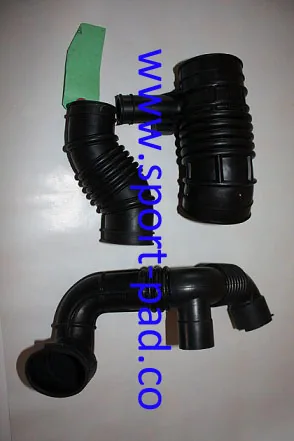
Various Hoses
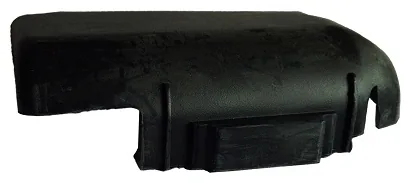
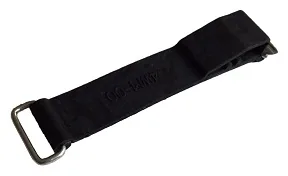
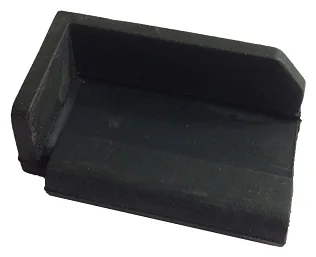
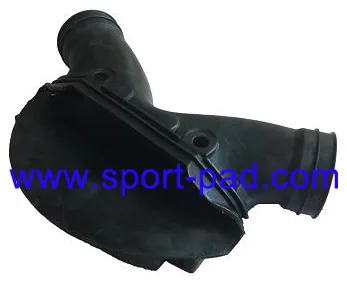
A group photograph rather than a single part: moulded hoses are tooled per bend angle, so this range is really a set of tools, not a set of sizes.
Specification
| Part family | Moulded rubber part |
|---|---|
| Construction | Single-compound moulding, no metal insert |
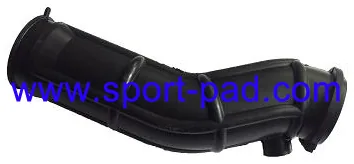
| Face detail | Group of moulded rubber elbow hoses with different bend angles and end forms. |
| Moulding compounds | EPDM, SBR, TPE, TPE-SEBS, PVC or PP, to drawing |
| Tooling | Designed and built in house |
| Prototype parts | 4 weeks from prototype tool |
| PPAP | Typically 8 weeks, to ISO/TS 16949 or VDA |
| Dimensions | Built to customer drawing or to a supplied sample |
| Moulded from | Beijing rubber plant (rubber) / Shanghai plant (plastics) |
The face on this part
Group of moulded rubber elbow hoses with different bend angles and end forms. It sits in the Rubber Parts group, and the photograph above is of the part itself rather than a rendering — what you see is the tread, the outline and the finish as they leave the tool.
Tooling and first parts
All tooling is designed and made in house. Parts from a prototype tool reach you in 4 weeks, which is the window in which the face, the retention and the hardness can still be changed without restarting anything.
Getting it approved
Where the part goes onto a programme we run PPAP to ISO/TS 16949 or VDA, typically over 8 weeks, on parts from the production tool rather than on prototypes.
What we need to quote it
The drawing or the sample, the annual volume, and the service conditions the part sees. If the part already exists in this catalogue we will tell you that instead of quoting a new tool.
Background reading
Choosing a Pedal Pad Compound: EPDM, SBR, TPE and When Each One Fails
Service conditions, not price, should pick the compound. Here is how we narrow it down and what we test to prove the choice.
Ribs, Lattices, Studs and Slots: What Each Pedal Tread Is For
Four tread families appear across this catalogue. Each one is a different answer to the same question about grip and wear.
How to Get a Pedal Pad Quoted: Send a Drawing, or Send the Part
What we need to price a part, what we can work out ourselves, and what genuinely cannot be guessed.
Questions buyers ask
What hardness should I specify?
Shore A hardness decides how the part feels and how fast the tread wears. Too hard and the pattern does nothing; too soft and the rib tips go first. Tell us the duty and we will propose a number to put on the drawing.
How long before I see a real Various Hoses sample?
Prototype parts in 4 weeks. That window is also when design changes are cheap — our designers will suggest improvements to the part while the tool can still absorb them.
What do you need from us to quote it?
Native SolidWorks, Pro-E or UG files, or STEP. Add the volume, the duty and the delivery country and we can quote tooling and parts together.
How is the material verified?
Beside the press rather than a week away. Hardness and density catch a mis-weighed batch, Mooney viscosity catches a compound that will not flow the same way tomorrow, and ozone and ageing catch what only shows up years later.
Quote the Various Hoses
Send the annual volume and, if you have one, the drawing. Prototype parts follow 4 weeks after a prototype tool.