
Sport Pad or Rubber Pad? The Difference That Decides Your Tooling Cost
A sport pad has a metal face; a rubber pad does not. That single difference drives tooling count, unit price and how the part is validated.
Two families, one footwell
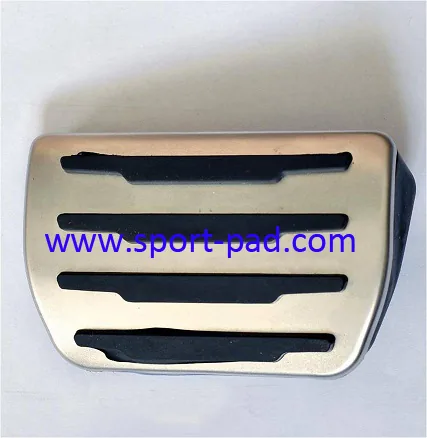
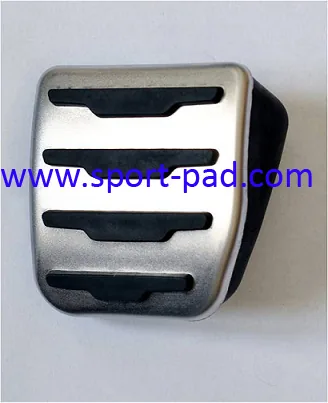
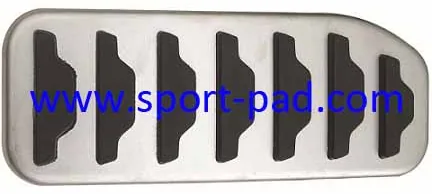
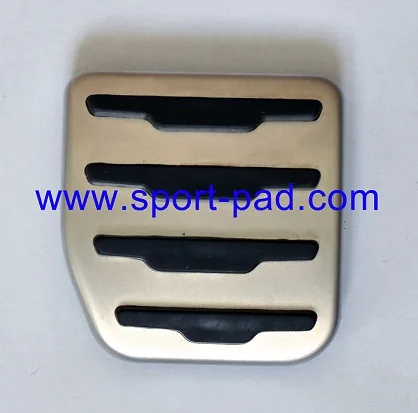
Everything in this catalogue is a pedal interface, but it splits cleanly in two. A sport pad is a metal finisher plate — brushed aluminium or stainless steel — with rubber moulded onto or pressed into it. A rubber pad is a single-compound moulding with no metal in it at all.
What the metal face buys
Appearance, mostly, and a hard edge that resists scuffing. It also lets you change the look of a pedal set without touching the rubber: the blank and the insert are separate tools, so brushed, sand blasted and polished versions of the same part share an insert.
What it costs
Two tools instead of one, a loading operation, and a cutting route for the blank — laser for thin material, CNC machining for thicker sheets. If the pedal is hidden under a mat or the programme volume is small, the all-rubber pad is usually the right answer.
How to tell which one you are looking at
In this catalogue the Sport Pads group is all metal-faced; the Rubber & Plastic Pads group is all single-compound. If you are working from a sample rather than a drawing, look at the edge: an overmoulded part has rubber wrapping the metal, a press-fit part shows a parting line.
Read next
Choosing a Pedal Pad Compound: EPDM, SBR, TPE and When Each…
Service conditions, not price, should pick the compound. Here is how we narrow it down and what we test to prove the choice.
Reading a Compound Code: What EP70, NBR70 and CI60 Tell You
The codes marked on our YAMAHA parts are a compact statement of family and hardness. Here is how to read one.
Overmoulding vs Press Fit: Two Ways to Get Rubber Onto a…
Both produce a metal-faced pedal pad. They differ in tooling, in retention and in how easily the part can be pulled apart.
Still deciding?
Send the service conditions and the annual volume. Our designers will propose a compound and a construction rather than asking you to pick one.