
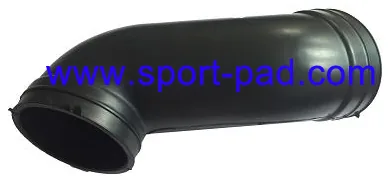
5KM-15472-00
A YAMAHA part number, quoted and tooled as such. The compound code on the part is EP70.
Specification
| Part number | 5KM-15472-00 |
|---|---|
| Part family | Moulded rubber part |
| Construction | Single-compound moulding, no metal insert |
| Compound code | EP70 (marked on the part) |
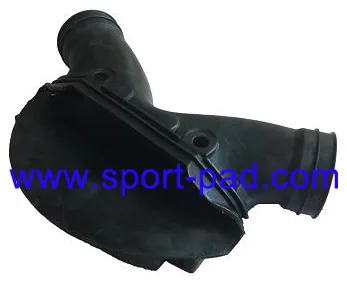
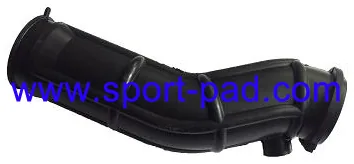
| Face detail | Moulded rubber intake duct with a flared mouth and a stepped bend. |
| Moulding compounds | EPDM, SBR, TPE, TPE-SEBS, PVC or PP, to drawing |
| Tooling | Designed and built in house |
| Prototype parts | 4 weeks from prototype tool |
| PPAP | Typically 8 weeks, to ISO/TS 16949 or VDA |
| Dimensions | Built to customer drawing or to a supplied sample |
| Moulded from | Beijing rubber plant (rubber) / Shanghai plant (plastics) |
The face on this part
Moulded rubber intake duct with a flared mouth and a stepped bend. It sits in the YAMAHA Rubber Parts group, and the photograph above is of the part itself rather than a rendering — what you see is the tread, the outline and the finish as they leave the tool.
One compound, one tool, one shot
The tread, the retaining geometry and any mounting holes or locating tabs are all formed in the tool rather than added afterwards. That is why the tool drawing and the part drawing are effectively the same document, and why a change to the face means a change to the tool.
Compound and hardness
We run EPDM, SBR, TPE, TPE-SEBS, PVC and PP with or without glass reinforcement. Oil or fuel contact rules EPDM out; weather and ozone rule SBR out. Shore A hardness decides how the part feels in use and belongs on the drawing, not in an email.
With no metal face, the compound is the part
There is nothing to hide behind. A pad that is too hard makes its tread pattern useless; one that is too soft wears through at the rib tips. Send the service conditions and our designers will propose a grade rather than asking you to guess one.
Background reading
Choosing a Pedal Pad Compound: EPDM, SBR, TPE and When Each One Fails
Service conditions, not price, should pick the compound. Here is how we narrow it down and what we test to prove the choice.
Reading a Compound Code: What EP70, NBR70 and CI60 Tell You
The codes marked on our YAMAHA parts are a compact statement of family and hardness. Here is how to read one.
Ribs, Lattices, Studs and Slots: What Each Pedal Tread Is For
Four tread families appear across this catalogue. Each one is a different answer to the same question about grip and wear.
Questions buyers ask
Can the tread pattern be changed?
The tread is cut into the tool, so a pattern change is a tool change. If you are early enough to be at prototype stage it costs little; after the production tool is cut it does not.
How long before I see a real 5KM-15472-00 sample?
Prototype parts in 4 weeks. That window is also when design changes are cheap — our designers will suggest improvements to the part while the tool can still absorb them.
What do you need from us to quote it?
Native SolidWorks, Pro-E or UG files, or STEP. Add the volume, the duty and the delivery country and we can quote tooling and parts together.
How is the material verified?
Beside the press rather than a week away. Hardness and density catch a mis-weighed batch, Mooney viscosity catches a compound that will not flow the same way tomorrow, and ozone and ageing catch what only shows up years later.
What does the EP70 marking on the part mean?
It is the customer's own compound designation, carried on the part so the grade travels with it. The letters give the family — EP for the EPDM grades, NBR for nitrile — and the digits give the nominal Shore A hardness.
Quote the 5KM-15472-00
Send the annual volume and, if you have one, the drawing. Prototype parts follow 4 weeks after a prototype tool.