
Ribs, Lattices, Studs and Slots: What Each Pedal Tread Is For
Four tread families appear across this catalogue. Each one is a different answer to the same question about grip and wear.
Ribs
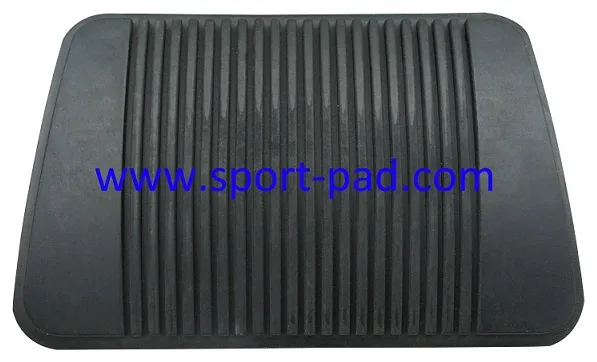
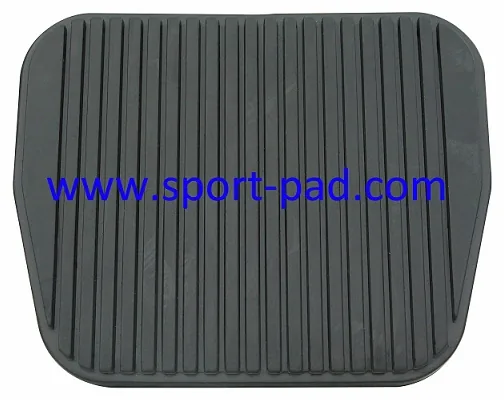
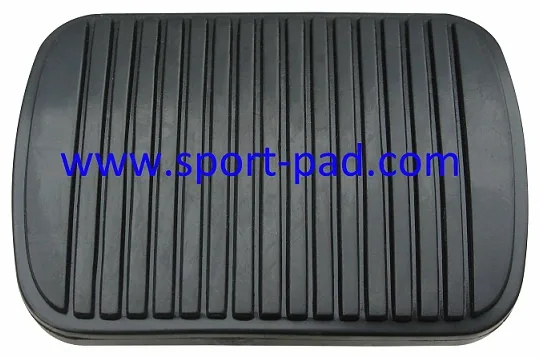
Parallel ridges, usually running front to back so they work with the direction the foot slides. Coarse ribs clear water and grit and wear slowly; fine ribs feel more positive and show wear at the tips first. The most common pedal face there is.
Diamond lattices
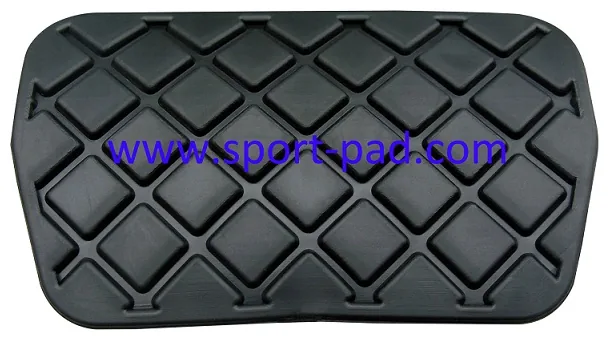
Crossed ribs, gripping in two directions at once. They suit clutch pedals, where the foot arrives at an angle. A dense small-cell lattice has more edge length per unit area, which is what actually produces grip on a wet sole; a large-pitch lattice stays useful under a work boot.
Studs
Round rubber pads set into a metal face. They keep grip even when the sole only covers part of the plate, which is why they turn up on wide automatic brake pedals. The GM family here is built entirely on the stud pattern.
Slots
Long rubber bars showing through cut-outs in the metal. The most metal-forward look of the four, and the cheapest insert to tool per unit of contact area — but the pattern is directional, so slot orientation has to match the pedal, not the styling sketch.
Read next
Sport Pad or Rubber Pad? The Difference That Decides Your…
A sport pad has a metal face; a rubber pad does not. That single difference drives tooling count, unit price and how the part is validated.
Choosing a Pedal Pad Compound: EPDM, SBR, TPE and When Each…
Service conditions, not price, should pick the compound. Here is how we narrow it down and what we test to prove the choice.
Reading a Compound Code: What EP70, NBR70 and CI60 Tell You
The codes marked on our YAMAHA parts are a compact statement of family and hardness. Here is how to read one.
Still deciding?
Send the service conditions and the annual volume. Our designers will propose a compound and a construction rather than asking you to pick one.