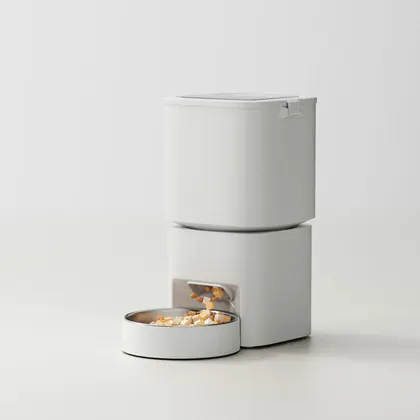
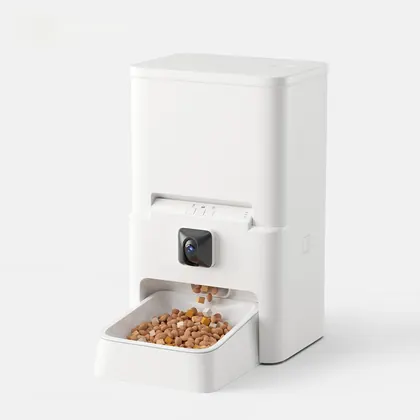
Start with the failure modes, not the feature list
Every smart feeder on the market claims app control, portion scheduling and a large hopper. The specification sheets converge because the components converge. What separates a product that earns four and a half stars from one that earns three is a short list of failure modes, and you should ask about each of them directly.
- Jamming: ask what happens when the auger meets an obstruction, and whether the event is reported to the app
- Humidity: ask how the hopper seals and whether there is a desiccant seat
- Power loss: ask whether a scheduled meal still dispenses on battery backup
- Wi-Fi pairing: ask whether the device accepts both 2.4 GHz and 5 GHz, since single-band devices fail on modern mesh routers
- Portion consistency: ask for the tolerance in grams, not a percentage
Separate the OEM question from the ODM question
OEM means an existing product with your branding on it. ODM means a new product developed for you. The two have completely different cost structures, timelines and risk profiles, and confusing them is the most common reason a sourcing project runs late.
- OEM: no tooling cost, 500 unit MOQ, roughly 30 days from approval to shipment
- ODM: tooling investment, 3000 unit MOQ, roughly 75 to 95 days before a production run
- OEM gives speed and low risk, ODM gives differentiation and exclusivity
- Most successful ranges start with OEM and move to ODM once demand is proven
Check certification against the destination, not the category
CE, FCC and RoHS cover a lot of ground but not everything. UKCA applies in Great Britain, PSE in Japan, KC in Korea. Camera products may face additional scrutiny on data handling. Each file takes time and money, so confirm what you need before tooling, not before shipping.
- Confirm the exact certification set for every destination market you plan to enter
- Ask whether test reports name the factory or a trading company
- Check that material certificates exist for food contact parts
- Budget four to six weeks for a certification cycle on a new product
Make the carton part of the price negotiation
Carton dimensions determine how many units fit in a container, which can move landed cost per unit by more than the difference you are negotiating on the unit price. Ask for the carton drawing and container loading plan alongside the quotation, not after it.
- Request carton dimensions, gross weight and units per 40 HQ with the quotation
- Compare landed cost per unit rather than FOB unit price
- Ask whether cartons are drop tested in the configuration they will ship in
- For marketplace fulfilment, confirm the packaging survives a courier network rather than a pallet
Order a sample and test it badly on purpose
A sample that works in a clean office with a strong Wi-Fi signal proves nothing. Test it the way a customer will: with your own kibble, on a crowded home network, with the power switched off mid-schedule.
- Test with the specific kibble shape and size your market buys
- Pair the device on a dual-band router with a single merged SSID
- Cut mains power during a scheduled meal and confirm the backup dispenses
- Leave food in the sealed hopper for three weeks and check the smell
- Strip the fountain completely and confirm every wetted surface can be reached