The environment under the floor
Below a slatted floor sits a mixture of slurry, ammonia, moisture and whatever disinfectant the wash routine uses. It is warm, it is humid and nobody inspects it. Every support material has to be judged against that, not against a spec sheet.
Steel: strong, and quietly corroding
Steel spans well and is cheap to buy. It also corrodes from the underside, where the damage is invisible until a beam fails. Galvanising slows the process; it does not stop it in an ammonia atmosphere, and any cut or drilled end is an open door.
Steel supports are still used, mostly in buildings where they can be inspected and replaced. In a sealed pit, that is rarely the case.
Concrete: durable until the reinforcement goes
A concrete beam is unaffected by ammonia. Its reinforcement is not. Where cover is thin or the beam has been chipped during installation, corrosion of the steel inside cracks the concrete off from within.
Concrete is also heavy. In a finished building, placing concrete beams often means lifting gear, restricted access and a slower programme.
FRP: no metal, no coating
A pultruded fibreglass beam is glass fibre in a resin matrix. There is no metal to corrode and no coating whose failure starts a clock. It is light enough for a two-person team to carry and place, it cuts with a standard abrasive blade, and a cut end is sealed with a cap rather than re-protected.
The trade-off is stiffness per unit depth: FRP deflects more than steel of the same section, which is why the section is matched to the span and the floor weight rather than chosen from habit.
Choosing a section
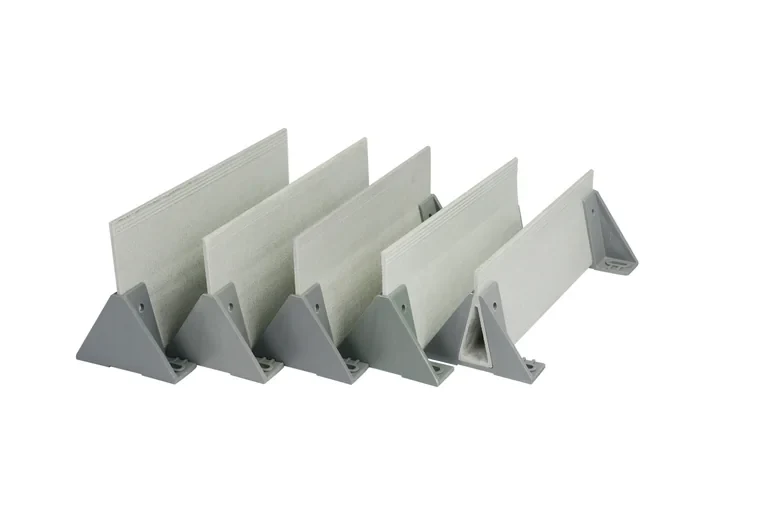
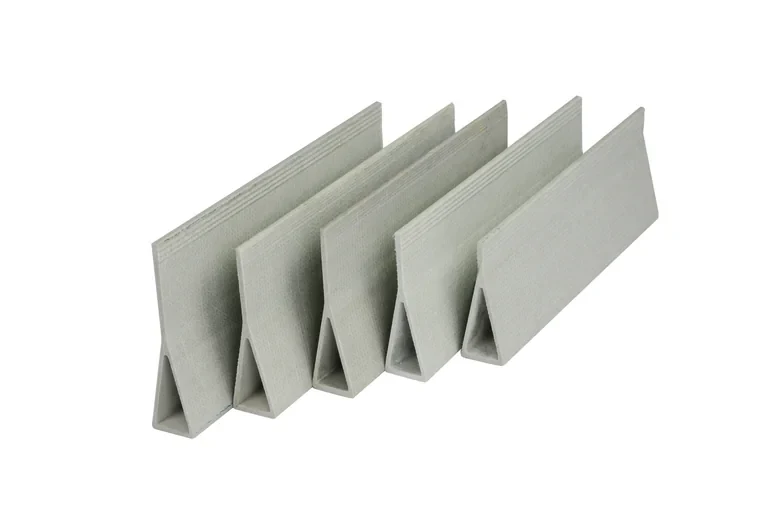
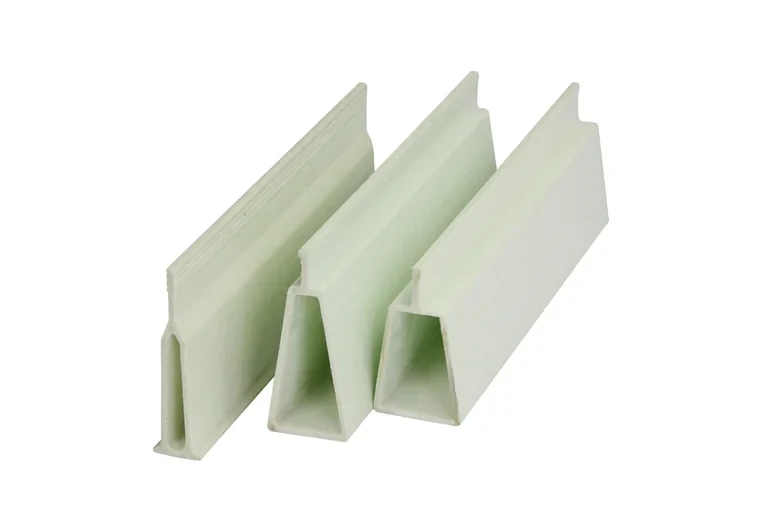
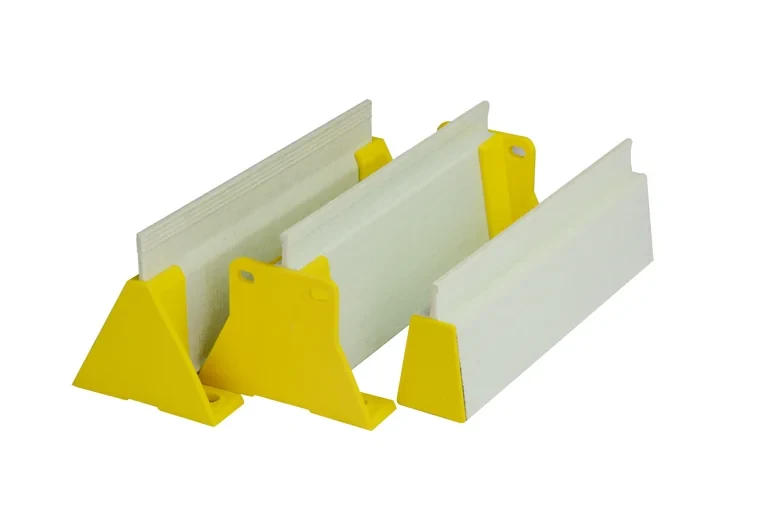
Send three numbers: the clear span, the panel weight or slat code, and the animal stage. Those decide whether you need a plain T section, a reinforced-rib T, an I profile for a wide span, or a triangular support with feet where levelling speed matters.
Cast-iron inserts change the calculation. Iron is significantly heavier than the plastic panel it replaces, and the beam under it must be confirmed, not assumed.
Whole-life comparison
Judged on purchase price alone, steel usually wins. Judged over the life of a building — including the cost of taking a room out of production to replace a support — the calculation looks different, which is why new houses are increasingly specified in FRP throughout.