
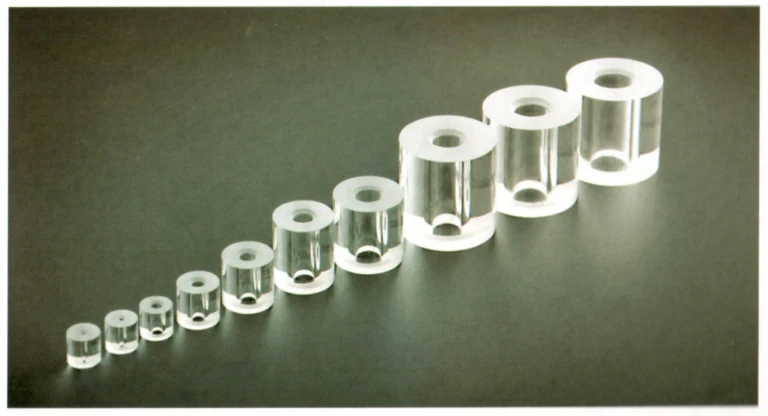
Quartz Glass Tubes
Quartz Glass Tube for Welding Copper Strand Conductor
A welding aid for butt welding copper conductor that replaces the ceramic tube completely.
View specifications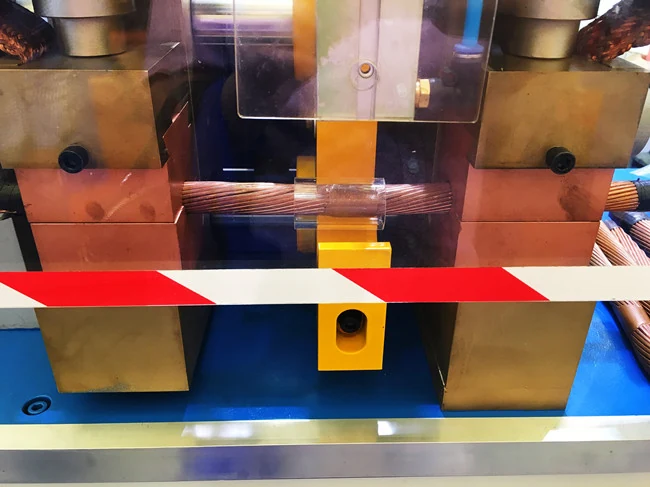
The published feature-by-feature comparison, the cost of one conductor break, and the 28 AWG validation behind the claim.
Hole diameter tolerance: ±0.01 mm for quartz against ±0.1 mm for ceramic — if the accuracy is not enough, the conductor passes through too tight or too loose, and both the weld quality and the outside diameter suffer. Bore smoothness: smooth against rough, and a rough wall causes cracks and unsound joints. Transparency: transparent against opaque, so the operator can see whether the jointing ends are fully aligned or fused and control the quality. Cone angle at the hole mouth: better on quartz, which makes threading the strand easier. Resistance to sudden temperature change: excellent against poor — ceramic is fragile when the conductor is heated instantly. Softening point: 1300 °C against 960 °C. Insulation degree: rated ten thousand times better than ceramic, which is stated as safer and more reliable.
Every cable plant wants continuous insulation extrusion, and an interruption always produces broken and short conductor. The source assessment breaks the loss into four parts: the cost of copper materials and copper processing, the cost of insulation materials and processing, the waste of working hours, and others such as electricity. Taking only the copper on a 0.5 mm² (20 AWG) conductor line, resuming production after an insulation extrusion shutdown wastes around 500 m of conductor, which at the prices quoted works out at roughly ¥140 per single break. That is copper alone, before the hours.
Welding equipment, welding current, welding pipe and conductor gap all influence the result. The published validation uses a smaller stranded conductor as the example: 28 AWG, 0.089 mm² sectional area, 7/0.127 mm construction, 200 N/mm² minimum tensile strength. Before welding the breaking force was 23.52 N, translated to 23.52 N/mm². After welding it was 19.6 N, translated to 220 N/mm². The conclusion recorded is OK.
The manufacturer records the sales range as Japan, the Philippines, Thailand, Vietnam, India, China and Taiwan, and states the product has been rated the best by many Japanese car cable companies for 3 years.
Hole diameter A runs 0.3-8.2 mm at ±0.02 mm normal or ±0.01 mm high precision. Length B and outside diameter C both run 6-20 mm at ±0.05 mm. The surface of both ends of the inside hole can be ground and inverted at a cone angle of 45° or 30°, and the product can be customised to the customer's requirement.
A welding aid for butt welding copper conductor that replaces the ceramic tube completely.
View specifications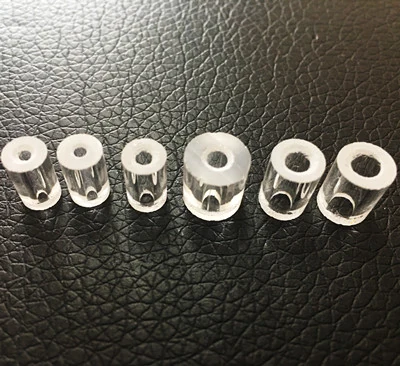
Hole diameter 0.3-8.2 mm, length and outside diameter 6-20 mm, ±0.01 mm on the high precision grade.
View specifications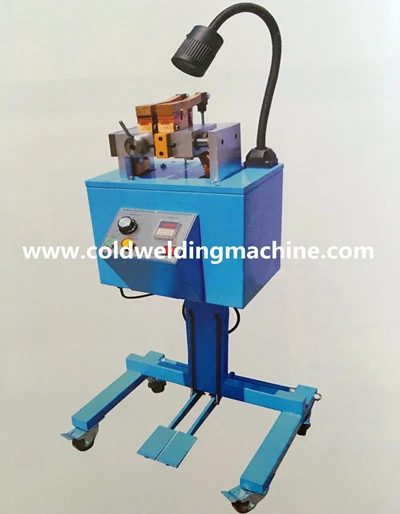
Single phase 220 V chamber welder with 12 gears and a quartz crucible, for bunched copper conductor.
View specificationsYes. Every figure quoted here appears in SGT's published product data, capacity tables or comparison charts for the equipment described.
Engineers and buyers specifying comparison article equipment for wire and cable production, wire drawing or conductor jointing.
Send the wire material, the diameter range, the section shape and your electrical supply. Those four answers are enough to name the machine and the die set.
All 38 products in the SGT catalogue are current production. The product pages carry the published dimensions, weights and capacities for each one.
Send the wire sizes and the machines you already run. The answer names the model, the die set and what to change first.