
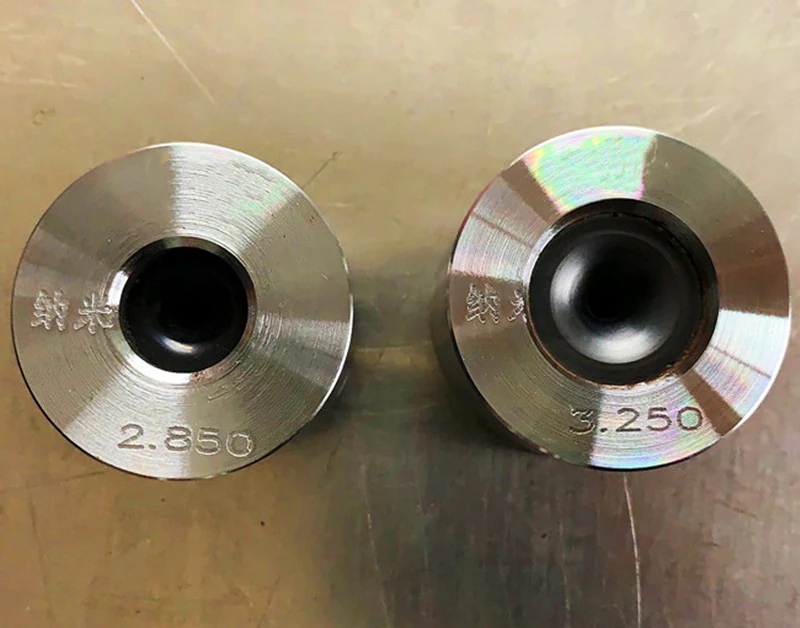
Diamond Drawing Dies
Nano Diamond Coated Drawing Dies
Zero wear across the die life, from φ0.50 mm to φ120 mm, for stranding bunching compacting and drawing.
View specifications
Three die materials, three wear profiles, and the size ranges each one actually covers.
Carbide has been used in the wire and cable industry for many years, in drawing applications where diamond dies are not economical or where the hole tolerance is not as critical. It is used extensively in the steel and non-ferrous industries, including bunching and stranding large diameter cables, and is available from 0.015 mm to 32.0 mm in a large range of nib and hole sizes. It is the practical default in a mixed die store.
Polycrystalline diamond dies can be used for any type of wet and dry wire drawing process, especially for larger sizes where demanding wear is a problem but surface finish is less critical. PCD lifespan is longer than tungsten carbide, natural diamond and single crystal diamond dies. Available φ0.03-20.00 mm for wire drawing and φ0.50-40.00 mm for cable stranding. The typical applications are saw wire, stainless steel wire, carbon steel wire, welding wire, aluminium wire, copper wire and tyre cord.
Nano dies are ideal for cable stranding, bunching and compacting, wire drawing and tube drawing, available from φ0.50 mm to φ120 mm. They extend die life at least 10 times longer than tungsten carbide wire dies, with zero wear during the entire life of the die. Smoother surface, lower friction and better price performance than PCD and tungsten carbide.
For wire and tube drawing from φ0.50 mm to φ40 mm, nano die life on aluminium wire is over 30 times tungsten carbide; on low carbon steel wire and stainless steel wire it is at least 10 times. For cable compacting and stranding from φ0.50 mm to φ120 mm, nano dies compact over 500 km of conductor while tungsten carbide dies compact only 20 km to 30 km.
Zero wear during the entire life of the die saves huge raw material costs, because a worn die produces oversize wire that is paid for by weight. Many cable manufacturers have found that replacing tungsten-carbide dies with nano dies results in significant raw material savings — which is a different calculation from price per die.
Pick the size that runs the most hours per week. Record the current die change frequency and the metres produced per die on the incumbent. Run the new die on the same wire, the same block and the same lubricant. Compare metres per die and, if the wire is sold by weight, compare the finished diameter at the start and end of each die life.
Zero wear across the die life, from φ0.50 mm to φ120 mm, for stranding bunching compacting and drawing.
View specifications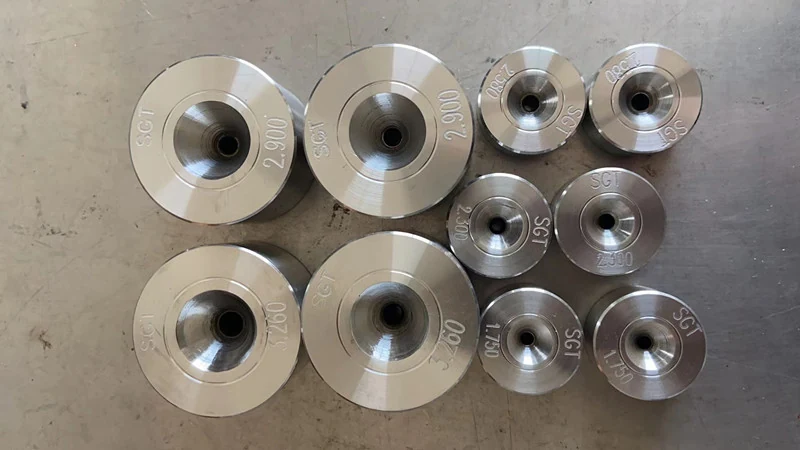
Polycrystalline diamond dies from φ0.03 mm to φ20.00 mm for drawing and to φ40.00 mm for stranding.
View specificationsYes. Every figure quoted here appears in SGT's published product data, capacity tables or comparison charts for the equipment described.
Engineers and buyers specifying buying equipment for wire and cable production, wire drawing or conductor jointing.
Send the wire material, the diameter range, the section shape and your electrical supply. Those four answers are enough to name the machine and the die set.
All 38 products in the SGT catalogue are current production. The product pages carry the published dimensions, weights and capacities for each one.
Send the wire sizes and the machines you already run. The answer names the model, the die set and what to change first.