
Cold Welding Machines
DA10 Table Cold Welder for 0.10-0.50 mm Copper
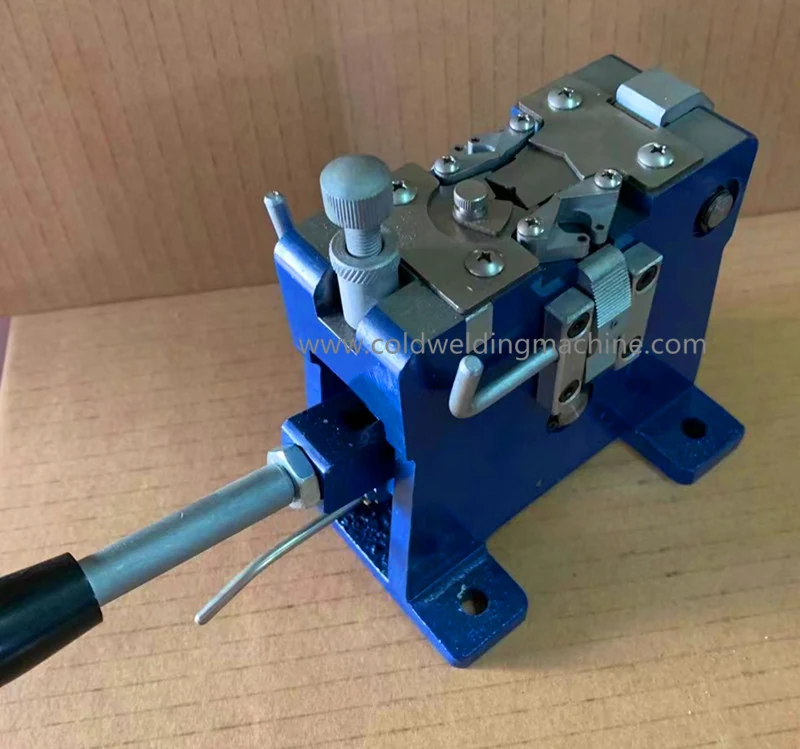
A 3.3 kg ductile cast iron table welder in a carry case, for fine wire in a narrow space.
View specifications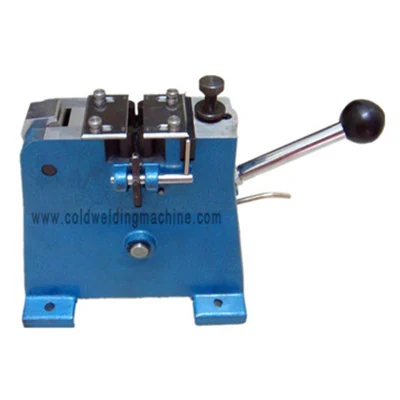
A solid-phase joint made by pressure alone: what cold welding does to the metal, which materials it takes, and where it beats a heat process.
Cold pressure welding joins non-ferrous metals and their alloys without heat, fillers or fluxes. Both wire ends are clamped in a cavity cut to the wire size and forced together. The metal upsets, the oxide layer on each face breaks up and is extruded out sideways as flash, and clean metal meets clean metal under enough pressure to bond. The result is a weld as strong as the parent material with the same electrical characteristics.
Every heat process leaves a heat-affected zone. On drawn wire that means an annealed band either side of the joint, which is the part that necks and breaks in the next pass. It also means an oxide, and on aluminium an oxide that forms faster than it can be displaced. Cold welding sidesteps both: there is nothing to anneal and the oxide is mechanically removed in the same stroke that makes the joint.
Most non-ferrous wire and strip. Copper from 0.10 mm to 25.00 mm and aluminium from 0.10 mm to 50.0 mm are the published ranges. Various aluminium alloys, 70/30 brass, zinc, silver and silver alloys, nickel, gold and many other materials can also be cold welded. Steel cannot — that is what resistance butt welding is for.
Cold welding joins different non-ferrous metals directly, which is why transformer manufacturers use it to weld copper rod terminations onto the end of an aluminium winding. Two wires of different diameter can also be joined, using special dies manufactured for the pair of sizes.
The tolerance held between the wire and the welding die is -1% to +2% of the wire. Outside that band the upset is either incomplete or the flash does not clear. This is why dies are specified by wire size rather than by machine, and why a change of wire diameter is a change of die.
Below about 1.30 mm copper a hand-held welder does the job and can be carried to the break. To 4.50 mm a desk machine gives the leverage. Above that the force has to come from a hydraulic press, which is where the CHY range starts at 1.00 mm and runs to 20.00 mm copper rod.
A 3.3 kg ductile cast iron table welder in a carry case, for fine wire in a narrow space.
View specifications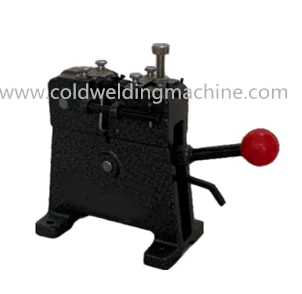
The bench-mounted DA10 build at 3.5 kg, for fine copper and aluminium wire from 0.10 mm.
View specifications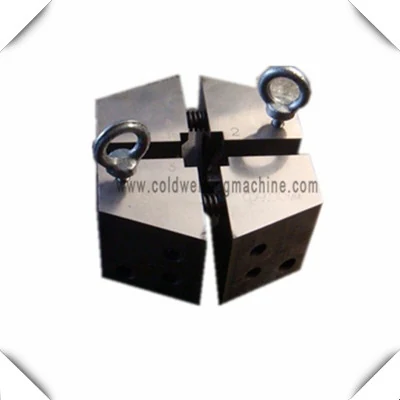
Matched die sets for CHY100 CHY200 CHY400 and CHY700, covering copper 1.00-13.00 mm and aluminium 1.00-25.00 mm.
View specificationsYes. Every figure quoted here appears in SGT's published product data, capacity tables or comparison charts for the equipment described.
Engineers and buyers specifying process equipment for wire and cable production, wire drawing or conductor jointing.
Send the wire material, the diameter range, the section shape and your electrical supply. Those four answers are enough to name the machine and the die set.
All 38 products in the SGT catalogue are current production. The product pages carry the published dimensions, weights and capacities for each one.
Send the wire sizes and the machines you already run. The answer names the model, the die set and what to change first.