
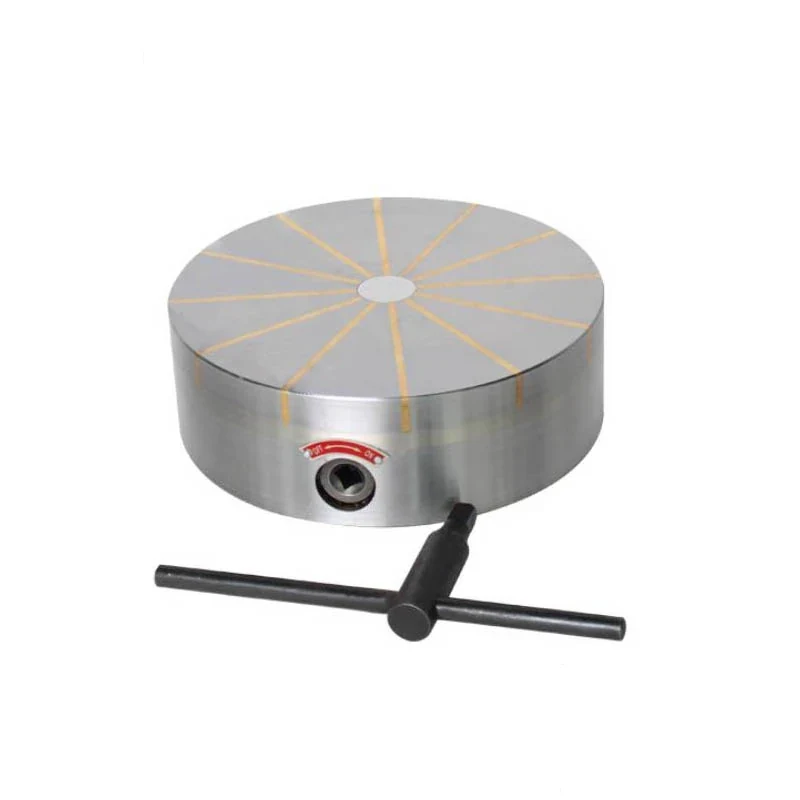
Magnetic Lathe Chuck
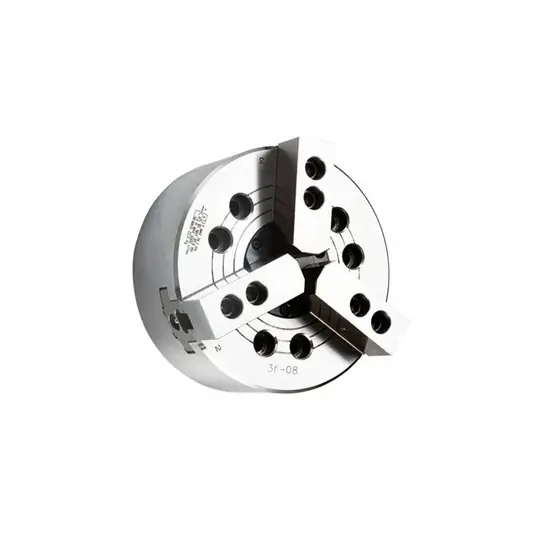
This permanent magnetic chuck holds work by magnetic suction instead of by jaw pressure, which changes what you can machine without distorting it. A jaw chuck concentrates force at three or four points, and a thin ring or a flat disc comes out of the cut out of round. Magnetic holding spreads uniform suction across the...
What This Machine Does
This permanent magnetic chuck holds work by magnetic suction instead of by jaw pressure, which changes what you can machine without distorting it. A jaw chuck concentrates force at three or four points, and a thin ring or a flat disc comes out of the cut out of round. Magnetic holding spreads uniform suction across the whole contact face, so the part stays the shape it went in as and the machined accuracy improves. Suction is up to 180 N/cm2. Because the magnet is permanent, no power supply is needed and there is no coil to heat the chuck, so nothing expands during the job and thermal drift does not enter the work. Clamping is a single lever movement, so positioning is accurate and loading is fast where jaw setting would be slow and awkward. The chuck suits light cutting work on small vertical plane grinders and on external cylindrical and internal grinders.
Why Buyers Choose This Machine
- Uniform magnetic suction holds the part without the distortion that jaw clamping causes
- Suction up to 180 N/cm2 across the whole contact face rather than at three points
- Permanent magnet needs no power supply so there is no cable to the machine and no power failure risk
- No coil heating means no thermal deformation of the chuck or the workpiece
- Whole top face is clear so the tool can reach the full part surface
- Fast accurate loading by a single lever instead of setting jaws for each part
Where Magnetic Lathe Chuck Earns Its Place
Problems It Solves
- Jaw clamping deforms thin and ring shaped workpieces
- Vibration during machining reduces accuracy and surface flatness
- Difficult clamping and inaccurate positioning slow the work down
- Electromagnetic chucks heat up and the heat affects the machining accuracy
- Jaws cover part of the workpiece so the tool cannot reach the full surface
Who It Is For
- Grinding shops working on thin flat and ring shaped parts
- Precision machine shops where part distortion causes rejects
- Toolrooms needing fast repeat loading without jaw setting
- Distributors supplying magnetic workholding to grinding shops
Application Scenarios
- Light cutting work on small vertical plane grinding machines
- External cylindrical grinding of discs and ring parts
- Internal grinding where jaw clamping would distort the bore
- Holding thin flat parts that cannot take point clamping
- Second operation work where the clamping must not mark the part
Technical Detail
Technical Features
- Permanent magnetic holding with no power supply required
- Suction up to 180 N/cm2
- Uniform suction across the contact face
- No heating and therefore no thermal deformation
- Accurate positioning with convenient single lever clamping
- Suitable for light cutting on plane cylindrical and internal grinders
Specifications
| Machine type | Permanent magnetic lathe and grinding chuck |
|---|---|
| Models | Magnetic lathe chuck |
| Holding method | Permanent magnetic suction |
| Suction | Up to 180 N/cm2 |
| Power supply | None required |
| Thermal behaviour | No heating and no heat deformation |
| Suitable machines | Small vertical plane grinder external cylindrical grinder and internal grinder |
| Duty | Light cutting work |
Figures above are taken from the product information we hold. Send us your application and we will confirm the exact specification for the model quoted.
How It Is Built and What Can Be Changed
Operations Performed
- Grinding
- Light turning
- Facing
Quality Control
- Magnetic suction checked against the 180 N/cm2 figure on the finished chuck
- Working face ground and checked for flatness
- Lever mechanism tested through magnetise and demagnetise cycles
- Holding test carried out on a sample workpiece before packing
Customisation Options
- Chuck diameter specified for the parts you hold
- Mounting arrangement prepared for your machine spindle or table
- Pole layout advised for the part sizes you work with
- Packing and marking prepared to your requirement
How It Compares With the Alternatives
| Three-jaw or four-jaw chuck | A jaw chuck grips at points and distorts thin rings and discs; magnetic holding spreads suction across the whole face so the part keeps its shape |
|---|---|
| Electromagnetic chuck | An electromagnetic chuck needs a power supply and generates heat that affects accuracy; this permanent magnetic chuck needs neither and does not heat up |
| Magnetic chuck for grinding machine XM91 | The XM91 dense pole rectangular chuck is for flat grinders and thin small parts at 100 N/cm2; this chuck is round and rated up to 180 N/cm2 for lathe and cylindrical grinding work |
Running the Machine
Step 1
Check the workpiece is a magnetic material and that the contact face is flat
Step 2
Clean the chuck face and the part so nothing is trapped between them
Step 3
Place the part centrally on the chuck and set the lever to magnetise
Step 4
Try to move the part by hand before starting the cut
Step 5
Keep cuts light because magnetic holding is intended for light cutting work
Step 6
Demagnetise with the lever to release and lift the part clear
Step 7
Keep the chuck face free of grinding debris and protect it from knocks
Related Applications and Guides
Engine Rebuilding Workshops
Engine rebuilding workshops recondition blocks heads crankshafts and valves to a geometry the engine will hold for a full service life. XAIMC supplies
General Machining Job Shops
Job shops take whatever work comes through the door, which means their equipment has to cover a wide range rather than do one thing perfectly. XAIMC s
Gear Hobbing Explained for Buyers of Gear Cutting Machines
Gear hobbing cuts gear teeth by rolling a rotating hob against a rotating blank so that the tooth form is generated rather than copied from a formed c
Radial Drilling Machine vs Bench Drilling Machine
A bench drilling machine brings the work to a fixed spindle, while a radial drilling machine moves the spindle over a heavy stationary workpiece on an
Questions About Magnetic Lathe Chuck
How strong is the holding force?
Suction is up to 180 N/cm2. Actual holding depends on the contact area, the surface finish of the part and the material, so send us your part details and we will advise.
Does it need a power supply?
No. It is a permanent magnetic chuck, so there is no cable to the machine, nothing to fail on a power cut and no coil heating.
What materials can it hold?
Only magnetic materials such as steel and cast iron. Aluminium, copper, brass and stainless grades that are not magnetic cannot be held this way.
Can I take heavy cuts on it?
No. The chuck is intended for light cutting work on small plane, cylindrical and internal grinding machines. Tell us your operation and we will confirm whether it suits.
Why does magnetic holding improve accuracy?
Suction is uniform across the contact face, so the part is not pulled out of shape as it would be by point clamping, and the chuck does not heat and distort during the job.
Will it fit my machine?
Send us your machine spindle or table mounting details and the chuck diameter you want and we will confirm the mounting arrangement.
What are your trade and payment terms?
FOB CFR and CIF. Payment is 30 percent by T/T on order and 70 percent before shipment, or an irrevocable L/C at sight.
Request a Quote on the Magnetic Lathe Chuck
Send us the work you need it to do, the voltage on your site and the port you ship to. We will come back with the model, the tooling and the lead time.