
KIA Sport Pad
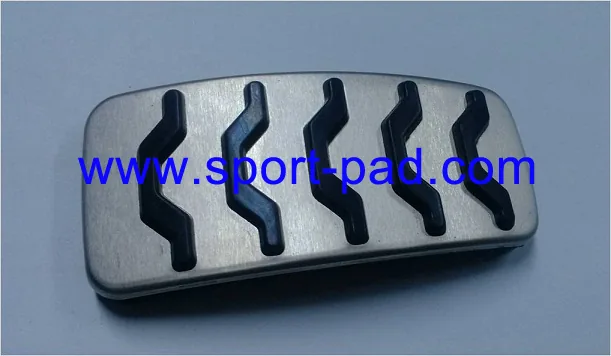
The curved bars follow the arc of the pedal face rather than running straight across it, which keeps the rubber contact even as the pedal swings through its travel.
Specification
| Part family | Overmoulded finisher plate |
|---|---|
| Construction | Metal face with moulded rubber inserts |
| Face detail | Brushed stainless face with five curved moulded rubber bars. |
| Face finish options | Brushed aluminium, sand blasted stainless steel or polished stainless steel |
| Face marking | Laser etching available on steel components |
| Insert compounds | EPDM, SBR, TPE or TPE-SEBS, to drawing |
| Tooling | Designed and built in house |
| Prototype parts | 4 weeks from prototype tool |
| PPAP | Typically 8 weeks, to ISO/TS 16949 or VDA |
| Dimensions | Built to customer drawing or to a supplied sample |
| Moulded from | Beijing rubber plant (rubber) / Shanghai plant (plastics) |
The face on this part
Brushed stainless face with five curved moulded rubber bars. It sits in the KIA Sport Pads group, and the photograph above is of the part itself rather than a rendering — what you see is the tread, the outline and the finish as they leave the tool.
How a finisher plate is built
The plate is cut from sheet — laser cut if the material is thin, CNC machined if it is thicker — then finished and married to a moulded rubber insert. On an overmoulded part the plate goes into the rubber tool and the compound is moulded onto and through it, so the two leave as one piece. On a press fit part the insert is moulded separately and pressed home.
Finishes you can specify
Brushed aluminium, sand blasted stainless steel or polished stainless steel. All three run off the same blank, so a finish change never touches the rubber tool. Brushing and blasting age evenly; polishing looks best on day one and shows every mark after that.
Putting a logo on it
Many of our customers require an aesthetic logo to be present on their parts. On steel components we laser etch it, after finishing rather than before, so the mark sits in the finished surface instead of under it.
Other parts in KIA Sport Pads
Evoque Auto Brake Pads
Land Rover Sport Pads
Evoque Man Brake Pads
Land Rover Sport Pads
Evoque Accelerate Pad
Land Rover Sport Pads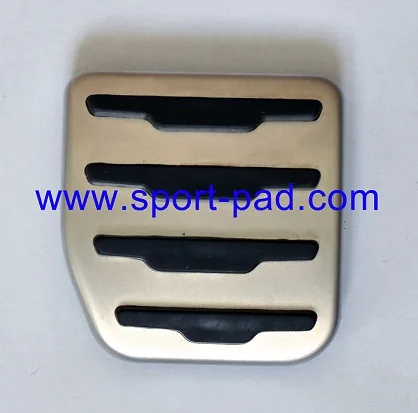
Evoque Clutch Pads
Land Rover Sport Pads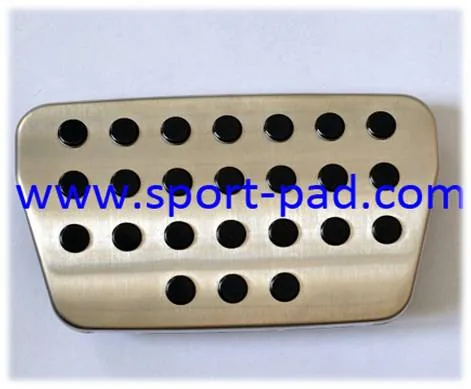
Mondeo Auto Brake Pad
Ford Sport Pads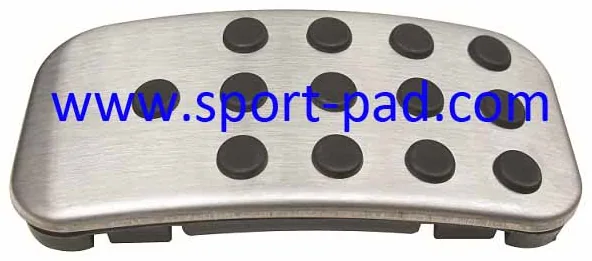
Mondeo Accelerate Pad
Ford Sport Pads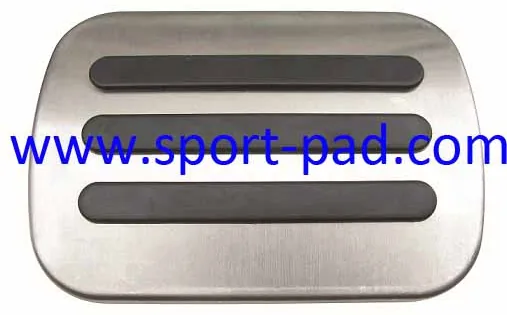
Mondeo Sport Pad 8
Ford Sport Pads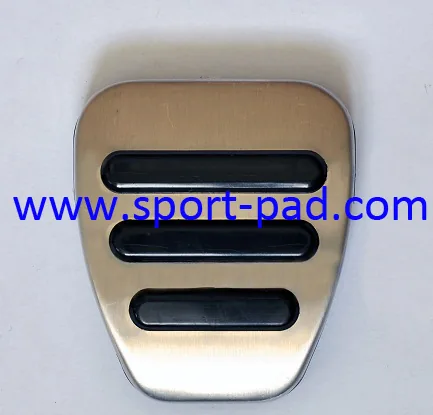
Mustang Sport Pad
Ford Sport PadsBackground reading
Sport Pad or Rubber Pad? The Difference That Decides Your Tooling Cost
A sport pad has a metal face; a rubber pad does not. That single difference drives tooling count, unit price and how the part is validated.
Overmoulding vs Press Fit: Two Ways to Get Rubber Onto a Finisher Plate
Both produce a metal-faced pedal pad. They differ in tooling, in retention and in how easily the part can be pulled apart.
Brushed, Sand Blasted or Polished: Picking a Pedal Face Finish
The three finishes buyers actually ask for, what each one hides, and why a finish change is not a tooling change.
Questions buyers ask
Is the rubber overmoulded or pressed in?
We produce both. Overmoulding gives one inseparable part and suits small or pryable inserts; press fit lowers tooling and suits large inserts that their own geometry already retains. Which one applies is set on the drawing before the tool is cut.
How long before I see a real KIA Sport Pad sample?
Four weeks from a prototype tool. The tool shop is in the same buildings as the moulding lines in Shanghai and Beijing, so prototype work does not queue behind a subcontractor.
What do you need from us to quote it?
A drawing or sample plus the annual volume. Say at that point whether PPAP is required and to which standard — ISO/TS 16949 or VDA — so it is planned in rather than added later.
How is the material verified?
In our Beijing facility, next to the production line: Shore A hardness, density, ozone, ageing, tensile strength, elongation to fracture, vulcanization and insulation resistivity, oil resistance and Mooney viscosity.
Quote the KIA Sport Pad
Send the annual volume and, if you have one, the drawing. Prototype parts follow 4 weeks after a prototype tool.