
Powder Versus Granule Dosing
Screw, volumetric cup, linear weigher and multihead. Matching the dosing head to the material is the single most important specification decision.
Why The Dosing Head Matters More Than The Machine
Two machines can share the same frame, the same PLC and the same sealing jaws and behave completely differently, because the dosing head is what actually meets your product. Get it wrong and no amount of tuning will fix the result.
Free Flowing Granules
Rice, seed, sugar, salt, plastic pellets and most grains fall cleanly and repeatably. A gravity-fed weigh hopper with staged feeding handles them well, and published accuracy on granule machines is about 0.2 percent.
Where granules cause trouble is degradation. Fragile products break on long drops and sharp transfers, so the feed path matters as much as the weigher.
Cohesive Powders
Flour, starch, milk powder, carbon black, pigments and fine additives bridge in the hopper, aerate on the way down and refuse to settle. Gravity feeding is unreliable with them.
The answer is a screw metering machine or screw scale: a servo-driven auger that meters by rotation rather than by fall. Published accuracy on the powder machines is about 0.5 percent, and it is achieved consistently because the auger controls the flow rate rather than relying on it.
Volumetric Measuring Cups
A measuring cup doses by volume, not by weight. It is fast, mechanically simple and cheap, and its published accuracy on the right material is about 0.1 percent.
The condition is in our own published scope of application: materials with the same proportion and uniform particle size, such as salt, grains, rice, medicine and food. If bulk density moves between batches, a cup will not hold weight.
Multihead And Combination Weighers
For irregular products such as snacks, nuts and frozen pieces, a combination weigher takes many small weighments and selects the combination closest to target. It is the accurate answer for products that cannot be dosed continuously, and it is what sits on top of a high-speed snack bagger.
Liquids And Pastes
Liquid and paste applications use a mixing tank, a rotor pump and a filling machine ahead of the bagger, with published accuracy of about 0.1 percent. Viscosity and temperature stability matter more than anything else here, so specify the product temperature at the filling point.
A Selection Table You Can Use
- Free flowing granule, stable density: gravity weigher with staged feeding.
- Free flowing granule, uniform particle size, cost sensitive: volumetric measuring cup.
- Cohesive or aerating powder: servo-driven screw metering.
- Irregular pieces or fragile snacks: combination or multihead weigher.
- Liquid, sauce or paste: mixing tank, rotor pump and filling machine.
- 500 kg to 2000 kg bulk: three-stage gate valve feeding on a ton bag frame.
Machines Referenced In This Guide
HN series powder semi-automatic packing scale
The semi-automatic spiral packing scale adopts the process of manual bagging, automatic measurement, induction automatic blan...
View machineHN P320 series powder full-automatic bag-making and packing machine
The unit is composed of automatic feeder (screw elevator), automatic metering machine (screw metering machine, screw scale),...
View machineHN series semi-automatic packing scales for granules
It is suitable for quantitative packaging of granular materials such as seed processing, milled rice processing, medicine, fe...
View machine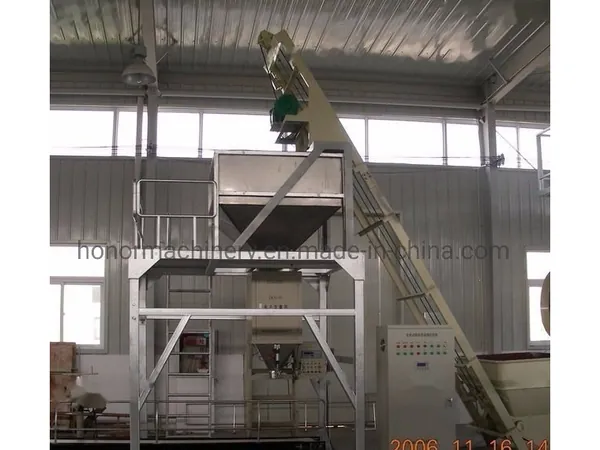
HN-50QB Packing Machine
HN-50QB corn rice bean nut pellet sugar salt two hopper bagging machine(5-50kg) Weighing packing machine with vertical sewing...
View machineRelated Guides
How To Choose A Packing Machine
The eight questions that decide the machine before price ever comes into it.
Material GuideBag Types For Packing Machines
Pillow, four-side seal, stand-up, zipper, M-bag, spouted and woven: what each one costs you.
Process GuidePacking Accuracy Explained
Why a machine rated at 0.2% can still give you 1% giveaway, and what to do about it.
Powder Versus Granule Dosing FAQ
Questions buyers ask before they order. If yours is not here, message us and an engineer will answer.
Can one machine take two different dosing heads?
How do I stop powder dusting at the fill point?
What if my bulk density varies a lot?
Apply This To Your Own Line
Send the product, the pack weight and the output and we will tell you exactly how this guidance applies to your case.
Send a drawing, a bag sample photo or a video of your current line on WhatsApp or by email — that is usually enough for us to quote.