
Packing Accuracy Explained
Why a machine rated at 0.2 percent can still cost you one percent in giveaway, and what to do about it.
What A Published Accuracy Figure Means
Every accuracy figure we publish is qualified: plus or minus 0.2 percent according to material properties, particle size and other parameters. That qualification is not a get-out. It is the whole story.
A weighing system is accurate to the extent that the material behaves predictably as it falls. The scale is rarely the limiting factor. The material is.
Where The Error Actually Comes From
In-flight material is the biggest single source. When the feeder cuts, some product is already in the air and it lands after the cut-off. The controller predicts that in-flight quantity and stops early to allow for it, and if the flow rate varies the prediction is wrong.
Bulk density variation is the second source. A powder that has absorbed moisture overnight occupies a different volume per kilogram, so a volumetric cup that was right yesterday under-fills today.
Vibration is the third. A palletiser slamming next to a weigh hopper puts noise into the load cell signal, and the controller reads that noise as weight.
Why Giveaway Is Bigger Than The Rated Accuracy
Rated accuracy describes the spread around the mean. Giveaway is what you add on top of the mean so that no pack ever goes under.
If your process spread is 0.5 percent and you set the target 0.5 percent high to be safe, your real giveaway is 0.5 percent regardless of what the machine is rated at. Tightening the spread lets you lower the target, and that is where the money is.
Staged Feeding Is The Main Control
Coarse, medium and fine feeding exists precisely to shrink the in-flight error. The bulk of the charge goes in fast, then the rate drops so that the last few percent lands slowly and predictably.
On our ton bag machine the feeding mechanism uses two gate valves, large and small, to control coarse, slow and fine three-stage feeding. That is why a 1000 kg bag can hold 0.1 percent static accuracy at all.
Dual Hopper Weighing For Speed With Accuracy
A single weigh hopper has to finish weighing before the next bag can start. A double metering bucket structure alternates so one hopper weighs while the other discharges, which is how the semi-automatic scales reach 8 to 18 bags a minute without giving up the X(0.2) accuracy class.
Practical Steps To Reduce Giveaway
- Keep the hopper level constant. A varying head above the feeder changes the flow rate and therefore the in-flight quantity.
- Isolate the weigh frame from line vibration. Do not bolt a weigher to the same steelwork as a palletiser.
- Check calibration against a certified reference weight on a schedule, not when someone complains.
- Store a recipe per product and per bag size. Re-tuning by hand at every changeover reintroduces the spread you spent money removing.
- Put a checkweigher on the outfeed and log the mean, not just the rejects. The mean tells you whether the target is set too high.
Machines Referenced In This Guide
HN series semi-automatic packing scales for granules
It is suitable for quantitative packaging of granular materials such as seed processing, milled rice processing, medicine, fe...
View machineHNWT2000 series ton bag packing machine
It is a metering control system composed of high-precision sensors and high-precision resolution control instruments, with hi...
View machineHN series 10kg-50kg automatic feeding bag packing machine and production line
The unit is composed of automatic feeding elevator, electronic weighing machine, automatic bag feeding and packaging machine,...
View machine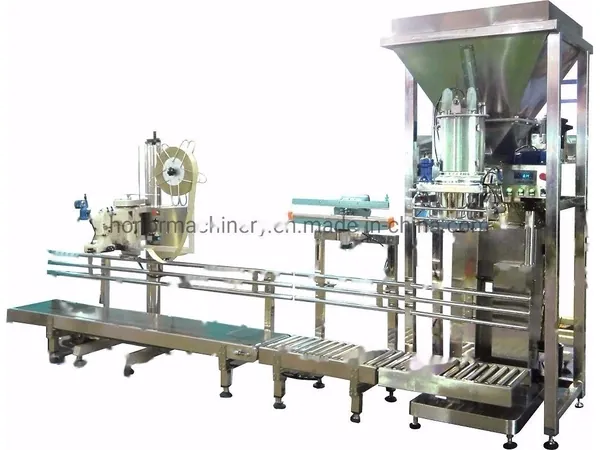
HN-50WLA Packing Machine
HN-50WLA semi-automatic powder packing machine (10-50kg) Carbon Black powder weighing Filling packaging Packing Machine
View machineRelated Guides
How To Choose A Packing Machine
The eight questions that decide the machine before price ever comes into it.
Material GuideBag Types For Packing Machines
Pillow, four-side seal, stand-up, zipper, M-bag, spouted and woven: what each one costs you.
ComparisonForm Fill Seal Versus Premade Bag Machines
Bag cost versus shelf appeal, and the volume at which the answer flips.
Packing Accuracy Explained FAQ
Questions buyers ask before they order. If yours is not here, message us and an engineer will answer.
What accuracy is realistic on powder?
Can you confirm accuracy before I order?
What is X(0.2) accuracy class?
Apply This To Your Own Line
Send the product, the pack weight and the output and we will tell you exactly how this guidance applies to your case.
Send a drawing, a bag sample photo or a video of your current line on WhatsApp or by email — that is usually enough for us to quote.