
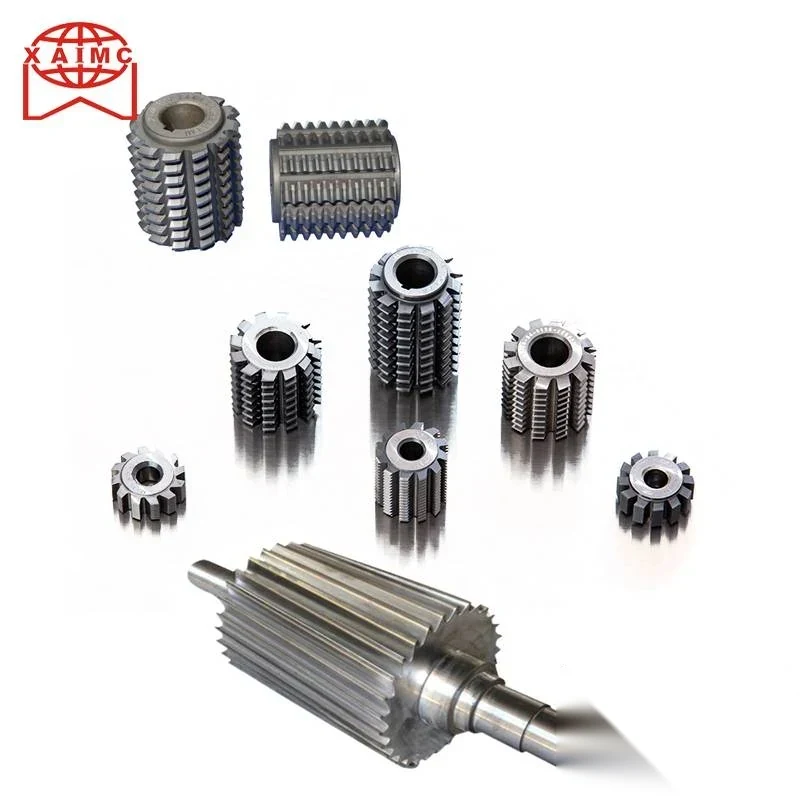
Pre-Grind HSS Module Hobbing Cutter Gear Hob
A gear hob cuts teeth by the generating method, the cutter and the blank rolling together so the tooth form is produced by a series of cuts rather than by a form tool. This pre-grind HSS module hob is made for gear production in cylindrical gears, worm gears and other cylindrical toothed workpieces. Pre-grind means the...
What This Machine Does
A gear hob cuts teeth by the generating method, the cutter and the blank rolling together so the tooth form is produced by a series of cuts rather than by a form tool. This pre-grind HSS module hob is made for gear production in cylindrical gears, worm gears and other cylindrical toothed workpieces. Pre-grind means the hob is made to cut teeth that will be ground afterwards, leaving the correct stock for the finishing operation instead of the tooth form the gear finishes with. The blade material is chosen to suit the workpiece material and the cutting conditions rather than being one grade for everything. Heat treatment is controlled to reach a suitable hardness with low internal stress in the blade, so the hob does not distort in use. Tolerance is held at plus or minus 0.005mm. Hobs are made as gear hobs, worm gear hobs, non-involute forming hobs and fixed hobs, and are produced to customer requirement.
Why Buyers Choose This Machine
- Generating action cuts the tooth form by rolling so one hob covers a whole tooth count range for its module
- Pre-grind design leaves the correct stock for gear grinding instead of finishing the tooth itself
- Blade material chosen for the workpiece material rather than one grade for every job
- Controlled heat treatment gives suitable hardness with low internal stress so the hob does not distort
- Tolerance held at plus or minus 0.005mm
- Made as gear hobs worm gear hobs non-involute forming hobs and fixed hobs
- Customised production to your module pressure angle and gear data
Where Pre-Grind HSS Module Hobbing Cutter Gear Hob Earns Its Place
Problems It Solves
- Form cutters need a different tool for every tooth count within a module
- A finishing hob used ahead of grinding leaves either too little or too much stock
- Hobs that distort after heat treatment cut a tooth form that is out of tolerance
- One blade grade for every workpiece material gives short tool life on harder gears
- Worm gear and non-involute forms cannot be produced with a standard involute hob
Who It Is For
- Gear manufacturers running hobbing machines
- Transmission and gearbox producers grinding finished gears
- Subcontract gear cutting shops
- Distributors supplying gear cutting tools
Application Scenarios
- Hobbing cylindrical spur and helical gears before grinding
- Cutting worm gears with a worm gear hob
- Producing splined and cylindrical toothed workpieces
- Non-involute tooth forms using a forming hob
- Gear production lines where hobbing is followed by a grinding operation
Technical Detail
Technical Features
- HSS module pre-grind hobbing cutter
- Cuts by the generative method for cylindrical toothed workpieces
- Blade material selected to suit the workpiece material and cutting conditions
- Controlled heat treatment for suitable hardness and low internal stress
- Sharpness high hardness and good toughness in the cutting edges
- Tolerance plus or minus 0.005mm
- Available as gear hobs worm gear hobs non-involute forming hobs and fixed hobs
Specifications
| Machine type | HSS module pre-grind gear hobbing cutter |
|---|---|
| Models | Pre-grind hobbing cutter gear hob made to customer gear data |
| Types | Gear hobs worm gear hobs non-involute forming hobs and fixed hobs |
| Cutting method | Generative method |
| Tolerance | Plus or minus 0.005mm |
| Blade material | Selected by workpiece material and cutting requirement |
| Heat treatment | Controlled for suitable hardness with low internal stress |
| Workpieces | Cylindrical gears worm gears and other cylindrical toothed parts |
| Related processes | Gear hobbing milling shaping broaching shaving grinding and lapping |
Figures above are taken from the product information we hold. Send us your application and we will confirm the exact specification for the model quoted.
How It Is Built and What Can Be Changed
Operations Performed
- Gear hobbing
- Gear milling
- Gear shaping
- Gear broaching
- Gear shaving
- Gear grinding
- Gear lapping
Quality Control
- Tooth form checked against the customer gear data before despatch
- Tolerance verified against the plus or minus 0.005mm figure
- Hardness checked after heat treatment
- Hob checked for distortion and run-out on the bore and faces
Customisation Options
- Module pressure angle and hob dimensions made to your gear data
- Blade material selected for the gear material you cut
- Hob type specified as gear worm gear forming or fixed hob
- Pre-grind stock allowance set for your grinding operation
- Marking and packing prepared to your requirement
How It Compares With the Alternatives
| Form milling cutter for gears | A form cutter is made for one tooth count and cuts one gap at a time; a hob generates the form and cuts continuously across the tooth count range for its module |
|---|---|
| Finishing gear hob | A finishing hob produces the final tooth form; this pre-grind hob leaves defined stock for a following gear grinding operation |
| Gear shaping | Shaping is the method for internal gears and gears with a shoulder close to the teeth; hobbing is faster on open external cylindrical gears |
Running the Machine
Step 1
Send us your gear drawing with module pressure angle tooth count and material
Step 2
Confirm the grinding stock allowance you need on the tooth flanks
Step 3
Mount the hob on the arbor and check run-out on the bore and the end faces
Step 4
Set the hob shift position and the machine cutting data for the gear material
Step 5
Cut a first gear and check tooth thickness and profile before running the batch
Step 6
Shift the hob along its length at intervals to spread wear across the teeth
Step 7
Send the hob for resharpening before the edges break down rather than after
Related Applications and Guides
Engine Rebuilding Workshops
Engine rebuilding workshops recondition blocks heads crankshafts and valves to a geometry the engine will hold for a full service life. XAIMC supplies
General Machining Job Shops
Job shops take whatever work comes through the door, which means their equipment has to cover a wide range rather than do one thing perfectly. XAIMC s
Gear Hobbing Explained for Buyers of Gear Cutting Machines
Gear hobbing cuts gear teeth by rolling a rotating hob against a rotating blank so that the tooth form is generated rather than copied from a formed c
Radial Drilling Machine vs Bench Drilling Machine
A bench drilling machine brings the work to a fixed spindle, while a radial drilling machine moves the spindle over a heavy stationary workpiece on an
Questions About Pre-Grind HSS Module Hobbing Cutter Gear Hob
What does pre-grind mean on a hob?
The hob is designed to leave stock on the tooth flanks for a following gear grinding operation, rather than producing the final finished tooth form itself.
What information do you need to quote a hob?
Module, pressure angle, tooth count and helix of the gear, the gear material, your hobbing machine and the grinding allowance you want. With that we can quote the correct hob.
What tolerance do you hold?
Tolerance is plus or minus 0.005mm.
What blade material will be used?
The blade material is chosen against the workpiece material and cutting conditions rather than fixed for every order. Tell us the gear material and we will specify it.
Can you make worm gear or non-involute hobs?
Yes. The range covers gear hobs, worm gear hobs, non-involute forming hobs and fixed hobs. Send us the form you need.
How are hobs packed for export?
Hobs are protected and packed for sea or air freight from Xi'an. Tell us your quantity and port and we will quote FOB CFR or CIF.
What are your payment terms?
30 percent by T/T on order and 70 percent before shipment, or an irrevocable L/C at sight.
Request a Quote on the Pre-Grind HSS Module Hobbing Cutter Gear Hob
Send us the work you need it to do, the voltage on your site and the port you ship to. We will come back with the model, the tooling and the lead time.