
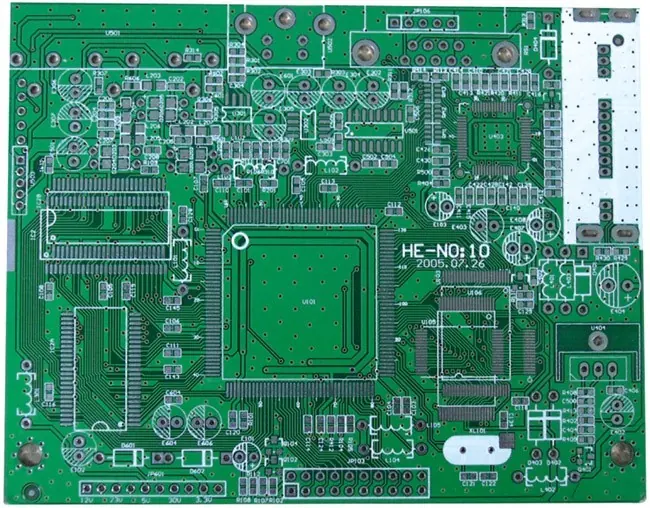
Double Sided FR4 Board With Lead Free HASL
A double sided FR4 board finished with lead-free hot air solder levelling. Two copper layers carry both through-hole parts and surface-mount devices on the same panel, which is why this build is still the default for power supplies, controllers and instrument boards that do not need buried routing.
What This Board Is
This is the board most buyers start with. Signal density stays low enough that everything routes on two layers, and the lead-free HASL finish keeps the unit cost down while staying RoHS compliant. The panel photographed here mixes edge connectors, a large QFP footprint and dozens of discrete passives, which is a realistic picture of what a two layer board is asked to do in industrial equipment.
Double sided boards run the full plated-through-hole line, then lead-free HASL rather than gold.
- Rigid PCB
- 2 layer
- Lead-free HASL
- RoHS
What You Get From This Build
- Lowest tooling and unit cost of any plated-through build, so prototype budgets go further
- Lead-free HASL gives a thick, robust solderable surface with a long shelf life before assembly
- Handles mixed through-hole and SMD assembly without a separate process route
- Two layers keep impedance behaviour simple and predictable for low speed logic and power stages
Who Specifies This Board
- Power supply and charger manufacturers moving off hand-wired prototypes
- Instrument and metering makers who need a board that tolerates field rework
- Industrial control OEMs building relay, sensor and interface cards
- Product developers who need boards cheap enough to iterate three times before freezing a design
Four Failures This Build Is Designed Against
Each one is a real way this class of board goes wrong, and the tolerance or process decision that prevents it.
Four layer quotes for a simple design
Many designs are quoted as four layer because the routing was never optimised. We review the Gerber set and tell you when two layers will carry the same circuit at a lower price.
Pads that will not wet after storage
Lead-free HASL puts a thick solder coat on every pad, so boards that sit in stores for months still wet properly when they reach the reflow oven.
Lifted pads during field repair
Plated hole wall thickness is held at 0.025 mm, which keeps barrels intact through the repeated heat cycles that service work puts into a board.
Boards that will not drop into the enclosure
Outline dimension tolerance is held to ±0.10 mm and hole position to ±0.05 mm, so mounting holes and connector cut-outs line up with the housing first time.
Technical Specification
Product detail from the catalogue record, followed by the published process capability for the Rigid PCB family. Anything the legacy catalogue did not record is marked TBC rather than filled in.
| Item | Technical specification |
|---|---|
| Product name | 2 Layer Rigid PCB |
| Legacy catalogue reference | 2 Layer |
| Product family | Rigid PCB |
| Layer count | 2 layer |
| Surface finish | Lead-free HASL |
| RoHS | RoHS compliant process, as recorded on the legacy catalogue |
| Layer count | 1 to 16 layers |
| Maximum panel dimension | 450 x 660 mm (18 x 26 in) |
| Minimum board thickness | 4 layers 0.40 mm (16 mil) / 6 layers 1.00 mm (40 mil) / 8 layers 1.20 mm (48 mil) |
| Minimum trace width | 0.075 mm (3 mil) |
| Minimum trace space | 0.075 mm (3 mil) |
| Minimum finished hole | 0.20 mm (8 mil) |
| Plated hole wall thickness | 0.025 mm (1 mil) |
| Plated hole diameter tolerance | ±0.075 mm (3 mil) |
| Non-plated hole diameter tolerance | ±0.05 mm (2 mil) |
| Hole position tolerance | ±0.05 mm (2 mil) |
| Outline dimension tolerance | ±0.10 mm (4 mil) |
| Minimum solder bridge | 0.10 mm (4 mil) |
| Warpage | ≤0.75% |
| Isolation resistance | >1012 Ω at normal condition |
| Hole resistance | <300 Ω at normal condition |
| Flammability rating | 94V-0 self-extinguishing |
| Open / short test voltage | 50 to 300 V |
What The Board Is Made Of
| Material | Specification |
|---|---|
| Base laminate | FR4 glass reinforced epoxy, 94V-0 self-extinguishing |
| Copper | Weight confirmed against the current your rails carry |
| Solder mask | LPI solder mask, green as standard, other colours on request |
| Legend | Silk screen legend ink, white as standard |
| Surface finish | Lead-free HASL, immersion nickel gold or electroplated nickel gold |
What Can Be Changed
- Layer count from 1 to 16
- Solder mask colour including blue and other colours
- Legend colour
- Lead-free HASL, immersion gold or electroplated gold
- Copper weight to suit the current your rails carry
- Delivery as singles, V-cut arrays or routed tab arrays
How This Board Is Made
Eight stages on equipment sourced from the USA, Japan, Germany and Israel. Every stage listed runs inside our own plant.
Film and tooling
Artwork plotted on a Mania 8850-P film plotter and the panel laid out for the order quantity.
Inner layers
Imaged, etched and checked before lamination, because a defect buried in the stack cannot be repaired.
Lamination
Cores and prepreg pressed on the MLB laminator to build the stack-up.
Drilling
Mania, Hitachi and domestic CNC drillers, thirteen machines in total, to a 0.20 mm minimum hole.
Plating
Desmear, automatic PTH line and graphic plating to a 0.025 mm barrel wall.
Mask and legend
Automatic screen printing and roller coating, then exposure and developing.
Surface finish
Lead-free HASL, immersion gold or electroplated gold according to the order.
Profile and test
CNC routing or V-cut to ±0.10 mm, then open and short testing at 50 to 300 V.
What Is Checked Before It Ships
- Inner layer inspection before lamination, because buried defects cannot be repaired
- Open and short testing at 50 to 300 V on every board
- Hole resistance verified below 300 Ω at normal condition
- Isolation resistance verified above 1012 Ω at normal condition
- Warpage held at ≤0.75% across the panel
What The Plant Holds
- ISO 9001:2000. Quality management system certification recorded by the company. Current revision year available on request.
- ISO 14001:1996. Environmental management system certification recorded by the company.
- UL. Certification recorded by the company. File number available on request.
- RoHS and lead free. Listed in the company environmental policy alongside pollution prevention and resource reduction.
Certificate numbers, issue dates and current revision years are not published on the legacy site. Ask for copies with your enquiry and they will be sent with the quotation.
How It Compares With The Alternatives
Three boards from our own catalogue, side by side, so the trade-off is visible rather than argued.
| Board | Layers or build | Finish | Best suited to |
|---|---|---|---|
| 2 Layer Rigid PCB | 2 | Lead-free HASL | Lowest cost, mixed THT and SMD assembly |
| 4 Layer Rigid PCB | 4 | Immersion gold | Dense SMD routing with a solid ground plane |
| 1 Layer Aluminium PCB | 1 | OSP | Heat conduction away from power devices |
What To Send With Your Enquiry
Four things that decide whether the quote comes back right the first time.
- Send Gerber RS-274X plus an NC drill file, or an ODB++ package if your CAD tool exports one.
- State the finished copper weight you need. If you do not state it we quote 1 oz outer copper.
- Mark the board outline on a separate mechanical layer and flag any non-plated holes.
- Tell us whether the board ships as singles or in an array, and give the rail width you want for the array.
2 Layer Rigid PCB Questions
Is lead free HASL flat enough for fine pitch parts?
For pitches down to about 0.5 mm it is. Below that the solder crown starts to cause placement problems and we recommend immersion gold, which is the finish we use on the 4, 10 and 12 layer boards.
What is the thinnest two layer board you can build?
The published minimum board thickness in our rigid capacity table starts at 0.40 mm for four layer construction. For two layer boards tell us the thickness you need and we will confirm against the laminate stock we hold.
Can you build this board in an array with V-cut?
Yes. We run a CNC V-cut machine in house, and flexible circuits use the same precise V-cut process. Send the array drawing or let us panelise it for you.
Do you test every board?
Open and short testing is carried out at 50 to 300 V as listed in our rigid capacity table.
Other Boards In The Rigid PCB Family
Boards built on the same line, with the same tolerances, in a different configuration.
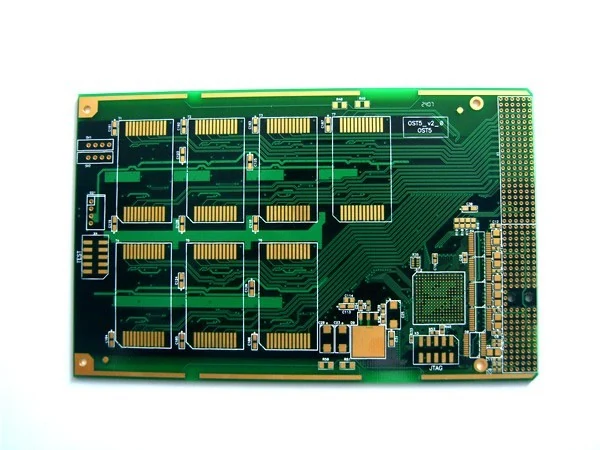
Four Layer Immersion Gold Board For Dense SMD Routing
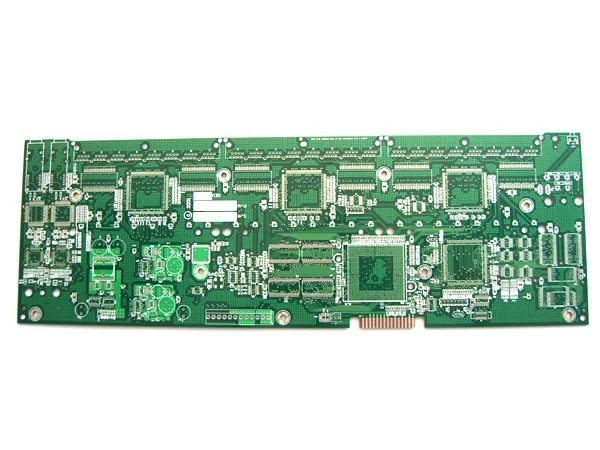
Six Layer Board With Lead Free HASL For Larger Controllers
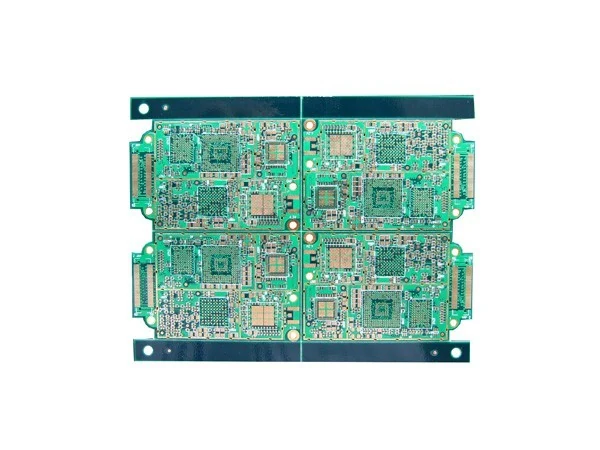
Eight Layer Board With Electroplated Gold For Contact Surfaces
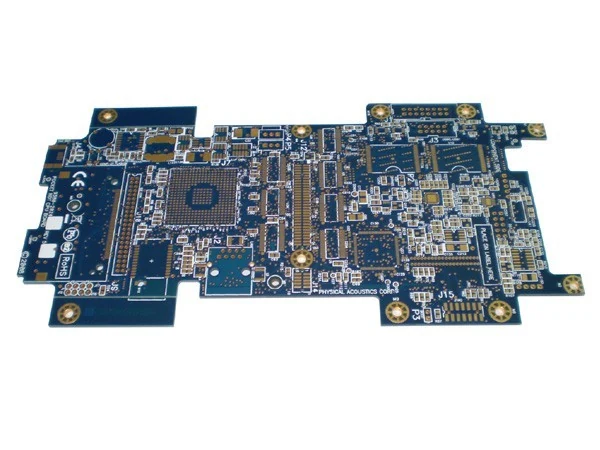
Ten Layer Immersion Gold Board For High Density Digital Designs
Where This Board Is Used
The fields the legacy catalogue records for this class of board.
This Board In Context
Background Reading
Layer count is the single decision that most affects the price and the electrical behaviour of a board. This guide sets ...
Three surface finishes cover almost every board we build. Choosing between them is not a quality decision, it is a fitne...
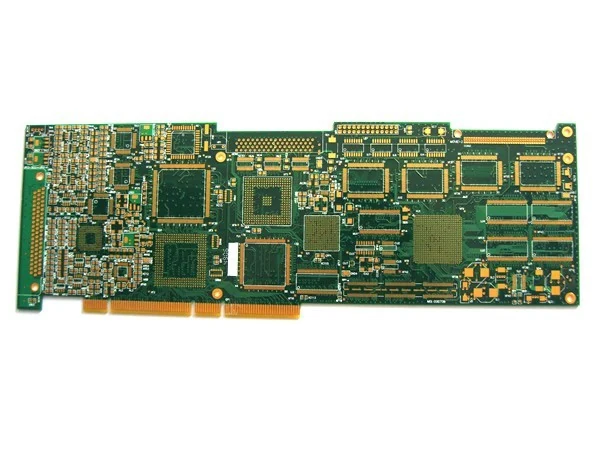
A capability table is a list of numbers until you know which failure each one prevents. This walks through the rigid PCB...
Get 2 Layer Rigid PCB Priced Against Your Own Files
Send Gerber RS-274X with an NC drill file, or an ODB++ package, with the layer count, thickness, copper weight, surface finish and quantity. We check it against the published capability before quoting.