
Aluminium Boards That Move Heat Out Of The Circuit
Single and double sided aluminium-based boards up to 450 x 450 mm, 0.3 to 3.0 mm thick, with a measured laminate thermal resistance of 1 °C/W and a maximum working temperature of 125 °C. Used where FR4 traps heat that has to go somewhere.
Every Aluminium PCB Board In The Catalogue
Each board below is a catalogue item with its own photograph, layer count and recorded surface finish.
What This Family Is For
FR4 is a thermal insulator. On a board with LEDs or switching power devices, that insulation is the problem: junction temperature rises, the device derates, and lumen maintenance or efficiency falls away. An aluminium core turns the board itself into the heat path, conducting sideways into whatever it is bolted to. The laminate we use is characterised against GJB1651 and GB/T4722, and the test values are published rather than described.
Who Buys Aluminium PCB From Us
- Lighting and luminaire manufacturers building LED bars and downlights
- Motor drive and BLDC controller makers
- Power supply builders with switching devices in a sealed volume
- Automotive electronics suppliers working to a fixed thermal budget
Typical Applications
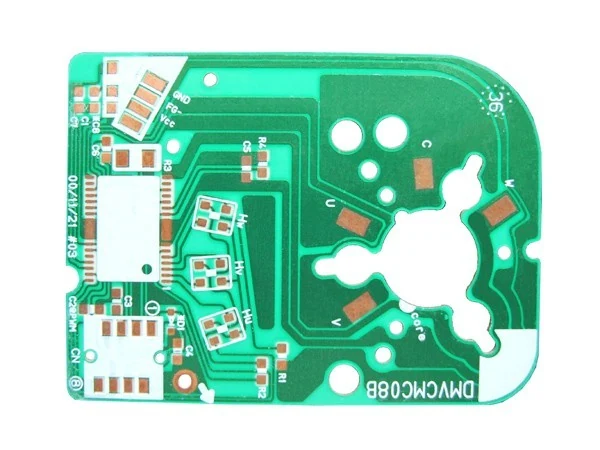
- Linear LED bars clamped into an aluminium extrusion
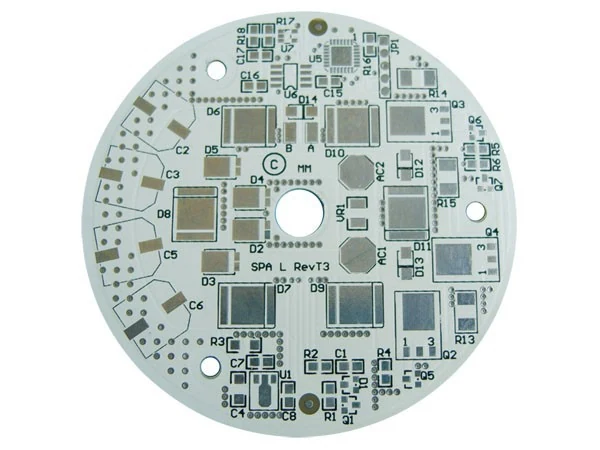
- Round driver boards inside downlight housings
- Profiled motor control boards inside a sealed motor housing
- Power converter output stages with devices above a few watts
Four Reasons This Family Is Built Here
Each point below is backed by a figure from the published capability tables rather than by a claim.
- 1 °C/W measured thermal resistance. Tested against an index value of 1.5 °C/W on a TO-220 package, so the number comes from a test rather than a datasheet.
- 125 °C maximum working temperature. Published for the laminate, which sets the real ceiling for a device mounted on it.
- Flat enough to bolt down. Bow and twist below 0.01 mm per mm, which matters on a board whose job is to make contact with a heatsink face.
- Characterised dielectric. Dielectric strength above 1.3 kV/mm, dielectric constant 3.5 tested at 1 MHz, breakdown voltage 6 kV DC tested.
Aluminium PCB Technical Standard
These are the figures the plant builds to. Check your design against them before ordering rather than after the first article.
| Item | Technical specification |
|---|---|
| Maximum board size | 450 x 450 mm, single and double sided |
| Board thickness | 0.3 to 3.0 mm |
| Minimum track width | 0.15 mm |
| Minimum track space | 0.15 mm |
| Minimum hole size | 0.5 mm |
| Plated hole wall thickness | >0.02 mm |
| Plated hole diameter tolerance | ±0.05 mm for φ≤0.8 mm / ±0.08 mm for φ>0.8 mm |
| Non-plated hole diameter tolerance | ±0.05 mm for φ≤0.4 mm / ±0.1 mm for φ>0.4 mm |
| Hole position tolerance | ±0.05 mm |
| Outline tolerance | ±0.2 mm |
| Insulation resistance | 1012 Ω at normal condition |
| Dielectric strength | >1.3 kV/mm |
| Peel-off strength | 1.4 N/mm |
| Solder mask abrasion | >5H |
| Thermal stress | 265 °C for 5 seconds |
| Flammability rating | 94V-0 |
| Maximum working temperature | 125 °C |
| Bow and twist | <0.01 mm/mm |
Aluminium Based Copper Clad Laminate Characteristics
Index values and measured test values for the laminate, with the test standard each figure comes from.
| Test item | Index value | Test value | Test method |
|---|---|---|---|
| Peel strength | 1.8 N/mm | 2.2 N/mm | GJB1651 clause 4010 |
| Breakdown voltage | 4 kV DC | 6 kV DC | GJB1651 clause 5040 |
| Dielectric loss tangent at 1 MHz | ≤0.03 | 0.02 | 40 °C, 93% RH, 96 h |
| Dielectric constant at 1 MHz | ≤4.4 | 3.5 | 40 °C, 93% RH, 96 h |
| Thermal shock, 2 min at 260 °C and 288 °C | No bubble, no delamination | No bubble, no delamination | GB/T4722 clause 17 |
| Flammability | FV-0 | FV-0 | GB/T4722 clause 26 |
| Thermal resistance | 1.5 °C/W | 1 °C/W | TO-220 |
Aluminium PCB Boards In Use
Boards from this family and the problem each one had to solve. Customer names and volumes are confidential.
Where Aluminium PCB Boards End Up
The industries the legacy catalogue records for this board family.
Guides Related To Aluminium PCB
Written for buyers and designers working with this board family.
Aluminium PCB Questions
How thick is an aluminium board?
0.3 to 3.0 mm total board thickness, single or double sided.
What is the thermal resistance of the laminate?
1 degree Celsius per watt measured, against an index value of 1.5, tested on a TO-220 package.
Can you plate through holes in an aluminium board?
Yes, for double sided construction. Plated hole wall thickness is above 0.02 mm and the minimum hole size is 0.5 mm.
What is the flammability rating?
94V-0, and FV-0 on the laminate flammability test to GB/T4722 clause 26.
How flat will the board be?
Bow and twist below 0.01 mm per mm of length.
Get A Aluminium PCB Quote From The Plant That Builds Them
Send your Gerber or ODB++ package with the layer count, thickness, copper weight, surface finish and quantity. We check it against the capability table above before quoting.