
Customising a Metal Mechanical Keyboard for Industrial Use
Case Material and Finish
The case sets the durability and the appearance of the finished keyboard. Aluminium alloy is the usual choice because it combines mechanical strength with a clean finished look and machines well. The finish is a separate decision from the material: anodising, sandblasting and electroplating each give a different surface, and they differ in wear resistance as well as appearance. In an industrial setting the finish is not cosmetic detail. It determines how the surface survives repeated contact with hands, gloves and cleaning agents, so specify it alongside the alloy rather than treating it as a late styling choice.
Selecting the PCB and Layout
The PCB decision splits two ways. Hot-swappable boards let switches be changed without soldering, which suits users who want to adjust feel later or service the keyboard in the field with minimal skill. Soldered boards are the more advanced option and give a fixed, permanent build. Layout runs from full size down to compact 60 per cent designs, and the choice should follow the operator task and the available panel or desk space rather than convention. Deciding hot-swap against soldered early matters, because it affects the board design itself and cannot be changed after tooling.
Switches Keycaps and Plate
Switches come in linear and tactile variants, and the difference is what the operator feels at actuation. The plate that carries the switches is available in aluminium, carbon fibre or FR4, and the material changes both the typing feel and the acoustics of the finished board. Keycaps are specified by material, typically PBT or ABS, and by printing method, which determines how long the legends survive abrasion. Stabilisers keep the larger keycaps moving smoothly and come in plate-mounted and PCB-mounted types. These four items together account for most of the perceived quality of the finished keyboard.
Precision Manufacturing and Surface Treatment
Consistency across a production run depends on tooling and machining. High-precision moulds and CNC machining give repeatable keycap shapes and structural integrity from unit to unit, which is what an OEM buyer actually needs when the keyboard has to drop into a fixed panel cut-out every time. Surface treatments applied afterwards, including oxidation, electroplating and laser engraving, improve durability as well as appearance, with laser engraving giving legends that do not rub off in the way printed markings can. KEYU runs CNC and sheet-metal equipment in house and holds over 1,000 sets of moulds.
Assembly and Acoustic Tuning
Assembly is where a custom build is either finished properly or left to the customer. A full assembly service covers stabiliser tuning so the large keys do not rattle, switch lubrication for smoother travel, and sound-dampening modifications including PET films fitted inside the case. These steps are labour rather than material, so they are worth specifying explicitly in an order rather than assuming they are included. In a shared control room or an office-adjacent industrial workstation, the acoustic work is often what makes a mechanical keyboard acceptable to the people sitting near it.
Firmware and Programmable Functions
Functional customisation happens in firmware. PCBs compatible with QMK or VIA allow keys to be fully programmable, support macros and allow RGB lighting to be configured, and they work across multiple operating systems. For an industrial deployment this matters more than it does for a consumer build: a single key can be mapped to a machine command sequence, reducing operator error and training time. Layout adaptations are made to the customer's requirement, so the physical key arrangement and the firmware mapping can be designed together instead of forcing the software to work around a stock layout.
Choosing the Service Level
Suppliers offer customisation at different depths. A DIY kit supplies pre-selected components, typically case, PCB and plate, for self-assembly, which suits a buyer with in-house capability and a need to control final build. Full customisation is an end-to-end service covering design consultation, material sourcing and quality testing, which suits an OEM integrator who wants a finished product against a specification. Post-sale support varies, with some providers including warranty coverage or troubleshooting assistance. Confirm which of these you are buying before comparing quotes, because the price difference between a kit and a finished unit is not a price difference on the same thing.
Products Mentioned
Custom Medical OEM Stainless Steel Keypad KY-2123
View Specification
KY-55A02 20 Key Stainless Steel Side Keypad
View Specification
IP65 Mini Keyboard With Trackpad KY-PC-VG160T
View Specification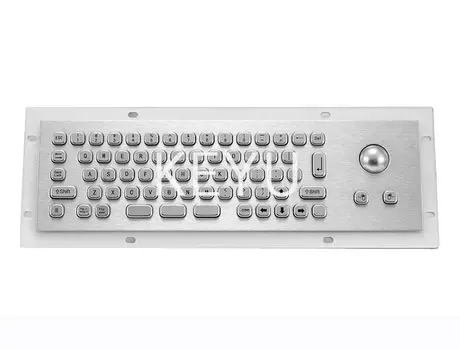
KY-PC-MINI-T Mini Stainless Steel Keyboard for Kiosks
View Specification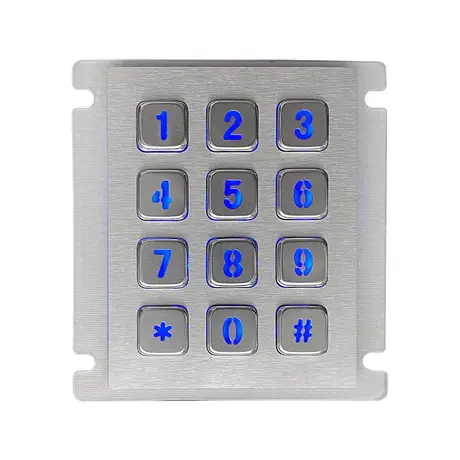
12 Key Industrial Backlight USB Keypad KY2068A-LED
View Specification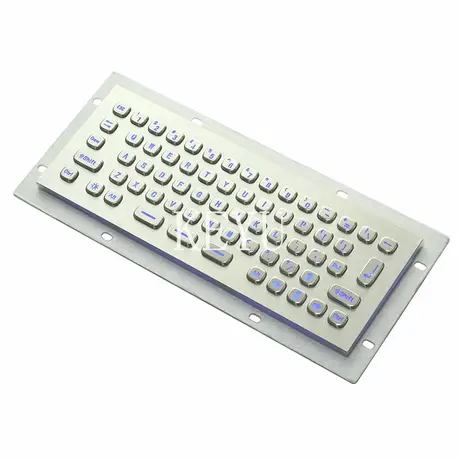
KY-PC-MINI-LED Backlit Metal Keyboard With SUS304 Panel
View SpecificationQuestions On This Topic
Hot-swappable or soldered PCB?
Does the plate material really change anything?
What does QMK or VIA compatibility give me?
What is included in a full customisation service?
Put This Into A Specification
Send us the application and we will tell you which of these choices actually matter for your terminal.