
How Industrial Keyboards Are Made from Material to Shipment
Where Material Choice Starts
Material selection comes first because everything downstream depends on it. Stainless steel is the most common housing and key material for industrial units: it resists corrosion, tolerates water and chemical contact, and holds up across a wide temperature range. Aluminium is used where weight matters more than chemical exposure. Silicone gives a sealed, soft-touch surface that can be washed down. Polycarbonate suits lighter enclosures and printed overlays. The right answer is not the toughest material available but the one matched to the actual exposure in your installation, because each choice changes the tooling route, the finishing steps and the final cost of the keyboard.
Choosing Between Mechanical and Membrane Switches
The switch is the part that registers every keystroke, so it decides how long the keyboard lasts in service. Mechanical switches are generally more durable and more reliable under heavy repeated use, and individual switches can be replaced. They cost more and they are noisier. Membrane switches are more affordable and easier to seal against liquid ingress, but they do not last as long under the same duty cycle. For a control desk that sees a shift-long stream of data entry, the mechanical option usually earns its price back. For an occasional-use panel on a machine, a membrane build is often the sensible specification.
Design and CAD Modelling
The design stage fixes size, key count, layout and any special features before a single part is cut. Engineers build a 3D CAD model containing the keys, switches, base plate and electronics so that fit and clearance can be checked on screen. Environmental requirements enter here too: a sealed design for water resistance or dust protection has to be planned into the housing geometry, gasket paths and cable exit from the beginning. Changes made at CAD stage cost drawing time. The same changes made after tooling cost a new mould. This is the point at which an OEM buyer should review the layout in detail and sign off.
Prototyping Before Tooling
A prototype is a working sample built to the approved design. It lets the engineering team confirm that the keyboard functions as intended, that the key feel is right, that the electronics behave and that the sealing concept holds. It also gives the customer something physical to assess against the real installation: panel cut-out, operator reach, glove use, cable routing. Problems found at this stage are inexpensive to correct. Prototype approval is the gate that releases the project to tooling, and it is worth taking the extra review cycle rather than discovering a layout error in the first production batch.
Stamping Moulding and Tooling
Metal keyboards are produced by stamping. Sheet material is fed into a press where a die cuts out the individual components such as key tops and the base plate, and the stamped parts are then cleaned and polished to a smooth finish. Silicone keyboards take a different route: liquid silicone is injected into a mould, then heated so the material cures into the finished shape. Both routes depend on tooling, the moulds and dies created after prototype approval. KEYU holds over 1,000 sets of moulds and runs CNC and sheet-metal equipment in house, which shortens the loop between a design change and a physical part.
Assembly and Volume Production
Assembly brings the finished parts together: keys are fitted to the base plate, the electronics are installed, and the unit is terminated to a cable or a wireless receiver. Once tooling is proven, volume production runs on automated stamping or moulding processes, which is what keeps unit-to-unit consistency acceptable across a large order. Consistency matters more than peak quality for an OEM integrator, because a panel cut-out sized to the first sample has to accept every unit in the batch. Repeatable tooling and a fixed assembly sequence are what deliver that.
Quality Control and Certification
Inspection runs through the whole process rather than sitting at the end. Incoming materials are tested against the durability specification. Switches are checked for correct function and for endurance under repeated actuation. Finished keyboards are exposed to the conditions they will meet in service, including water, dust, dirt and temperature extremes. Performance testing covers keystroke accuracy and response. Certification by regulatory bodies such as FCC and CE confirms the unit meets applicable safety and reliability requirements. KEYU products carry CE, RoHS, FCC and EMC marks, with IP65, IP66, IP67 and IK07 ratings available depending on the model.
Products Mentioned
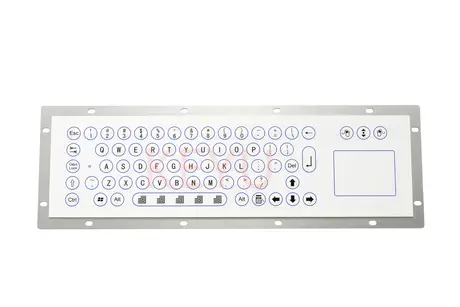
KY-UT385 Medical Membrane Keyboard With Touchpad
View Specification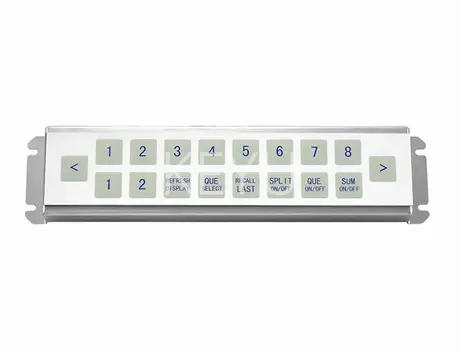
KY2060B Thin Panel Metal Membrane Keypad
View Specification
IP65 Waterproof Silicone Keyboard KY-GJ305
View Specification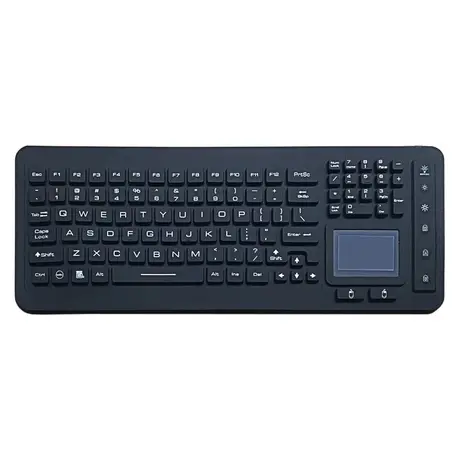
KY-GJ-98-BL Washable Silicone Keyboard With 98 Keys and Backlight
View Specification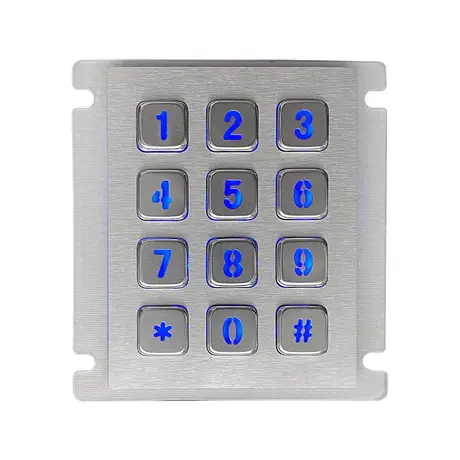
12 Key Industrial Backlight USB Keypad KY2068A-LED
View Specification
12 Key Industrial Numeric USB Keypad KY2073C-USB
View SpecificationQuestions On This Topic
Why is stainless steel the default material for industrial keyboards?
At what point in the process should I finalise my layout?
Are mechanical switches always the better choice?
What testing is applied before shipment?
Put This Into A Specification
Send us the application and we will tell you which of these choices actually matter for your terminal.