How to Choose a Diamond Blade Bond for Stone
Nearly every complaint about a diamond blade is a bond problem described as a quality problem. This is how bond selection actually works, and how to read what a worn blade is telling you.
What a bond is and what it does
A diamond segment is a metal matrix with diamond crystal held in it. The matrix is the part that wears away. As it wears it exposes fresh crystal, and that continuous exposure is what keeps a blade cutting. Diamond does the cutting; the matrix decides when each crystal arrives and when it leaves.
So a bond is a wear-rate decision. It has to wear at roughly the same rate as the diamond dulls. Wear too slowly and the matrix holds onto blunt crystals — the blade glazes, stops cutting and starts polishing the stone. Wear too quickly and sharp crystals fall out before they have done their work, and the segment disappears.
Why marble and granite need opposite bonds
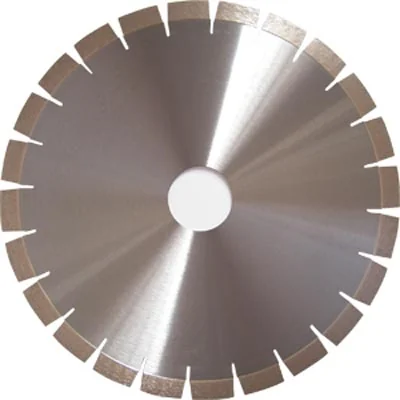
Hard abrasive stone like granite dulls diamond quickly, so the matrix has to release crystals often. But granite also abrades the matrix quickly on its own account, so the matrix has to be hard enough to survive. The result is a hard matrix combined with a coarse, high-strength crystal.
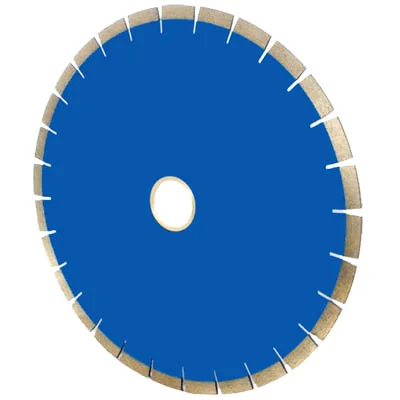
Soft stone like marble or limestone barely abrades the matrix at all. Put a granite bond on marble and nothing wears the matrix, the crystals go blunt in place, and the blade glazes over within a few square metres. A marble bond is deliberately softer so that the soft stone can still open it up.
This is why our edge cutting programme runs separate granite and marble series with separate Item ID families, rather than one blade described as suitable for both.
Reading a blade that is not working
A glazed segment with a shiny flat face and no visible crystal means the bond is too hard for the material. The fix is a softer matrix, not more feed pressure.
Segments that wear down fast and evenly, with crystal falling out looking sharp and unused, mean the bond is too soft. Go harder.
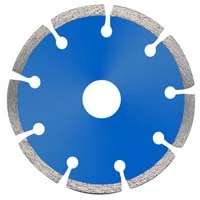
Segment loss at the joint rather than wear across the face is a welding question, not a bond question. Side-loaded work — tuck point, crack chasing, slot cutting — needs laser welding or silver brazing, which is why those series are built that way.
Core cracking or a blue-tinted core means heat: not enough water, too much feed, or a closed rim where the job needed slots.
Grit and concentration
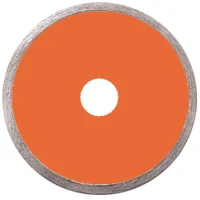
Coarser grit cuts faster and leaves a rougher edge; finer grit cuts slower and leaves an edge closer to polish-ready. On hard stone, coarse grit also survives longer. Blades meant for chip-free work on marble therefore run finer grit and a continuous rim.
Concentration is how much diamond sits in the matrix. Higher concentration spreads the load across more crystals, extending life on hard material, but it also slows the cut because each crystal takes a smaller bite. It costs more, and above a certain point the extra diamond does nothing for you.
What to send us for a recommendation
The stone by name, not by category. Granite from two quarries can behave differently enough to change the bond.
The machine and its spindle power. A blade specified for a 22 kW bridge saw will not perform on an 11 kW machine because it never reaches the pressure the bond needs.
The cut: depth, feed rate, wet or dry, and whether it is a straight cut or a profile.
The current tool and its failure mode. This is the most useful single piece of information, because it tells us which direction to move in.