The Stone Polishing Sequence from Calibration to Gloss
A polishing line is a relay. Each station hands the next one a surface, and the last station cannot fix what the first one got wrong. Here is what each step is responsible for.
Station one: thickness, not finish
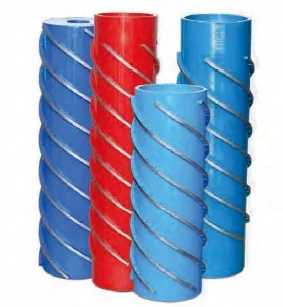
Calibration comes before any grinding. A diamond roller brings every slab to the same thickness so that the heads downstream see a consistent surface and consistent load. Skipping or under-specifying this station is the most common reason a line cannot hold gloss, because a thickness error becomes a pressure error at every station after it.
Our rollers run 400-600 mm for stone and 240-320 mm for tile, silver welded for continuous duty.
Station two: rough calibrating and smoothing
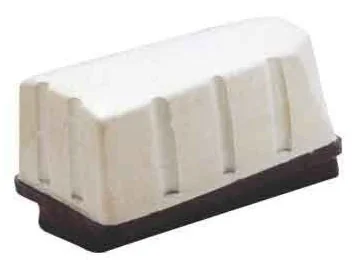
Magnesite abrasives do the rough calibrating and smoothing on granite and marble lines, in separate grades because marble is softer. This station removes the saw marks; it is not trying to produce a finish.
Getting this station wrong leaves marks that survive three more steps, which is why it is worth running the correct grade rather than whatever is in the store.
Station three and four: metal then resin fickerts
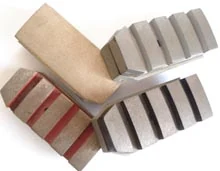
Metal bond fickerts take the stock off through the rough and medium grades. Resin bond fickerts follow on the same 140 and 170 mm bases and leave a finer scratch pattern.
The handover between them is where most gloss problems start. If the metal bond steps are pushed too hard to save time, the resin steps spend their life removing metal-bond scratches and the line slows down anyway.
Station five: buffs and gloss
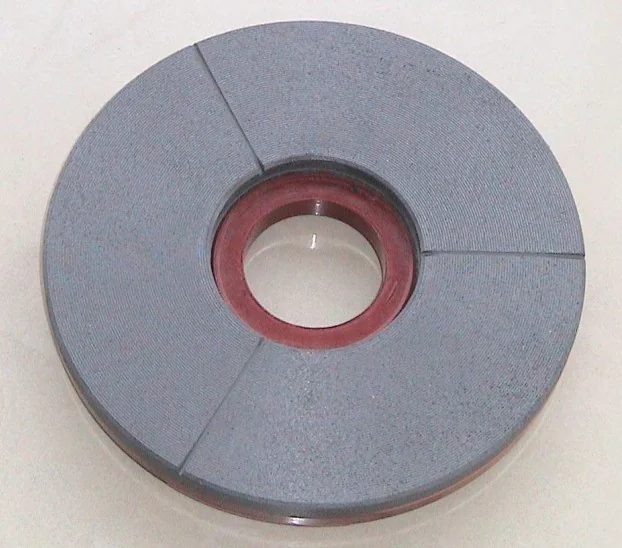
Polishing buffs bring the gloss up on the flat face. Gloss that fades within days usually means the buff stage was rushed or the surface arriving at it was not yet scratch-free.
On marble and glass a cerium oxide compound at this stage lifts the gloss further; on granite the buff alone is normally enough.
Off the line: edges profiles and repair
Edges, profiles and cut-outs never see the line. Flexible pads in wet and dry versions, a finish buff, and profile or finger bits cover that work at the bench and on site.
The dry pad series exists because an installed worktop cannot be flooded with water, and the repair has to be made where the stone is.