Diamond Blade Rim Types Explained
Rim geometry decides two things a bond cannot: how fast swarf leaves the kerf, and how much the blade hits the stone. Everything else about rim choice follows from those two.
Continuous rim
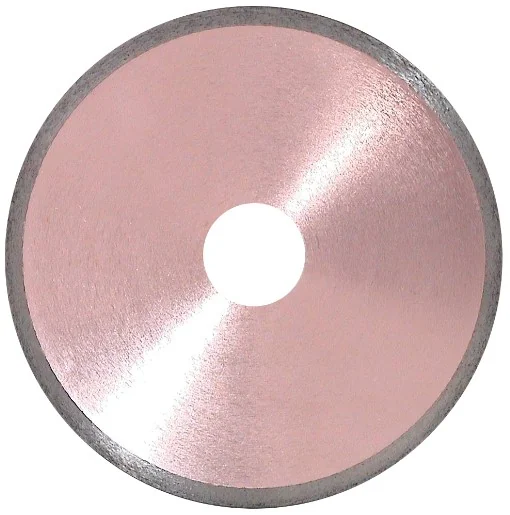
A closed ring of diamond with no gaps. Nothing interrupts contact with the stone, so nothing slams into the edge, which is why this is the rim for chip-free work on marble, limestone, glass and polished porcelain.
The cost is cooling and swarf clearance. A continuous rim needs water. Run it dry and it heats, glazes and eventually warps the core.
Turbo and wave rims
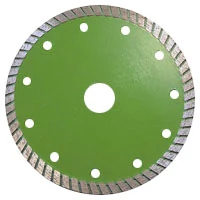
A turbo rim is a continuous rim with a waved or stepped cutting face. It keeps the edge almost closed, so chipping stays low, while the profile breaks the contact patch into a cycle that lets water in and swarf out.
Wave versions go further, increasing cutting surface without closing the swarf path. That makes them the choice for long cuts in dense granite where heat rather than diamond is the limit. Thin turbo versions reduce kerf where the offcut is valuable.
Segmented rims
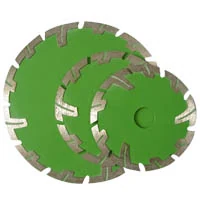
Separate segments with gaps between them. Maximum swarf clearance and the fastest feed rates, at the cost of each segment striking the stone as it enters the cut.
That strike is what chips edges, so segmented blades belong on rough sizing cuts, thick material and laminated glass where the interlayer would gum a closed rim. Special laser-cut slots on the ceramic series serve the same purpose.
Deep teeth and high segment
Deep teeth blades run tall segments with deep gullets and protection segments behind them. The tall segment is diamond depth you can consume before the blade is finished; the protection segment guards the steel when the operator cuts dry.
High segment versions of continuous, turbo and segmented rims exist for one reason: where a blade change costs more than the blade, segment height is the economics of the job.
U-slot key-slot and specialty geometries
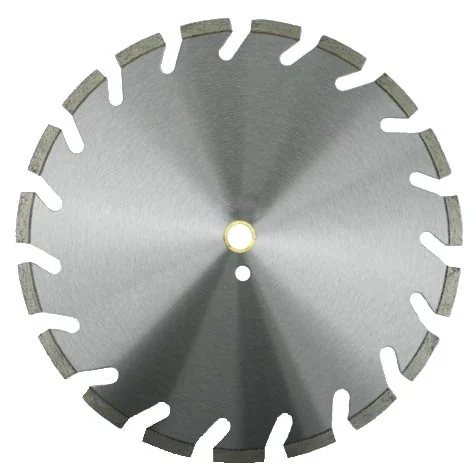
Construction blades add slot shapes aimed at the material rather than the finish. A wide U-slot keeps cutting in brick and block dust that packs a narrow slot solid. A key-slot layout clears the soft sticky swarf of asphalt.
Concave bodies are a separate case: the body itself is curved so the blade can follow a radius without binding, which is what makes dry curve cutting possible at all.
Choosing in one line
Chip-free finish on soft or brittle material: continuous rim. Balanced speed and finish, especially with limited water: turbo or wave. Maximum speed on rough cuts and thick material: segmented. Long shifts on one blade: high segment. Dusty masonry: wide U-slot. Asphalt: key slot. Curves: concave body.