
E6013 Rutile Electrode for All-Position Welding of Low Carbon Steel.
A general-purpose rutile-covered electrode with stable arc at low current, suitable for sheet metal and short welds where clean bead appearance and easy slag removal are required.
Product Overview
E6013 is a rutile-coated electrode for manual metal arc welding of low carbon steel structures. The coating provides good flow in the molten weld pool, resulting in a smooth bead profile on both butt and fillet joints.
It features good slag detachability and low spatter, reducing the need for post-weld cleaning. The electrode maintains arc stability at low welding currents, making it suitable for thin sheet metal and short welds where burn-through is a concern.
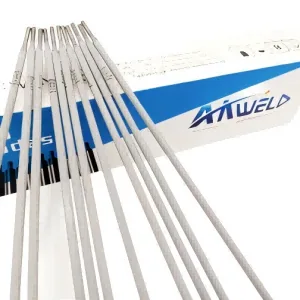
AKWELD supplies E6013 to AWS A5.1 E6013 and ISO 2560-A E 35 A R 1 2 classifications in the diameters listed below.
Application: Used to weld low carbon steel structures, particularly suitable for she-et steel and short weld welding.
Key Benefits
Stable Arc at Low Current.
The rutile coating ensures consistent arc performance down to low current levels, allowing 2.5 mm electrodes to operate at 50-60 A on thin sections without arc instability or plate burn-through.
Clean Bead on Butt and Fillet Joints.
Good fluidity of the molten weld metal produces a uniform, well-shaped bead in both joint types, reducing the need for grinding before painting or inspection.
Slag That Lifts Off.
The slag detaches easily after solidification, minimizing the time spent on inter-run cleaning and reducing the risk of slag entrapment in subsequent passes.
All-Position Capability
The electrode can be used in flat, horizontal, vertical, and overhead positions, enabling a single consumable to cover all joint orientations without switching.
Where It Is Used
- Low carbon steel structural fabrication.
- Sheet steel welding where burn-through is a concern.
- Short welds and tack welding.
- General maintenance and repair on mild steel components.
Who It Is For
- Welding consumable distributors requiring a general-purpose mild steel electrode.
- Steel fabrication shops working with thin and medium plate.
- Maintenance teams needing one electrode for all welding positions.
Problems It Solves
- Burn-through and blown-out joints when welding sheet steel with electrodes that lack arc stability at low current.
- Excess grinding and rework due to rough bead profile and stubborn slag.
- Need to carry multiple electrode types to cover different positions on the same job.
Specifications
Published by the factory for E6013. Values not shown are not published on the datasheet and are marked as such rather than estimated.
| Standard | Designation |
|---|---|
| Classification 1 | E6013 |
| Classification 2 | ISO 2560-A:E 35 A R 1 2 |
| Classification 3 | AWS A5.1 E6013 |
| Element | Content |
|---|---|
| C | ≤0.20 |
| Si | ≤1.0 |
| Mn | ≤1.2 |
| S | ≤0.035 |
| P | ≤0.040 |
| Ni | ≤0.30 |
| Mo | ≤0.30 |
| Cr | ≤0.20 |
| V | ≤0.08 |
| Property | Value |
|---|---|
| Tensile strength (MPa) | ≥430 |
| Yield Stress (MPa) | ≥330 |
| Elongation (%) | ≥17 |
| Impact values (J) | ≥47J/-20℃ |
| Diameter | Current range |
|---|---|
| 2.5mm | F/H-60-90A V/OH-50-80A |
| 3.2mm | F/H-80-130A V/OH-80-110A |
| 4.0mm | F/H-150-190A V/OH-130-170A |
Technical Features
- Rutile coating designed for all-position manual metal arc welding.
- Deposited metal tensile strength at least 430 MPa with yield stress at least 330 MPa.
- Elongation at least 17 percent and impact energy at least 47 J at minus 20 degrees C.
- Chemical composition: C ≤0.20%, Si ≤1.0%, Mn ≤1.2%, S ≤0.035%, P ≤0.040%, Ni ≤0.30%, Mo ≤0.30%, Cr ≤0.20%, V ≤0.08%
- Supplied in 2.5 mm, 3.2 mm and 4.0 mm diameters with published current ranges for each.
Use Guide
- Select diameter by plate thickness, then set current within the published range: 2.5 mm runs 60-90 A flat and horizontal, 50-80 A vertical and overhead.
- Clean oil, rust, paint and moisture from joint surfaces before welding.
- Keep electrodes dry in sealed packaging; re-dry any exposed to air before use.
- Remove slag completely between passes using chipping and wire brushing to prevent inclusion in the next run.
How It Compares
E6013 and E6011 both weld low carbon steel in all positions, but E6013 has a rutile coating that provides a stable arc and clean bead, ideal for thin materials and cosmetic welds. E6011 uses a cellulosic coating for deeper penetration and better performance on dirty or poorly prepared joints, but produces more spatter and a rougher bead. For low-hydrogen requirements, a basic-coated electrode is preferred.
Related Grades
Other welding electrodes in the same family.
E6013 Questions
Which diameters and current ranges are available?
What classifications does this electrode meet?
What impact toughness does the deposited metal reach?
Can I get a full catalogue and packing details before ordering?
What packing is E6013 supplied in?
Can we test E6013 before placing a production order?
Request a Quotation for E6013
Send the diameter, the quantity and the destination port. Our technical team replies with packing, pricing and the data you need to qualify the grade.