
AK-ER80CS Gas Shielded Welding Wire for High-Strength Low-Alloy Steel.
An 800 MPa grade gas shielded welding wire with multi-element alloy strengthening, low impurity content, and excellent low-temperature toughness for demanding applications in hydropower, marine, and oil & gas infrastructure.
Product Overview
AK-ER80CS is a gas shielded welding wire designed for low alloy and high-strength steel applications. It uses a multi-element alloy strengthening method and strictly controls sulfur and phosphorus content to achieve high-strength, high-toughness, and high-purity weld metal.
The wire delivers excellent all-position welding performance, with a smooth and aesthetically pleasing weld bead. Both as-welded and heat-treated deposited metal exhibit strong low-temperature ductility and crack resistance, meeting the demands of critical structural components.
Application: AK-ER80CS is an 800MPA grade gas shielded welding wire for low alloy and high strength steel. It adopts multi-element alloy strengthening method, strictly controls the content of impurities such as s and p in the welding wire, and obtains high strength, high toughness and high purity weld metal, excellent all-position welding process, beautiful weld molding. Both as-welded and as-heat-treated deposited metals have excellent low temperature ductility and crack resistance. Mainly used for welding of WSD690E high strength and high toughness penstock in pumped storage power station, it is also suitable for the thick plates such as volute and seat ring in the same strength hydraulic power generation equipment, and the WCF80, EQ70, E690, Q690E and ASTMA514GR in the marine engineering ships, oil platforms and oil pipelines. Q High-strength low-alloy steel welding.
Key Benefits
High Strength and Toughness.
The wire achieves a tensile strength of at least 760 MPa and a yield stress of at least 660 MPa, with an elongation of at least 15 percent and impact energy of 135 J at minus 40 degrees C.
Low Impurity Control
Sulfur content is limited to 0.005 percent and phosphorus to 0.008 percent, reducing the risk of hot cracking and improving weld metal cleanliness.
Excellent Low-Temperature Performance
Both as-welded and heat-treated weld metal maintain high ductility and crack resistance at minus 40 degrees C, suitable for cold-climate environments.
Versatile Application Range
Designed for welding WSD690E, WCF80, EQ70, E690, Q690E, and ASTM A514GR high-strength low-alloy steels used in penstocks, volutes, seat rings, marine vessels, oil platforms, and pipelines.
Where It Is Used
- Welding of WSD690E high-strength, high-toughness penstocks in pumped storage power stations.
- Thick plate welding of volutes and seat rings in hydraulic power generation equipment.
- Construction of marine engineering vessels, oil platforms, and oil pipelines.
- Welding of Q690E, EQ70, E690, and ASTM A514GR high-strength low-alloy steels.
Who It Is For
- Welding consumable distributors supplying high-strength steel welding solutions.
- Fabricators and EPC contractors working on hydropower, marine, and oil & gas projects.
- Maintenance teams responsible for high-strength steel structures requiring crack-resistant welds.
Problems It Solves
- Achieving high-strength weld metal with sufficient toughness in low-temperature service environments.
- Controlling sulfur and phosphorus levels to prevent hot cracking in critical joints.
- Maintaining consistent weld quality across thick-section and all-position welds in demanding structural applications.
- Reducing the risk of porosity and cracking in outdoor welding by following recommended gas and process controls.
Specifications
Published by the factory for AK-ER80CS. Values not shown are not published on the datasheet and are marked as such rather than estimated.
| Standard | Designation |
|---|---|
| Classification | EN ISO —— AWS A5.28 ER110S-G GB/T —— |
| Element | Content |
|---|---|
| C | 0.080 |
| Si | 0.60 |
| Mn | 1.72 |
| S | 0.005 |
| P | 0.008 |
| Ni | 2.0 |
| Cu | 0.10 |
| Mo | 0.50 |
| Cr | 0.18 Mechanical |
| Tensile strength (MPa) | ≥760 |
| Yield Stress (MPa) | ≥660 |
| Elongation (%) | ≥15 |
| Impact values (J) | 135J/-40℃ |
| Recommended | 1.0mm: F(H)-100-240A/ |
| V(OH)-70-160A 1.2mm | F(H)-120-280A/ |
| V(OH)-80-180A 1.6mm | F(H)-150-350A |
Mechanical property data for this grade is not published on the factory datasheet. Ask our technical team for the test record before you qualify it.
Note: 1. protective gas Ar+ 20% CO2, the mixed gas, gas flow 15-20 L/min. Control arc length during welding to avoid welding defects such as blowhole. 2. When welding, it is advisable to control the length of dry extension of welding wire at 10-18mm. When the current is more than 250A, the dry elongation should be controlled in the range of 20-25mm 3. and the impurities such as rust, oil and water should be thoroughly removed from the welding place. 4. thin plate welding torch can be inclined to the side of the weld to reduce penetration to avoid penetration of the base metal. 5. When the wind speed is 1.5 m/s in outdoor construction, measures should be taken to prevent air hole and other defects
Technical Features
- Multi-element alloy strengthening for high strength and toughness.
- Sulfur content ≤ 0.005 percent, phosphorus content ≤ 0.008 percent.
- Tensile strength ≥ 760 MPa, yield stress ≥ 660 MPa, elongation ≥ 15 percent.
- Impact energy ≥ 135 J at minus 40 degrees C.
- Supplied in 1.0 mm, 1.2 mm, and 1.6 mm diameters.
- Compatible with EN ISO ——, AWS A5.28 ER110S-G, and GB/T —— standards.
Use Guide
- Use a shielding gas mixture of argon plus 20 percent CO2 at a flow rate of 15–20 L/min.
- Control arc length during welding to prevent porosity and other defects.
- Maintain dry extension of the wire between 10–18 mm; for currents above 250 A, extend to 20–25 mm.
- Thoroughly remove rust, oil, and moisture from the joint before welding.
- For thin plate welding, incline the torch slightly away from the weld to reduce penetration.
- When wind speed exceeds 1.5 m/s during outdoor welding, implement protective measures to prevent porosity.
How It Compares
AK-ER80CS is a gas shielded wire for high-strength low-alloy steel, differing from basic or rutile-covered electrodes in its use of a mixed gas shield and higher strength. It is not intended for low-strength steels where simpler wires would suffice. Compared to other ER110S-G type wires, AK-ER80CS achieves higher toughness at low temperatures and lower impurity levels, making it suitable for critical structural applications.
Related Grades
Other welding wire in the same family.
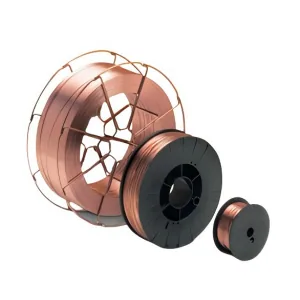
AK-ER80CS Questions
What are the recommended welding parameters for 1.0 mm diameter wire?
What are the mechanical properties of the deposited metal?
Which standards does AK-ER80CS meet?
What shielding gas and flow rate are recommended?
What packing is AK-ER80CS supplied in?
Can we test AK-ER80CS before placing a production order?
Request a Quotation for AK-ER80CS
Send the diameter, the quantity and the destination port. Our technical team replies with packing, pricing and the data you need to qualify the grade.