
AKJ501 Acidic Sintered Flux for Submerged Arc Welding of Low-Carbon and Low-Alloy Steel.
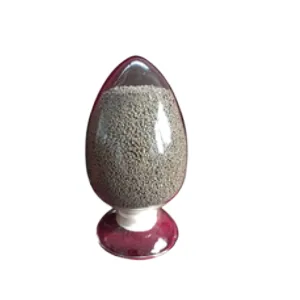
A gray, round, acidic sintered flux with a basicity of 0.5 to 0.8, suitable for high-speed welding of low-carbon and low-alloy steel components with excellent low-temperature impact toughness.
Product Overview
AKJ501 is an aluminum-titanium acidic sintered flux with a basicity of approximately 0.5 to 0.8. It is supplied as gray round particles with a particle size of 10 to 60 mesh (2.0 to 0.28 mm).
When used with matching welding wires such as H08A or H08MnA, it is primarily applied in submerged arc welding of low-carbon steel and certain low-alloy steels, including boiler pressure vessels and ship structures.
The flux supports stable arc performance and produces a well-shaped weld bead with easy slag removal. The deposited metal exhibits good low-temperature impact toughness, suitable for service in demanding environments.
Application: With the corresponding welding wire (such as H08A, H08MnA, etc.), it is mainly used for submerged arc welding of low-carbon steel and some low-alloy steel (such as) boiler pressure vessels, ships, etc. The deposited metal has good low-temperature impact toughness. JH-SJ501M is especially suitable for high-speed welding of water-cooled walls of power plant boilers, and the welding speed can reach more than 70m/h.
Key Benefits
Stable Arc and Smooth Weld Bead.
The flux provides a stable arc during welding, especially when using DC power with the welding wire connected to the positive electrode, resulting in a smooth, well-defined weld bead.
Easy Slag Removal
The slag formed during welding detaches easily from the weld surface, reducing the need for post-weld cleaning and minimizing the risk of slag entrapment.
High-Speed Welding Capability
JH-SJ501M, a variant of AKJ501 with a particle size of 14 to 16 mesh (1.18 to 0.28 mm), is specifically suited for high-speed welding of power plant boiler water-cooled walls, achieving welding speeds exceeding 70 m/h.
Good Low-Temperature Impact Toughness.
The deposited metal maintains excellent impact toughness at low temperatures, making it suitable for applications requiring reliable performance under thermal stress.
Where It Is Used
- Submerged arc welding of low-carbon steel structures.
- Welding of low-alloy steel components in boiler and pressure vessel fabrication.
- Shipbuilding and marine structural welding.
- High-speed welding of power plant boiler water-cooled walls using JH-SJ501M variant.
Who It Is For
- Welding consumable distributors supplying flux for industrial fabrication.
- Boiler and pressure vessel manufacturers requiring consistent flux performance.
- Power plant maintenance teams performing high-speed repairs on water-cooled walls.
- Shipyard welders working on low-alloy steel hull and structural components.
Problems It Solves
- Inconsistent weld quality due to unstable arc or difficult slag removal in submerged arc welding.
- Slow welding speeds in boiler and pressure vessel fabrication limiting productivity.
- Lack of low-temperature toughness in deposited metal for cold-service applications.
- Difficulty sourcing a single flux that supports both standard and high-speed welding processes.
Specifications
Published by the factory for AKJ501. Values not shown are not published on the datasheet and are marked as such rather than estimated.
| Element | Content |
|---|---|
| SiO₂+TiO₂ | 25.0-35.0 |
| CaO+MgO | 15.0-25.0 |
| S | 0.06 |
| P | 0.08 |
| CaF₂ | 5.0-15.0 |
| Al₂O₃+MnO | 30.0-40.0 |
Mechanical property data for this grade is not published on the factory datasheet. Ask our technical team for the test record before you qualify it.
Size: 10-60
Technical Features
- Aluminum-titanium acidic sintered flux with basicity of 0.5 to 0.8.
- Particle size: 10 to 60 mesh (2.0 to 0.28 mm); JH-SJ501M variant: 14 to 16 mesh (1.18 to 0.28 mm)
- Suitable for DC power with welding wire connected to the positive electrode.
- Chemical composition includes SiO₂+TiO₂ (25.0–35.0%), CaO+MgO (15.0–25.0%), CaF₂ (5.0–15.0%), Al₂O₃+MnO (30.0–40.0%), S (0.06%), P (0.08%)
- Deposited metal has good low-temperature impact toughness.
Use Guide
- Select the appropriate flux particle size based on the welding setup: 10–60 mesh for general use, 14–16 mesh for high-speed applications.
- Use DC power with the welding wire connected to the positive electrode for optimal arc stability and weld bead quality.
- Ensure the flux is stored in a dry environment and kept sealed to prevent moisture absorption.
- Clean the joint surfaces of oil, rust, and contaminants before welding to avoid porosity and defects.
How It Compares
AKJ501 and JH-SJ501M are both acidic sintered fluxes with similar chemical makeup and performance. The key difference lies in particle size: JH-SJ501M (14–16 mesh) is optimized for high-speed welding, particularly in power plant boiler water-cooled walls, while AKJ501 (10–60 mesh) is suitable for general submerged arc welding. Basic fluxes offer higher toughness and lower hydrogen content but require stricter drying and handling. AKJ501 is not recommended for applications requiring low-hydrogen deposits.
Related Grades
Other welding flux in the same family.
AKJ501 Questions
What particle sizes are available for AKJ501 and JH-SJ501M?
Which welding wires are recommended for use with AKJ501?
What is the basicity range of AKJ501?
Can AKJ501 be used for high-speed welding?
What packing is AKJ501 supplied in?
Can we test AKJ501 before placing a production order?
Request a Quotation for AKJ501
Send the diameter, the quantity and the destination port. Our technical team replies with packing, pricing and the data you need to qualify the grade.