
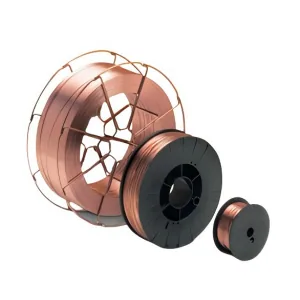
AK-S100A/ AK-AF100SD Submerged Arc Welding Wire and Flux for High Strength Low Alloy Steel.
A submerged arc welding system designed for high strength low alloy steel, delivering stable arc, easy slag removal, and excellent low temperature impact toughness and crack resistance in the deposited metal.
Product Overview
AK-S100A is a submerged arc welding wire for low alloy high strength steel, and AK-AF100SD is a fluorine-base type sintered flux with a basicity of about 1.8. The combination is used for welding high strength steels such as B950CF, with proven application in Baosteel B950CF steel operations.
The system provides good welding technology, stable arc, easy slag removal, and deposited metal with high low temperature impact toughness and crack resistance, suitable for demanding structural and pressure pipe applications.
Application: AK-S100A is a submerged arc welding wire for low alloy high strength steel, AK-AF100SD is a fluorine-base type sintered flux, basicity about 1.8. The combination of AK-S100A and AK-AF100SD has the advantages of good welding technology, stable arc, easy slag removal and good low temperature impact toughness and crack resistance of deposited metal. Suitable for B950CF high strength steel structure and pressure pipe welding, mainly used in Baosteel B950CF steel welding operations, but also used in other fields such as strength level welding operations.
Key Benefits
Stable Arc and Easy Slag Removal.
The AK-S100A/ AK-AF100SD combination delivers a stable arc during welding and produces slag that lifts off easily, reducing inter-pass cleaning time and minimizing the risk of slag entrapment.
High Low Temperature Impact Toughness.
Deposited metal achieves 120 J at minus 20 degrees C and 81 J at minus 40 degrees C, meeting the toughness requirements for low temperature service in high strength steel applications.
Good Crack Resistance
The system is formulated to resist cracking in the weld metal, particularly important in high strength steels with susceptibility to hydrogen-induced cracking.
Suitable for High Strength Steel Welding.
Designed for welding B950CF and other high strength steels, with deposited metal tensile strength ranging from 930 MPa to 1130 MPa and yield stress of at least 790 MPa.
Where It Is Used
- Welding of B950CF high strength steel structures and pressure pipes.
- Fabrication and maintenance of high strength steel components in oil and gas, power generation, and heavy industry.
- Applications requiring high toughness and crack resistance at low temperatures.
Who It Is For
- Welding consumable distributors supplying high strength steel welding systems.
- Fabricators and EPC contractors working with B950CF and similar high strength steels.
- Maintenance teams performing repairs on high strength steel pressure vessels and pipelines.
Problems It Solves
- Achieving consistent weld metal properties in high strength low alloy steel when base metal chemistry and strength level are demanding.
- Managing hydrogen-induced cracking risk in high strength steel welds through controlled flux and post-weld heat treatment.
- Ensuring low temperature toughness and crack resistance in critical joints without compromising weldability or slag removal.
Specifications
Published by the factory for AK-S100A/ AK-AF100SD. Values not shown are not published on the datasheet and are marked as such rather than estimated.
| Standard | Designation |
|---|---|
| Classification | EN ISO —— AWS —— GB/T —— |
| Element | Content |
|---|---|
| C | 0.064 |
| Si | 0.30 |
| Mn | 1.64 |
| S | 0.006 |
| P | 0.005 |
| Ni | 3.15 |
| Cu | 0.18 |
| Mo | 0.52 |
| Cr | 0.49 Mechanical |
| Tensile strength (MPa) | 930-1130 |
| Yield Stress (MPa) | ≥790 |
| Elongation (%) | ≥12 |
| Impact values (J) | 120J/-20℃ , 81J/-40℃ |
| Recommended | —— |
Mechanical property data for this grade is not published on the factory datasheet. Ask our technical team for the test record before you qualify it.
Note: 1. before the use of flux must be 300 ~ 350 ° C baking 1 ~ 2 hours, welding wire should be dry before use, no oil, Rust State 2. welding should be strictly removed before the welding oil, rust, moisture and other impurities, 3. When Welding, preheat 100 ~ 200 ° C (depending on plate thickness and material) . 4. Recommended welding specification (taking Φ4.0 wire as an example) I = 500 ~ 550A, U = 28 ~ 32V, welding speed V = 30 ~ 50cm/min, inter-pass temperature 150 ~ 180 ° C. 5. After welding, it needs 200 ~ 250 ° C heat preservation for 2 ~ 4 hours to remove hydrogen. Flux Quality Requirements: 1. Flux Water Content ≤0.10% 2. Mechanical inclusions ≤0.30. 3. Sulfur content of flux 0.050% 4. Phosphorus content ≤0.060% Of flux deposited metal x-ray detection requirements: Grade I Deposited metal diffusion hydrogen content: ≤5.0 ml/100g (mercury or thermal conductivity method)
Technical Features
- AK-S100A wire chemical composition: C 0.064%, Si 0.30%, Mn 1.64%, S 0.006%, P 0.005%, Ni 3.15%, Cu 0.18%, Mo 0.52%, Cr 0.49%
- Deposited metal tensile strength: 930–1130 MPa, yield stress: ≥790 MPa, elongation: ≥12%
- Impact values: 120 J at minus 20 degrees C, 81 J at minus 40 degrees C.
- AK-AF100SD flux basicity: about 1.8, water content ≤0.10%, mechanical inclusions ≤0.30%, sulfur content ≤0.050%, phosphorus content ≤0.060%
- Deposited metal x-ray detection: Grade I, diffusion hydrogen content ≤5.0 ml/100g (mercury or thermal conductivity method)
Use Guide
- Pre-bake AK-AF100SD flux at 300–350 °C for 1–2 hours before use.
- Ensure AK-S100A welding wire is dry and free of oil, rust, or moisture before welding.
- Clean joint surfaces thoroughly to remove oil, rust, and moisture prior to welding.
- Preheat the base metal to 100–200 °C depending on plate thickness and material.
- For Φ4.0 mm wire, recommended parameters: current 500–550 A, voltage 28–32 V, welding speed 30–50 cm/min, inter-pass temperature 150–180 °C.
- After welding, perform post-weld heat treatment at 200–250 °C for 2–4 hours to remove hydrogen.
How It Compares
AK-S100A/ AK-AF100SD is a fluorine-base sintered flux system designed for high strength low alloy steel welding. It differs from standard fluxes by offering higher basicity (1.8), lower hydrogen content, and improved low temperature toughness. Compared to rutile or mixed fluxes, it provides better crack resistance and mechanical properties in high strength steels, but requires stricter pre-weld and post-weld procedures.
Related Grades
Other welding wire in the same family.
AK-S100A/ AK-AF100SD Questions
What is the recommended preheat temperature?
What are the recommended welding parameters for Φ4.0 mm wire?
What post-weld heat treatment is required?
What are the flux quality requirements?
What packing is AK-S100A/ AK-AF100SD supplied in?
Can we test AK-S100A/ AK-AF100SD before placing a production order?
Request a Quotation for AK-S100A/ AK-AF100SD
Send the diameter, the quantity and the destination port. Our technical team replies with packing, pricing and the data you need to qualify the grade.