
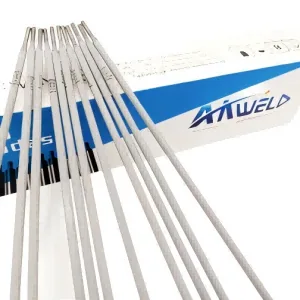
AKR317 Low-Hydrogen Sodium-Coated Electrode for Heat-Resistant Steel Welding.
A low-hydrogen-sodium-coated electrode for all-position welding of chromium-molybdenum-vanadium pearlitic heat-resistant steel, delivering high strength and excellent creep and fatigue resistance up to 600℃.
Product Overview
AKR317 is a low-hydrogen-sodium-coated electrode designed for manual metal arc welding of chromium-molybdenum-vanadium pearlitic heat-resistant steel, including 1Cr-0.5Mo 0.25V steel plates used in large-scale equipment exposed to harsh service conditions and complex corrosive media.
The electrode provides excellent welding processability and can be used in all positions, making it suitable for on-site installation and construction where consistent performance is critical.
The deposited metal has low levels of impurities, with sulfur ≤ 0.010% and phosphorus ≤ 0.012%, and meets the chemical and mechanical requirements specified in GB/T 5118 E5515-1CMV.
AKR317 is supplied to EN ISO 3580 B E5515-G, AWS A5.5 E8015-G, and GB/T 5118 E5515-1CMV classifications.
Application: Suitable for welding chromium-molybdenum-vanadium vanadium pearlitic heat-resistant steel (1Cr-0.5Mo 0.25V) steel plates for large-scal equipment with harsh service conditions and complex corrosive media such as petrochemical, coal chemical, and thermal power plants.
Key Benefits
High Strength and Creep Resistance.
The deposited metal achieves a tensile strength of 650 MPa and yield stress of 565 MPa, with elongation of 23% and impact values of 149 J, 138 J, and 169 J at 20℃, ensuring reliable performance under high-temperature and high-stress conditions.
Low Impurity Content
Sulfur content is ≤ 0.003% and phosphorus ≤ 0.008%, with other impurities such as As, Sn, and Sb each ≤ 0.003%, resulting in a pure weld metal with minimal risk of embrittlement.
All-Position Welding Capability
The electrode maintains stable arc performance and good bead control in flat, horizontal, vertical, and overhead positions, supporting efficient on-site welding without switching consumables.
Suitable for Harsh Service Environments.
Welded joints retain high strength and oxidation resistance at temperatures below 600℃, with excellent creep and fatigue resistance, making the electrode ideal for petrochemical, coal chemical, and thermal power plant applications.
Where It Is Used
- Welding of 1Cr-0.5Mo 0.25V chromium-molybdenum-vanadium pearlitic heat-resistant steel plates.
- Construction and maintenance of large-scale equipment in petrochemical and coal chemical plants.
- High-temperature components in thermal power plants exposed to complex corrosive media.
- On-site welding in demanding industrial environments requiring consistent, code-compliant joints.
Who It Is For
- Welding consumable distributors supplying heat-resistant steel electrodes for industrial projects.
- Petrochemical and power plant maintenance teams requiring reliable, high-performance welding consumables.
- Fabricators of pressure vessels and heat exchangers operating under high-temperature conditions.
Problems It Solves
- Achieving high-strength, creep-resistant welds in heat-resistant steels used in harsh industrial environments.
- Reducing the risk of weld metal embrittlement from high sulfur and phosphorus levels in low-alloy steels.
- Ensuring consistent weld quality across all positions during on-site construction without rework.
Specifications
Published by the factory for AKR317. Values not shown are not published on the datasheet and are marked as such rather than estimated.
| Standard | Designation |
|---|---|
| Classification | EN ISO 3580 B E5515-G AWS A5.5 E8015-G GB/T 5118 E5515-1CMV |
| Element | Content |
|---|---|
| C | 0.08 |
| Mn | 0.76 |
| P | 0.008 |
| S | 0.003 |
| Si | 0.21 |
| Cr | 1.27 |
| Mo | 0.58 |
| V | 0.23 |
| As | 0.003 |
| Sn | 0.001 |
| Sb | 0.001 |
| Property | Value |
|---|---|
| Tensile strength (MPa) | 650 |
| Yield Stress (MPa) | 565 |
| Elongation (%) | 23 |
| Impact values (J) | 149J 138J 169J/20℃ |
Technical Features
- Low-hydrogen-sodium coating for reduced hydrogen-induced cracking risk.
- Deposited metal tensile strength ≥ 650 MPa, yield stress ≥ 565 MPa, elongation ≥ 23%
- Impact values ≥ 138 J at 20℃, with typical values of 149 J and 169 J.
- Sulfur ≤ 0.003%, phosphorus ≤ 0.008%, and other impurities ≤ 0.003% by weight.
- Supplied to EN ISO 3580 B E5515-G, AWS A5.5 E8015-G, and GB/T 5118 E5515-1CMV classifications.
Use Guide
- Select electrode diameter based on joint thickness and welding position, ensuring current remains within the recommended range for stable arc and proper penetration.
- Clean joint surfaces thoroughly to remove oil, rust, moisture, and contaminants before welding to prevent porosity and cracking.
- Store electrodes in sealed packaging and re-dry if exposed to moisture; follow re-baking procedures as per standard practice.
- Remove slag completely between passes to avoid inclusions and ensure full fusion in subsequent runs.
How It Compares
AKR317 and E8015-G both meet AWS A5.5 E8015-G and are low-hydrogen electrodes for heat-resistant steels. AKR317 is specifically formulated for chromium-molybdenum-vanadium pearlitic steels with enhanced creep and fatigue resistance. Basic-coated electrodes like E8015-G are suitable for high-strength applications but may require stricter storage and handling. AKR317 offers superior purity and mechanical properties in high-temperature service environments.
Related Grades
Other welding electrodes in the same family.
AKR317 Questions
What are the chemical composition limits for AKR317?
What mechanical properties does the deposited metal achieve?
Which standards does AKR317 meet?
Can I get technical data and packing details before ordering?
What packing is AKR317 supplied in?
Can we test AKR317 before placing a production order?
Request a Quotation for AKR317
Send the diameter, the quantity and the destination port. Our technical team replies with packing, pricing and the data you need to qualify the grade.