
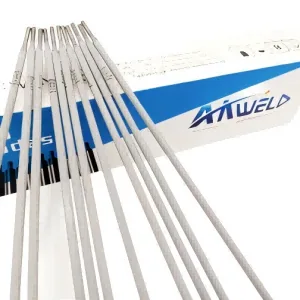
AKR307L Low-Hydrogen Sodium Coated Electrode for Cr1.0%-Mo0.5% Heat-Resistant Steel.
A low-hydrogen sodium type covered electrode for all-position welding of low carbon heat-resistant steel with controlled preheat and post-weld tempering requirements.
Product Overview
AKR307L is a low-hydrogen sodium coated electrode designed for manual metal arc welding of Cr1.0%-Mo0.5% heat-resistant steel and 30CrMoSi cast steel. It is suitable for service temperatures below 520℃ and meets EN ISO 3580 B E5516-1CM, AWS A5.5 E8016-B2, and GB/T 5118 E5515-B2L classifications.
The electrode delivers excellent technological performance with low spatter, good slag detachability, and a smooth, attractive weld bead appearance. It is used with direct current reversed polarity (DCRP) and supports all-position welding using short-arc technique.
Application: Used for welding Cr1.0%-Mo0.5% heat-resistant steel below 520℃, such as boiler pipes, high pressure vessels, equipment for petroleum refining, etc. Also used for welding 30CrM oSi cast steel.
Key Benefits
Low-Hydrogen Sodium Coating
The sodium-based coating minimizes hydrogen content in the weld metal, reducing the risk of hydrogen-induced cracking in heat-resistant steel applications.
Stable Arc and Low Spatter.
The coating formulation ensures a stable arc and minimal spatter during welding, improving weld quality and reducing post-weld cleaning time.
Good Slag Detachability
The slag lifts off easily after solidification, allowing clean inter-run surfaces without the need for extensive chipping or wire brushing.
All-Position Welding Capability
AKR307L supports flat, horizontal, vertical, and overhead welding positions, enabling consistent performance across complex joint geometries.
Where It Is Used
- Welding of Cr1.0%-Mo0.5% heat-resistant steel in boiler pipes and high-pressure vessels.
- Fabrication and repair of equipment used in petroleum refining.
- Joining of 30CrMoSi cast steel components in high-temperature service environments.
- All-position welding in industrial and structural applications requiring controlled heat input.
Who It Is For
- Welding consumable distributors supplying heat-resistant steel electrodes.
- Boiler and pressure vessel fabricators working with Cr-Mo steels.
- Pipeline and petrochemical contractors requiring controlled preheat and post-weld tempering.
- Maintenance teams working on high-temperature equipment with strict metallurgical requirements.
Problems It Solves
- Cracking in welds due to high hydrogen content in heat-resistant steel joints.
- Inconsistent weld quality from poor slag control or unstable arc in vertical and overhead positions.
- Lack of a single electrode that meets multiple international standards for Cr-Mo steel welding.
- Difficulty in achieving proper preheat and post-weld tempering without a clear process guide.
Specifications
Published by the factory for AKR307L. Values not shown are not published on the datasheet and are marked as such rather than estimated.
| Standard | Designation |
|---|---|
| Classification 1 | EN ISO 3580 B E5516-1CM AWS A5.5 E8016-B2 |
| Classification 2 | GB/T 5118 E5515-B2L |
| Element | Content |
|---|---|
| C | 0.05 |
| Mn | 0.90 |
| P | 0.030 |
| S | 0.030 |
| Si | 1.0 |
| Cr | 1.0-1.5 |
| Mo | 0.4-0.65 |
| Property | Value |
|---|---|
| Tensile strength (MPa) | ≥520 |
| Yield Stress (MPa) | ≥390 |
| Elongation (%) | ≥17 |
| Impact values (J) | ≥27J/normal temperature |
| Diameter | Current range |
|---|---|
| 2.5mm | |
| 300mm | 60-90A |
| 3.2mm | |
| 350mm | 90-120A |
| 4.0mm | |
| 400mm | 140-180A |
| 5.0mm |
Technical Features
- Low-hydrogen sodium coating for controlled hydrogen levels in weld metal.
- Deposited metal tensile strength at least 520 MPa, yield stress at least 390 MPa, elongation at least 17 percent.
- Impact toughness at least 27 J at normal temperature.
- Chemical composition: C 0.05%, Mn 0.90%, P 0.030%, S 0.030%, Si 1.0%, Cr 1.0-1.5%, Mo 0.4-0.65%
- Supplied in 2.5 mm, 3.2 mm, 4.0 mm, and 5.0 mm diameters with specified current ranges.
Use Guide
- Preheat the base metal to 160–220 ℃ before welding to prevent cracking.
- Bake electrodes at 350–380 ℃ for one hour before use and consume immediately after baking.
- Clean all contaminants such as rust, oil, and moisture from the joint surfaces prior to welding.
- Use direct current reversed polarity (DCRP) with short-arc technique for optimal weld quality.
- After welding, temper the weldment at 680–720 ℃ to relieve residual stresses and stabilize microstructure.
How It Compares
AKR307L and E8016-B2 both belong to the low-hydrogen sodium type and are used for Cr-Mo heat-resistant steel. AKR307L is specifically formulated for Cr1.0%-Mo0.5% steel with controlled preheat and tempering. E8016-B2 is a broader classification that may cover different alloy systems. AKR307L offers better slag control and lower spatter than some alternatives, but requires strict adherence to preheat and post-weld heat treatment.
Related Grades
Other welding electrodes in the same family.
AKR307L Questions
What are the recommended welding parameters for each diameter?
Which standards does AKR307L meet?
What is the required preheat and post-weld tempering temperature?
How should the electrodes be stored and prepared before use?
What packing is AKR307L supplied in?
Can we test AKR307L before placing a production order?
Request a Quotation for AKR307L
Send the diameter, the quantity and the destination port. Our technical team replies with packing, pricing and the data you need to qualify the grade.