
AKM-100 High-Strength Welding Wire for Ultra-High Strength Steel.
A solid wire designed for high-deposition, low-spatter welding with ultra-low hydrogen content and excellent low-temperature impact performance on ultra-high strength steel.
Product Overview
AKM-100 is a solid welding wire for gas metal arc welding of ultra-high strength steel. It is formulated to deliver a deposited metal with an ultra-low and seamless structure, achieving a diffusible hydrogen content as low as 3 ml/100g.
The wire produces a soft and stable arc with minimal spatter, a beautiful weld bead shape, almost no slag, and the least smoke and dust during welding. It offers high deposition efficiency and excellent low-temperature impact performance.
Application: Suitable for welding of ultra-high strength stee.
Key Benefits
Ultra-Low Hydrogen Content
The deposited metal has a diffusible hydrogen content as low as 3 ml/100g, reducing the risk of hydrogen-induced cracking in high-strength steel welds.
Stable Arc and Low Spatter.
The wire provides a soft and stable arc with minimal spatter, improving weld quality and reducing post-weld cleaning time.
Beautiful Bead Profile and Minimal Fumes.
The weld bead has a smooth, attractive shape with almost no slag and the least smoke and dust, improving working conditions and reducing the need for surface preparation.
High Deposition Efficiency
The wire delivers high deposition efficiency, which increases productivity and reduces material waste during welding.
Where It Is Used
- Welding of ultra-high strength steel structures.
- Critical joints requiring low hydrogen and high toughness.
- Fabrication and repair in demanding environments where low-temperature impact performance is essential.
Who It Is For
- Welding consumable distributors supplying high-performance solid wires.
- Fabricators working with ultra-high strength steel in structural and heavy equipment applications.
- Maintenance teams handling high-strength steel components requiring reliable, low-hydrogen welding.
Problems It Solves
- Hydrogen-induced cracking in high-strength steel welds due to high diffusible hydrogen content.
- Excessive spatter and fumes that degrade weld quality and working conditions.
- Low deposition efficiency and poor bead appearance in high-speed welding applications.
Specifications
Published by the factory for AKM-100. Values not shown are not published on the datasheet and are marked as such rather than estimated.
| Standard | Designation |
|---|---|
| Classification 1 | EN ISO 18276- A:T 89 4Mn2NiMo M M21 1 |
| Classification 2 | AWS A5.28 E120C-K4 |
| Classification 3 | GB/T 17493 E120C-K4 |
| Element | Content |
|---|---|
| C | 0.15 |
| Mn | 0.75-2.25 |
| P | 0.025 |
| S | 0.025 |
| Si | 0.8 |
| Ni | 0.50-2.50 |
| Mo | 0.15-0.65 |
| Cr | 0.15-0.65 |
Mechanical property data for this grade is not published on the factory datasheet. Ask our technical team for the test record before you qualify it.
| Diameter | Current range |
|---|---|
| 1.2mm | :20-32V / 180-300A |
| 1.6mm | :25-35V / 250-350A |
Technical Features
- Formulated to meet EN ISO 18276- A:T 89 4Mn2NiMo M M21 1, AWS A5.28 E120C-K4, and GB/T 17493 E120C-K4 standards.
- Chemical composition: C 0.15%, Mn 0.75-2.25%, P 0.025%, S 0.025%, Si 0.8%, Ni 0.50-2.50%, Mo 0.15-0.65%, Cr 0.15-0.65%
- Deposited metal diffusible hydrogen content as low as 3 ml/100g.
- Recommended welding parameters: 1.2 mm diameter at 20-32 V / 180-300 A, 1.6 mm diameter at 25-35 V / 250-350 A.
Use Guide
- Select wire diameter based on joint thickness and welding position: 1.2 mm for thin sections, 1.6 mm for thicker sections.
- Set voltage and current within the recommended ranges: 20-32 V and 180-300 A for 1.2 mm, 25-35 V and 250-350 A for 1.6 mm.
- Ensure the base metal and surrounding area are clean of oil, rust, paint, and moisture before welding.
- Use shielding gas as specified in the welding procedure, and maintain consistent travel speed and gun angle.
How It Compares
AKM-100 is a solid wire designed for high-strength steel with ultra-low hydrogen and excellent low-temperature impact performance. It differs from standard carbon steel wires by its controlled alloying elements and low hydrogen content. Compared to flux-cored wires, it produces less fume and slag, and offers higher deposition efficiency. It is not intended for use on low-alloy or mild steel where lower strength and higher hydrogen levels are acceptable.
Related Grades
Other welding wire in the same family.
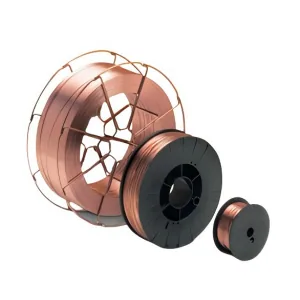
AKM-100 Questions
What standards does AKM-100 meet?
What is the diffusible hydrogen content of the deposited metal?
What are the recommended welding parameters?
What is the chemical composition of the wire?
What packing is AKM-100 supplied in?
Can we test AKM-100 before placing a production order?
Request a Quotation for AKM-100
Send the diameter, the quantity and the destination port. Our technical team replies with packing, pricing and the data you need to qualify the grade.