
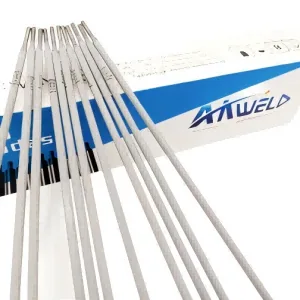
AKD017 Basic Cast Iron Edge Surfacing Electrode.
A basic-coated electrode for surfacing and repair welding of cast iron and alloy cast iron, delivering crack-free deposits with minimal spatter and easy slag removal.
Product Overview
AKD017 is a basic cast iron edge surfacing electrode designed for repair and surfacing of cast iron and alloy cast iron components, particularly for trimming mold edges. The electrode produces a martensitic carbide-dispersed microstructure in the deposited metal, which contributes to good crack resistance.
Welding can be performed without preheating the base metal, and the deposited metal remains crack-free after welding. The arc is stable, spatter is minimal, and slag removal is straightforward, reducing post-weld cleaning time.
Application: It is suitable for surfacing and repair welding of cast iron and alloy ca st iron trimming mold edges.
Key Benefits
Crack-Free Deposit Without Preheating.
The deposited metal maintains integrity without requiring preheating, which simplifies the welding process and reduces thermal stress on the base material.
Stable Arc and Low Spatter.
The basic coating ensures a stable arc during welding, resulting in minimal spatter and improved weld quality, especially in repair applications.
Easy Slag Removal
The slag formed during welding lifts off easily, reducing the need for extensive chipping or grinding between passes.
Good Bead Shape and Surface Finish.
The electrode produces a smooth, well-shaped bead with consistent appearance, suitable for precision surfacing and mold edge restoration.
Where It Is Used
- Surfacing of cast iron components in foundries and repair shops.
- Repair welding of alloy cast iron mold edges.
- Restoration of worn or damaged cast iron surfaces where crack resistance is critical.
- Maintenance of casting tools and dies requiring dimensional rebuilding.
Who It Is For
- Foundries and metal casting workshops performing mold edge repairs.
- Maintenance teams in industrial plants with cast iron equipment.
- Welding contractors specializing in repair of heavy cast iron machinery.
- Fabricators working with alloy cast iron components requiring durable surfacing.
Problems It Solves
- Cracking in deposited metal during or after welding of cast iron without preheating.
- High spatter and difficult slag removal that increase post-weld cleanup time.
- Inconsistent bead shape and poor surface finish in surfacing applications.
- Need for multiple electrodes or complex preheating procedures for cast iron repair.
Specifications
Published by the factory for AKD017. Values not shown are not published on the datasheet and are marked as such rather than estimated.
| Element | Content |
|---|---|
| C | 0.28-0.35 |
| Si | 1.0-2.0 |
| Cr | 5.5-7.5 |
| Mn | 0.6-1.5 |
| P | 0.040 |
| S | 0.040 |
Mechanical property data for this grade is not published on the factory datasheet. Ask our technical team for the test record before you qualify it.
| Diameter | Current range |
|---|---|
| 3.2mm | |
| 350mm | 100-130A |
| 4.0mm |
Technical Features
- Basic coating formulated for cast iron edge surfacing and repair welding.
- Deposited metal microstructure: martensitic with dispersed carbides.
- Chemical composition: C 0.28-0.35%, Si 1.0-2.0%, Cr 5.5-7.5%, Mn 0.6-1.5%, P 0.040%, S 0.040%
- Available in 3.2 mm and 4.0 mm diameters with recommended current ranges: 100-130 A for 3.2 mm, 130-170 A for 4.0 mm.
- Baking requirement: 300-350°C for 1 hour before use.
Use Guide
- Bake the electrodes at 300-350°C for 1 hour before welding to ensure low hydrogen content and arc stability.
- Remove rust, oil, moisture, and other contaminants from the weld area before starting the weld.
- Use the recommended current range: 100-130 A for 3.2 mm diameter, 130-170 A for 4.0 mm diameter.
- Maintain a short arc length and consistent travel speed to achieve a uniform bead and minimize spatter.
- Clean slag completely between passes to avoid inclusions and ensure good interpass fusion.
How It Compares
AKD017 is a basic-coated electrode for cast iron surfacing, differing from rutile or cellulosic types in its low spatter and crack-resistant deposit. Unlike some electrodes requiring preheating, AKD017 delivers crack-free results without preheat. It is not intended for structural welding of carbon steel. For applications requiring higher ductility or lower hardness, a nickel-based electrode may be preferred.
Related Grades
Other welding electrodes in the same family.
AKD017 Questions
What is the recommended baking temperature and time?
What are the chemical composition limits?
What current ranges are recommended for each diameter?
Is preheating required before welding?
What packing is AKD017 supplied in?
Can we test AKD017 before placing a production order?
Request a Quotation for AKD017
Send the diameter, the quantity and the destination port. Our technical team replies with packing, pricing and the data you need to qualify the grade.