
AKD-58 Cladding Electrode for Wear-Resistant Surface Repair.
A stable-arc, low-spatter electrode for overlay welding on worn components such as gears and mining machinery, with easy slag removal and consistent performance.
Product Overview
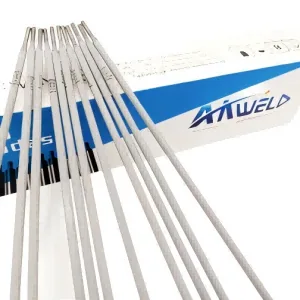
AKD-58 is a covered electrode for manual metal arc welding used in cladding applications on surfaces subject to wear. It is designed for overlay welding on components like gears, buckets, and mining machinery to restore or enhance surface durability.
The electrode delivers a soft, stable arc with low spatter and excellent slag removal, resulting in a smooth, well-shaped weld bead. Its performance is optimized for consistent operation during cladding, with low fume generation and good process stability.
Application: Suitable for welding the surfaces of various worn parts, such as gears, buckets, mining machinery, etc.
Key Benefits
Stable Arc and Low Spatter.
The electrode maintains a stable arc across the recommended current range, minimizing spatter and reducing the need for post-weld cleaning.
Easy Slag Removal
Slag detaches readily after welding, reducing the time required for inter-pass cleaning and lowering the risk of slag entrapment.
Smooth Bead Shaping
The molten weld metal flows evenly, producing a clean, well-formed bead profile suitable for surface restoration and wear resistance.
Low Fume Emission
The coating formulation results in reduced fume generation during welding, improving working conditions in confined or poorly ventilated areas.
Where It Is Used
- Cladding of worn gears and drive components.
- Surface repair on mining machinery buckets and cutting edges.
- Overlay welding on parts exposed to abrasive wear.
- Rebuilding surfaces on heavy-duty industrial equipment.
Who It Is For
- Welding contractors specializing in surface repair and cladding.
- Maintenance teams in mining and heavy equipment industries.
- Fabricators restoring worn components to extend service life.
- EPC contractors requiring consistent cladding performance on site.
Problems It Solves
- Inconsistent cladding quality due to unstable arc or poor slag removal on worn surfaces.
- High spatter and fume levels that increase cleaning time and affect welder safety.
- Difficulty in achieving smooth, uniform overlays on complex or high-wear components.
- Lack of reliable consumables for cladding applications requiring consistent performance.
Specifications
Published by the factory for AKD-58. Values not shown are not published on the datasheet and are marked as such rather than estimated.
| Standard | Designation |
|---|---|
| Classification | AWS A5.13 EFe2 |
| Element | Content |
|---|---|
| C | 0.50 |
| P | 0.030 |
| S | 0.030 |
| Si | 0.50 |
| Cr | 5.80 |
| Mo | 0.60 |
| Mn | 0.95 |
Mechanical property data for this grade is not published on the factory datasheet. Ask our technical team for the test record before you qualify it.
| Diameter | Current range |
|---|---|
| 1.2mm | 28-30V 250-280A 18- |
| 25mm | 20-25l/min |
| 1.6mm | 30-32V 280-320A 18- |
Technical Features
- Covered electrode for manual metal arc welding in cladding applications.
- Chemical composition includes 5.80% Cr, 0.60% Mo, 0.50% C, 0.95% Mn, 0.030% P, 0.030% S, and 0.50% Si.
- Meets AWS A5.13 EFe2 classification.
- Available in 1.2 mm and 1.6 mm diameters.
- Recommended voltage range: 28-32 V, current range: 250-320 A depending on diameter.
Use Guide
- Use CO₂ as the protective gas for shielding during welding.
- Preheat large workpieces to approximately 250°C before overlay welding.
- Maintain an interlayer temperature of 250-350°C during multi-pass cladding to ensure consistent metallurgical properties.
- Clean the base surface thoroughly before welding to remove oil, rust, and contaminants.
- Store electrodes in a dry environment and re-dry if exposed to moisture before use.
How It Compares
AKD-58 is designed for cladding and surface repair, not for structural welding. It differs from general-purpose electrodes like E6013 in that it is formulated for wear resistance and surface integrity. While E6013 prioritizes arc stability and bead appearance on mild steel, AKD-58 focuses on depositing a wear-resistant layer with controlled chemistry and consistent slag behavior. For high-strength structural joints, a different electrode class would be required.
Related Grades
Other welding electrodes in the same family.
AKD-58 Questions
What is the chemical composition of AKD-58?
Which standard does AKD-58 meet?
What are the recommended welding parameters?
Do I need to preheat the workpiece?
What packing is AKD-58 supplied in?
Can we test AKD-58 before placing a production order?
Request a Quotation for AKD-58
Send the diameter, the quantity and the destination port. Our technical team replies with packing, pricing and the data you need to qualify the grade.