
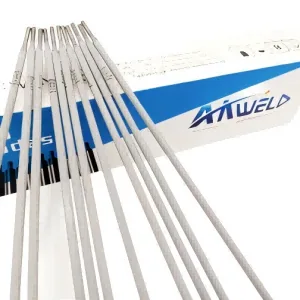
AK-W607 Low-Temperature Steel Electrode for All-Position Welding.
A low-hydrogen sodium-coated electrode designed for welding low-temperature steels with excellent impact toughness down to -60℃.
Product Overview
AK-W607 is a low-temperature steel electrode with a low-hydrogen sodium coating containing nickel, suitable for all-position welding using direct current reverse polarity.
The deposited metal maintains good impact toughness at -60℃, making it suitable for critical low-temperature applications where mechanical performance under extreme conditions is essential.
It meets the EN ISO 2560-B:E 7015-G, AWS A5.5 E7015-G, and GB/T 5117 E5015-G classifications, ensuring compatibility with international welding standards.
Application: Welding -60C low temperature steel structure, such as 13MnSi63, 09MnNiNb, E36, etc.
Key Benefits
Excellent Impact Toughness at -60℃.
The deposited metal achieves a minimum impact value of 54 J at -40℃, with performance maintained at -60℃, ensuring reliability in cryogenic environments.
Low-Hydrogen Sodium Coating
The low-hydrogen sodium coating reduces the risk of hydrogen-induced cracking, especially in high-strength and low-temperature applications.
All-Position Welding Capability
AK-W607 can be used in flat, horizontal, vertical, and overhead positions, allowing consistent weld quality across complex joint geometries.
Nickel-Enhanced Toughness
The inclusion of 0.60-1.0% nickel in the deposited metal improves toughness and ductility, particularly in low-temperature service conditions.
Where It Is Used
- Welding low-temperature steel structures such as 13MnSi63, 09MnNiNb, and E36.
- Critical joints in cryogenic storage tanks and pipelines operating at sub-zero temperatures.
- Structural components exposed to extreme cold in Arctic or high-altitude environments.
Who It Is For
- Welding consumable distributors supplying low-temperature welding electrodes.
- Fabricators working with low-temperature steels in cold climates.
- Contractors involved in cryogenic or low-temperature infrastructure projects.
Problems It Solves
- Achieving reliable weld metal toughness at -60℃ in critical low-temperature applications.
- Reducing the risk of hydrogen cracking in high-strength low-temperature steels through low-hydrogen electrode selection.
- Using a single electrode for all welding positions without sacrificing mechanical properties or weld quality.
Specifications
Published by the factory for AK-W607. Values not shown are not published on the datasheet and are marked as such rather than estimated.
| Standard | Designation |
|---|---|
| Classification | EN ISO 2560-B:E 7015-G P AWS A5.5 E7015-G GB/T 5117 E5015-G |
| Element | Content |
|---|---|
| C | 0.07 |
| Si | 0.5 |
| Mn | 1.20-1.70 |
| S | 0.035 |
| P | 0.035 |
| Ni | 0.60-1.0 |
| Property | Value |
|---|---|
| Tensile strength (MPa) | ≥490 |
| Yield Stress (MPa) | ≥390 |
| Elongation (%) | ≥22 |
| Impact values (J) | ≥54J/-40℃ |
| Diameter | Current range |
|---|---|
| 2.5mm | 60-100A |
| 3.2mm | 80-130A |
| 4.0mm | 140-200A |
| 5.0mm | 180-240A |
Technical Features
- Low-hydrogen sodium coating with nickel content of 0.60-1.0% in the deposited metal.
- Deposited metal tensile strength of at least 490 MPa and yield stress of at least 390 MPa.
- Elongation of at least 22% and impact toughness of at least 54 J at -40℃.
- Available in 2.5 mm, 3.2 mm, 4.0 mm, and 5.0 mm diameters with specified current ranges.
- Meets EN ISO 2560-B:E 7015-G, AWS A5.5 E7015-G, and GB/T 5117 E5015-G classifications.
Use Guide
- Select electrode diameter based on joint thickness and position: 2.5 mm (60-100 A), 3.2 mm (80-130 A), 4.0 mm (140-200 A), 5.0 mm (180-240 A)
- Use direct current reverse polarity (DCEN) for stable arc and consistent weld quality.
- Keep electrodes dry in sealed packaging; re-dry if exposed to moisture before use.
- Clean joint surfaces thoroughly to remove oil, rust, paint, and moisture before welding.
How It Compares
AK-W607 and E7015 both belong to the low-hydrogen sodium-coated electrode family and are suitable for all-position welding. AK-W607 is specifically formulated for low-temperature service with enhanced toughness down to -60℃, while standard E7015 electrodes may not guarantee the same impact performance at such low temperatures. Cellulosic electrodes offer deeper penetration but are not suitable for low-temperature applications due to higher hydrogen content and lower toughness.
Related Grades
Other welding electrodes in the same family.
AK-W607 Questions
What is the impact toughness of the deposited metal?
Which standards does AK-W607 meet?
What are the recommended welding currents for each diameter?
Can I get technical data and packing details before ordering?
What packing is AK-W607 supplied in?
Can we test AK-W607 before placing a production order?
Request a Quotation for AK-W607
Send the diameter, the quantity and the destination port. Our technical team replies with packing, pricing and the data you need to qualify the grade.