
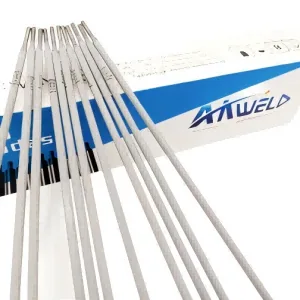
AK-J707RH Ultra-Low Hydrogen High Strength Steel Electrode.
A low hydrogen sodium coated electrode for all-position welding of high strength low alloy steel structures with tensile strength equivalent to 690 MPa.
Product Overview
AK-J707RH is a low hydrogen sodium type covered electrode designed for manual metal arc welding of high strength low alloy steel structures with a tensile strength equivalent to 690 MPa. The electrode is suitable for all welding positions when used with DC reverse polarity.
It delivers excellent process performance with a stable arc, minimal spatter, easy slag removal, and a smooth, aesthetically pleasing weld bead. The deposited weld metal exhibits high plasticity, toughness, and good resistance to cold bending, cracking, and explosion.
AK-J707RH meets the EN ISO 18275-B:E 6915-G, AWS A5.5 E10015-G, and GB/T 5117 E6915-G classifications.
Application: Suitable for welding low alloy steel structures with tensile strength eq uivalent to 690MPa.
Key Benefits
Ultra-Low Hydrogen for High Toughness.
The low hydrogen sodium coating minimizes hydrogen content in the weld metal, reducing the risk of hydrogen-induced cracking in high strength steel joints.
Stable Arc and Low Spatter.
The electrode provides a stable arc across the recommended current range, with minimal spatter, improving weld quality and reducing post-weld cleaning.
Easy Slag Removal
The slag layer detaches easily after welding, allowing for quick and complete removal between passes without residue.
Excellent Joint Integrity
The weld metal demonstrates good cold bending, crack resistance, and explosion resistance, suitable for critical structural applications.
Where It Is Used
- High strength low alloy steel structures with tensile strength equivalent to 690 MPa.
- Pressure vessels and boilers requiring high toughness welds.
- Offshore and onshore pipeline systems under high stress.
- Heavy machinery and crane structures.
- Bridge and structural steel components exposed to low temperature environments.
Who It Is For
- Welding consumable distributors supplying high strength steel electrodes.
- Fabricators working with high strength low alloy steels in demanding environments.
- EPC contractors requiring certified consumables for critical structural welds.
- Maintenance teams repairing high strength steel components in oil & gas and power industries.
Problems It Solves
- Achieving high toughness and crack resistance in welds on high strength low alloy steel with tensile strength equivalent to 690 MPa.
- Reducing hydrogen-induced cracking risk in thick-section or high-stress joints through ultra-low hydrogen electrode technology.
- Maintaining consistent weld quality and process performance across all positions with a single electrode type.
Specifications
Published by the factory for AK-J707RH. Values not shown are not published on the datasheet and are marked as such rather than estimated.
| Standard | Designation |
|---|---|
| Classification | EN ISO 18275-B:E 6915-G P AWS A5.5 E10015-G GB/T 5117 E6915-G |
| Element | Content |
|---|---|
| C | 0.05 |
| Si | 0.3 |
| Mn | 1.69 |
| S | 0.007 |
| P | 0.018 |
| Ni | 1.78 |
| Mo | 0.37 |
| Property | Value |
|---|---|
| Tensile strength (MPa) | 730 |
| Yield Stress (MPa) | 660 |
| Elongation (%) | 24 |
| Impact values (J) | 82J/-50℃ |
| Diameter | Current range |
|---|---|
| 2.5mm | 70-100A |
| 3.2mm | 100-140A |
| 4.0mm | 140-180A |
| 5.0mm | 180-220A |
Technical Features
- Low hydrogen sodium type coating for all-position welding with DC reverse polarity.
- Deposited metal tensile strength at least 730 MPa, yield stress at least 660 MPa, elongation at least 24 percent.
- Impact toughness at least 82 J at minus 50 degrees C.
- Chemical composition: C 0.05%, Si 0.3%, Mn 1.69%, S 0.007%, P 0.018%, Ni 1.78%, Mo 0.37%
- Available in 2.5 mm, 3.2 mm, 4.0 mm, 5.0 mm diameters with published current ranges.
Use Guide
- Select electrode diameter based on joint thickness and position. Use 2.5 mm for thin sections, 5.0 mm for thicker materials.
- Set welding current within the recommended range: 2.5 mm (70-100 A), 3.2 mm (100-140 A), 4.0 mm (140-180 A), 5.0 mm (180-220 A).
- Use DC reverse polarity (DCEN) for optimal arc stability and penetration.
- Keep electrodes dry in sealed packaging. Re-bake if exposed to moisture before use.
- Remove slag completely between passes to prevent inclusions and ensure sound welds.
How It Compares
AK-J707RH and E10015-G both meet AWS A5.5 E10015-G and are low hydrogen electrodes for high strength steel. AK-J707RH uses a sodium type coating suitable for all positions with DC reverse polarity. Basic electrodes like E10015-G are known for high toughness and low hydrogen, but require strict drying and are more sensitive to moisture. Cellulosic or rutile electrodes are not suitable for high strength steel applications due to higher hydrogen content and lower toughness.
Related Grades
Other welding electrodes in the same family.
AK-J707RH Questions
What are the recommended welding parameters for each diameter?
Which standards does AK-J707RH meet?
What are the mechanical properties of the deposited metal?
Can I get technical data and packing details before ordering?
What packing is AK-J707RH supplied in?
Can we test AK-J707RH before placing a production order?
Request a Quotation for AK-J707RH
Send the diameter, the quantity and the destination port. Our technical team replies with packing, pricing and the data you need to qualify the grade.