
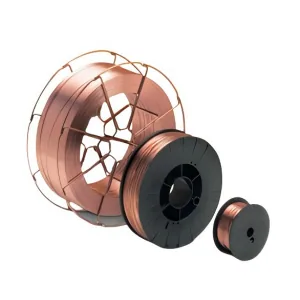
AK-ERCuZn-B TIG and MIG Wire for Brass and Copper Alloy Welding.
A zinc-rich brass welding wire with silicon and manganese additions that improves molten metal fluidity and reduces zinc loss during welding, suitable for copper, steel, copper-nickel alloy, and gray cast iron with argon shielding.
Product Overview
AK-ERCuZn-B (TIG / MIG) is a copper-zinc alloy welding wire designed for gas shielded arc welding of brass, copper, copper-nickel alloys, and gray cast iron. It contains small amounts of silicon, manganese, and nickel to enhance weld pool fluidity and reduce zinc evaporation during the welding process.
The wire is supplied to EN ISO 24373 CuZn40Ni, AWS A5.7 ERCuZn-B, and GB/T 9460 CuZn40Ni standards. It is recommended to preheat the base material to 400–500°C before welding to ensure proper fusion and minimize cracking risks.
Application: Brass welding wire containing a small amount of iron, silicon, and ma nganese has good fluidity of molten metal. Due to the existence of silicon, it can mo re effectively inhibit the evaporation of zinc. It can be used for gas protection of cop per, steel, copper-nickel alloy, and gray cast iron. Argon arc welding, and inserting carbide tools. It needs to be preheated at 400-500°C before welding.
Key Benefits
Reduced Zinc Evaporation
The silicon content in AK-ERCuZn-B helps suppress zinc loss during welding, which improves fume control and maintains the alloy composition in the weld deposit.
Good Molten Metal Fluidity.
The addition of manganese and silicon enhances the flow of the molten weld metal, resulting in a smooth, well-formed bead with minimal underfill or porosity.
Suitable for Multiple Base Metals.
This wire can be used to join brass, copper, copper-nickel alloys, and gray cast iron, making it a versatile choice for repair and fabrication applications.
Preheating Compatibility
The requirement to preheat to 400–500°C ensures good fusion and reduces the risk of cracking, especially in thicker sections or materials with high thermal conductivity.
Where It Is Used
- Welding of brass components in industrial and marine applications.
- Repair and joining of copper and copper-nickel alloy structures.
- Welding gray cast iron with controlled heat input.
- TIG and MIG welding of copper-based materials with argon shielding.
Who It Is For
- Welding consumable distributors supplying brass and copper welding wires.
- Fabricators working with brass, copper, and copper-nickel alloys.
- Maintenance teams repairing gray cast iron parts in pumps and valves.
Problems It Solves
- Zinc loss during welding of brass due to high evaporation rates, to porosity and poor mechanical properties.
- Poor weld pool fluidity in copper-based alloys, causing underfill and lack of fusion.
- Difficulty in joining dissimilar metals like copper and cast iron without cracking or poor adhesion.
Specifications
Published by the factory for AK-ERCuZn-B (TIG / MIG). Values not shown are not published on the datasheet and are marked as such rather than estimated.
| Standard | Designation |
|---|---|
| Classification | EN ISO 24373 CuZn40Ni AWS A5.7 ERCuZn-B GB/T 9460 CuZn40Ni |
| Element | Content |
|---|---|
| ISO24373 Cu | 56.0-60.0 |
| AI | ≤0.01 |
| Mn | 0.01-0.50 |
| Ni | 0.20-0.80 |
| Pb | ≤0.05 |
| Sn | 0.80-1.1 |
| Si | 0.04-0.20 |
| Zn | BaI |
| Other | ≤0.50 |
| Property | Value |
|---|---|
| Solids-Temperature | 866℃ |
| Liquids-Temperature | 882℃ |
| Density | 8.39kg/dm³ |
| Tensile Strength | —— |
| Elongation | —— |
| Brinell-Hardness | —— |
Technical Features
- Composed of copper with 56.0–60.0% Cu, 40% Zn, and controlled additions of Si (0.04–0.20%), Mn (0.01–0.50%), Ni (0.20–0.80%), Sn (0.80–1.1%), and Pb (≤0.05%)
- Solidus temperature at 866°C and liquidus temperature at 882°C, indicating a narrow melting range suitable for controlled welding.
- Density of 8.39 kg/dm³, consistent with standard brass alloy properties.
- Supplied to EN ISO 24373 CuZn40Ni, AWS A5.7 ERCuZn-B, and GB/T 9460 CuZn40Ni standards.
Use Guide
- Preheat the base material to 400–500°C before welding to reduce thermal stress and improve fusion.
- Use argon or argon-rich shielding gas for TIG and MIG welding to maintain arc stability and protect the molten pool.
- Clean the joint surfaces from oil, grease, rust, and oxides prior to welding to prevent contamination and porosity.
- Maintain consistent travel speed and proper torch angle to achieve uniform bead profile and avoid undercutting.
How It Compares
AK-ERCuZn-B is a zinc-rich brass wire with silicon and manganese additions, which improves fluidity and reduces zinc evaporation. Unlike pure copper wires, it offers better wetting on brass and cast iron but requires preheating to avoid cracking.
Related Grades
Other welding wire in the same family.
AK-ERCuZn-B (TIG / MIG) Questions
What are the key alloying elements in AK-ERCuZn-B?
What standards does this wire meet?
What is the recommended preheat temperature?
What is the melting range of this wire?
What packing is AK-ERCuZn-B (TIG / MIG) supplied in?
Can we test AK-ERCuZn-B (TIG / MIG) before placing a production order?
Request a Quotation for AK-ERCuZn-B (TIG / MIG)
Send the diameter, the quantity and the destination port. Our technical team replies with packing, pricing and the data you need to qualify the grade.