
AK-ERCuAg1 TIG and MIG Wire for Zinc-Coated Steel and Non-Ferrous Alloys.
A silver-containing copper alloy wire designed for MIG welding of zinc-coated steel in automotive bodies, with proven suitability for brass, low-alloy copper, non-ferrous metals, and cast iron.
Product Overview
AK-ERCuAg1 is a copper-silver alloy welding wire for gas tungsten arc welding (GTAW) and gas metal arc welding (GMAW). It is formulated for use on zinc-coated steel, particularly in automotive body fabrication, where weld integrity and appearance are critical.
The wire meets EN ISO 24373 CuAg1, AWS A5.7 ERCuAg1, and GB/T 9460 CuAg1 standards, ensuring compatibility with international specifications for brazing and joining non-ferrous metals and low-alloy steels.
Application: Particularly desired for MIG welding of zinc-coated-steel in auto bodies. It is also recommended for brass,low-alloy copper,non-ferrous and low-metal ste el and cast iron. An ideal material for making auto bodies.
Key Benefits
Suitable for Zinc-Coated Steel in Automotive Applications.
The low melting range and controlled composition of AK-ERCuAg1 reduce the risk of zinc vaporization and spatter during welding, making it ideal for joining galvanized steel in auto body panels.
Good Flow and Wetting on Brass and Copper Alloys.
The presence of silver and controlled levels of alloying elements improves fluidity and wetting on brass, low-alloy copper, and non-ferrous metals, resulting in smooth, consistent weld beads.
Low Impurity Levels for Clean Welds.
Trace elements such as lead (≤0.01%), arsenic (≤0.05%), and aluminum (0.01%) are kept below specified limits to minimize porosity and ensure clean, sound weld metal.
Consistent Mechanical Properties
The deposited metal has a tensile strength of 200 N/mm², elongation of 30%, and Brinell hardness of 60 HB, supporting ductility and resistance to cracking in service.
Where It Is Used
- MIG welding of zinc-coated steel in automotive body fabrication.
- Joining brass and low-alloy copper components.
- Welding non-ferrous metals and cast iron.
- Brazing applications requiring good joint strength and appearance.
Who It Is For
- Automotive body fabricators requiring reliable filler metal for galvanized steel.
- Welding distributors supplying non-ferrous and brass welding materials.
- Maintenance teams working on brass fittings, copper piping, and cast iron parts.
Problems It Solves
- Welding distortion and zinc spatter when using standard copper wires on galvanized steel in auto body production.
- Poor wetting and weak joints when joining brass or low-alloy copper with unsuitable filler metals.
- Inconsistent weld quality due to high impurity levels in low-cost filler wires.
Specifications
Published by the factory for AK-ERCuAg1 (TIG / MIG). Values not shown are not published on the datasheet and are marked as such rather than estimated.
| Standard | Designation |
|---|---|
| Classification 1 | EN ISO 24373 CuAg1 |
| Classification 2 | AWS A5.7 ERCuAg1 |
| Classification 3 | GB/T 9460 CuAg1 |
| Element | Content |
|---|---|
| Cu | ≥99.5 |
| Al | 0.01 |
| Fe | 0.05 |
| Mn | 0.20 |
| Ni | 0.30 |
| Pb | ≤0.01 |
| Si | 0.10 |
| Ag | 0.8-1.2 |
| As | ≤0.05 |
| Other | ≤0.20 |
| Property | Value |
|---|---|
| Solids-Temperature | 1070℃ |
| Liquids-Temperature | 1080℃ |
| Density | 8.9kg/dm³ |
| Tensile Strength | 200N/mm² |
| Elongation | 30% |
| Brinell-Hardness | 60HB |
Technical Features
- Composed of copper with silver content between 0.8% and 1.2%, and trace elements within specified limits.
- Melting range from 1070℃ to 1080℃, suitable for controlled heat input in thin-section and sensitive materials.
- Density of 8.9 kg/dm³, consistent with standard copper alloy wires.
- Tensile strength of 200 N/mm², elongation of 30%, and Brinell hardness of 60 HB in the as-welded condition.
- Compliant with EN ISO 24373 CuAg1, AWS A5.7 ERCuAg1, and GB/T 9460 CuAg1 standards.
Use Guide
- Select wire diameter based on joint thickness and equipment capability; use standard MIG or TIG parameters for copper alloys.
- Clean joint surfaces of oil, grease, paint, and zinc residue before welding to avoid contamination and porosity.
- Use inert gas shielding such as argon or argon-helium mixtures to maintain weld pool stability and prevent oxidation.
- Avoid excessive heat input to prevent grain growth and reduce the risk of cracking in the heat-affected zone.
How It Compares
AK-ERCuAg1 differs from standard copper wire (e.g., ERCu) by including 0.8–1.2% silver, which improves fluidity, wetting, and joint strength. For non-ferrous joints requiring higher strength or ductility, other silver-bearing alloys may be preferred, but AK-ERCuAg1 offers a balanced solution for general-purpose brazing and joining.
Related Grades
Other welding wire in the same family.
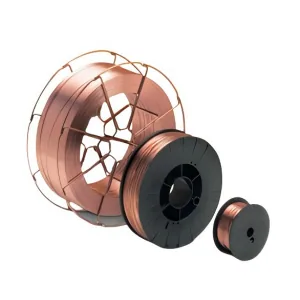
AK-ERCuAg1 (TIG / MIG) Questions
What are the key alloying elements in AK-ERCuAg1?
What standards does AK-ERCuAg1 meet?
What are the mechanical properties of the deposited metal?
Can I get technical data sheets and packaging details?
What packing is AK-ERCuAg1 (TIG / MIG) supplied in?
Can we test AK-ERCuAg1 (TIG / MIG) before placing a production order?
Request a Quotation for AK-ERCuAg1 (TIG / MIG)
Send the diameter, the quantity and the destination port. Our technical team replies with packing, pricing and the data you need to qualify the grade.